News Magazine


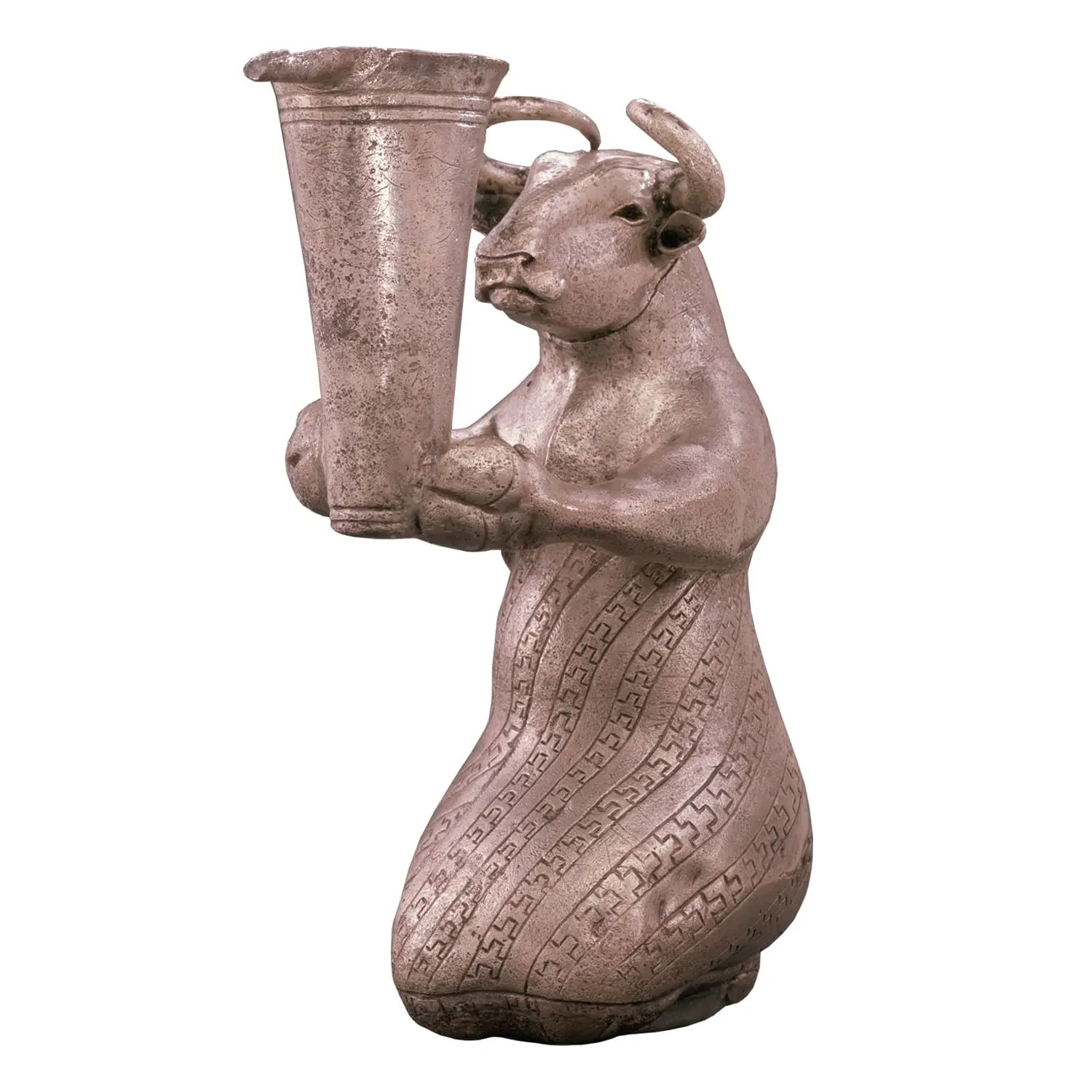
The silver statuette of a seated bull is an exceptionally beautiful ancient artifact from the Early Elamite period of Persia’s ancient civilization. This exquisite piece dates back to approximately 2900–3100 BCE (around 5,000 years ago). The head and limbs of this abstract creature are bovine, while its body is human. The silver seated bull statuette was discovered in southwestern Iran. It stands 16.3 centimeters tall.

The figure wears a distinctive garment featuring a remarkably elegant stepped (terraced) pattern, decorated in a striped design. This mythological being is depicted holding a jug with a pouring spout. Today, the silver seated bull statuette is preserved in the Metropolitan Museum of Art in New York.

This remarkable artifact, with its patterned attire and the vessel in its hand, represents a fascinating fusion of human and animal traits in the mythology of ancient Persia. Such hybrid depictions of animals in human roles were common in the Early Elamite period and likely symbolized some form of supernatural power bestowed by the gods upon rulers.

Furthermore, the use of silver in this well-known sculpture—crafted during the Bronze Age—reflects not only the admirable artistry of its creators but also the advanced capabilities of ancient Elamite civilization in the extraction and smelting of precious metals.

Persia is the cradle of an ancient civilization, and we Persians are the inheritors of this extraordinary heritage. It is our duty to know it, preserve it, and honor it.


PARS INTERNATIONAL DAILY

By admin , 2 July, 2026

Imagine being able to recall what you ate for breakfast on a random Tuesday ten years ago, what the weather was like, the clothes you wore, and even the conversations you had that day. For most people, memories gradually fade over time. But for a very small number of individuals, this remarkable level of recall is a daily reality. This rare phenomenon is known as Hyperthymesia, or Highly Superior Autobiographical Memory (HSAM).

By admin , 9 July, 2026

Moscow — Russian ships passing through the Strait of Hormuz are not required to pay any transit fees, Russian envoy Mikhail Ulyanov said, noting that Iranian authorities do not impose such charges on Russian vessels.

Ulyanov’s remarks came in response to questions about maritime passage through the strategic waterway, which links the Persian Gulf with the Gulf of Oman and serves as a vital route for global energy shipments.

By admin , 9 July, 2026

Also known as the Great Wall of Gorgan (Persian: Divār-e Bozorg-e Gorgān), is one of the most remarkable military engineering achievements of ancient Iran and one of the longest defensive walls ever built. Located in the northeastern region of present-day Iran, near the ancient land of Gorgan in Golestan Province, it stretches for approximately 195–200 kilometers from the Caspian Sea in the west toward the mountains of the east.

By admin , 9 July, 2026

A remnant of the Sasanian era, stands in the historic garden-city of Natanz in Isfahan Province as a precious memento of one of the most glorious periods of Iranian history. This religious structure was registered on Iran’s National Heritage List on 9 July 1932 (18 Tir 1311 in the Iranian calendar). Today marks the ninety-fourth anniversary of that historic registration.

By admin , 6 July, 2026

This raises an important question: why has this happened? Why has our community—which once took pride in striving for excellence through service, industry, education, and healing humanity—now become so narrowly focused on material needs? Why have so many families and young people come to define success almost exclusively in financial terms?

By admin , 6 July, 2026

Born in 1811 in the Kingdom of Hungary, Franz Liszt became one of the first true international “superstars” of classical music. Before pop stars existed, there was Liszt: audiences fainting at concerts, newspapers obsessing over his appearance, and fans treating his recitals like religious experiences. The term “Lisztomania” was literally coined to describe the frenzy surrounding him in the 1840s.

By admin , 5 July, 2026

A society that does not narrate itself is forgotten; the role of stories in the continuity of Zoroastrians.

By admin , 5 July, 2026

Responsibility for safeguarding Naqsh-e Rostam does not rest solely with Iran's Ministry of Cultural Heritage. The Ministry of Energy, the Ministry of Agriculture, the Fars Governorate, the Regional Water Company, and other relevant government agencies also bear direct responsibility for protecting the natural setting of this World Heritage site. Protecting cultural heritage is impossible without safeguarding the region's land and water resources.

By admin , 4 July, 2026

Before the internationally acclaimed airline Iran Air officially began operations in 1962, an earlier company called Iranian Airways had already been established in 1946. However, it was Iran Air that earned a distinguished reputation among the world's leading airlines thanks to its modern fleet and high service standards. On 4 July 1965 (13 Tir 1344 in the Iranian calendar), the airline entered the jet age by operating its first scheduled flight with a jet aircraft.