
News Magazine


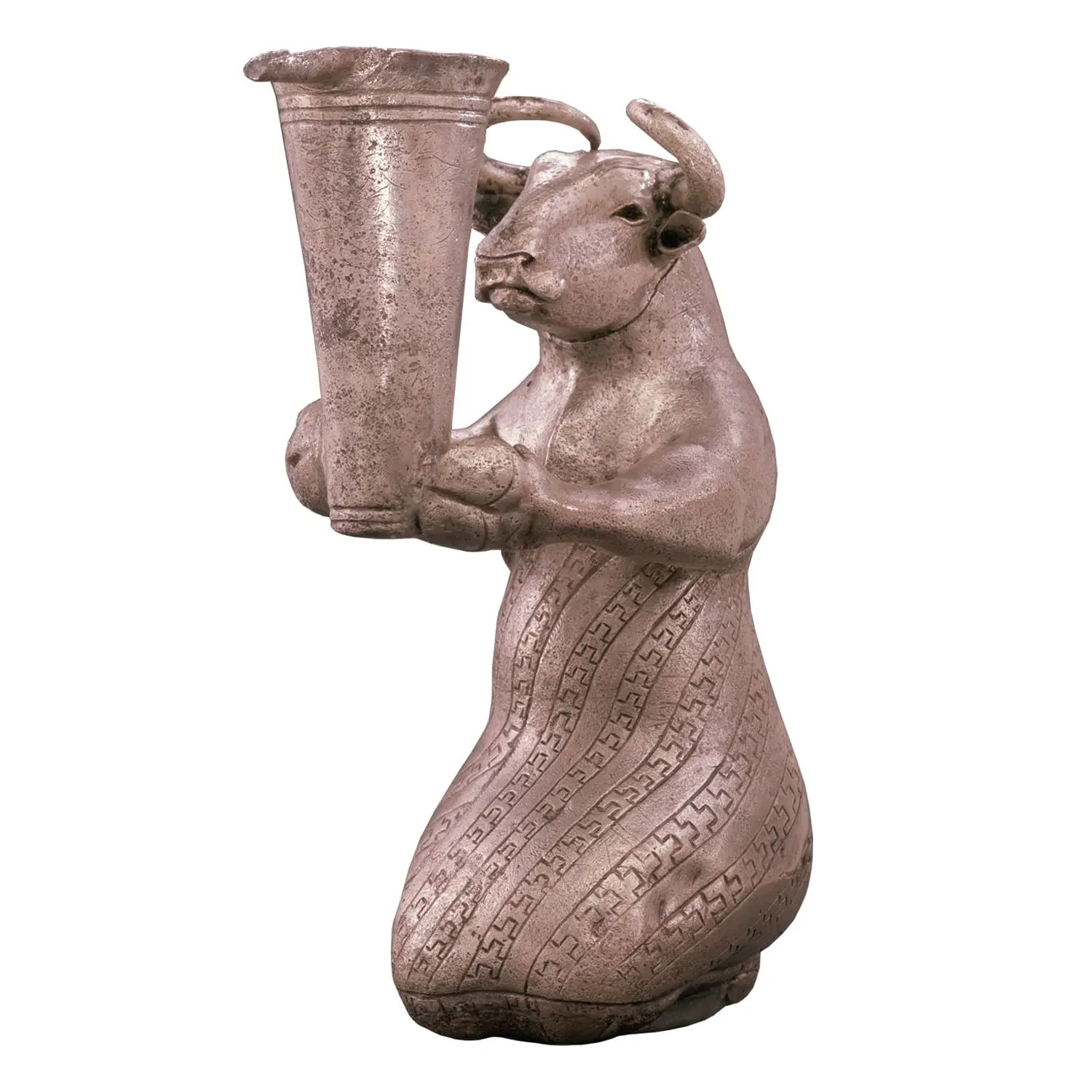
The silver statuette of a seated bull is an exceptionally beautiful ancient artifact from the Early Elamite period of Persia’s ancient civilization. This exquisite piece dates back to approximately 2900–3100 BCE (around 5,000 years ago). The head and limbs of this abstract creature are bovine, while its body is human. The silver seated bull statuette was discovered in southwestern Iran. It stands 16.3 centimeters tall.

The figure wears a distinctive garment featuring a remarkably elegant stepped (terraced) pattern, decorated in a striped design. This mythological being is depicted holding a jug with a pouring spout. Today, the silver seated bull statuette is preserved in the Metropolitan Museum of Art in New York.

This remarkable artifact, with its patterned attire and the vessel in its hand, represents a fascinating fusion of human and animal traits in the mythology of ancient Persia. Such hybrid depictions of animals in human roles were common in the Early Elamite period and likely symbolized some form of supernatural power bestowed by the gods upon rulers.

Furthermore, the use of silver in this well-known sculpture—crafted during the Bronze Age—reflects not only the admirable artistry of its creators but also the advanced capabilities of ancient Elamite civilization in the extraction and smelting of precious metals.

Persia is the cradle of an ancient civilization, and we Persians are the inheritors of this extraordinary heritage. It is our duty to know it, preserve it, and honor it.


PARS RECORDS DAILY
By admin , 12 July, 2026

In an era when modern humanity is more than ever caught in the acceleration of life, scattered thoughts, and social disorder, the question of the “path to salvation” has become one of our most recurring individual and collective concerns. Many search for solutions in external changes: in politics, economics, laws, administrative structures, and systems of power. Without doubt, these fields are important; yet there is a deeper truth that is often overlooked amid the noise of daily analysis: society is formed in human beings before it takes shape in institutions; and human beings, before becoming citizens, managers, or political actors, are first members of a family.

By admin , 2 July, 2026

Imagine being able to recall what you ate for breakfast on a random Tuesday ten years ago, what the weather was like, the clothes you wore, and even the conversations you had that day. For most people, memories gradually fade over time. But for a very small number of individuals, this remarkable level of recall is a daily reality. This rare phenomenon is known as Hyperthymesia, or Highly Superior Autobiographical Memory (HSAM).

By admin , 17 July, 2026

The more we search through the forgotten writings of Iranian history, the more we realize how little we know about our country's past. We also come to understand the hardships and suffering our ancestors endured at the hands of rulers in their efforts to preserve their language, script, culture, and national identity.

By admin , 16 July, 2026


Zoroastrians of Mazraeh Kalantar, Meybod, Mark the End of the Panji Ritual with the Ancient Tash-e Boom Ceremony

By admin , 15 July, 2026

It is impossible to speak of the history and archaeology of Iran without remembering the late Alireza Shapour Shahbazi. The central focus of this exceptional scholar's research was the history of the Achaemenid and Sasanian empires, yet he never overlooked the Shahnameh or the many other expressions of Iran's ancient cultural heritage. Indeed, anything that shed light on the ancient history of Iran was, for Shahbazi, worthy of careful investigation and scholarly attention. Now, twenty years after his passing, we perhaps appreciate more than ever what an extraordinary historian and archaeologist the field has lost. The anniversary of his death, on 16 July, offers an opportunity to briefly reflect on his remarkable scholarly legacy.

By admin , 13 July, 2026

Al-Khwarizmi is one of Iran’s most renowned scholars, with a reputation that extends throughout the world. His name was not only celebrated in the past; even today, he is recognized globally for his originality and contributions to mathematics, astronomy, geography, and philosophy. Today, the 22nd of Tir, marks his auspicious birthday.

By admin , 13 July, 2026

The nomination dossier for the global registration of Alamut Fortress is still open, and discussions continue regarding the progress of its preparation and implementation. In addition, the methods and results of archaeological excavations at the fortress require proper reporting. It is now necessary to understand what plans have been prepared to ensure the successful inscription of this globally significant Iranian cultural heritage site.

By admin , 13 July, 2026

Today, the 22nd of Tir, marks the anniversary of the passing of one of Iran’s most renowned archaeologists, the late Mostafavi Kashani. He played a significant role in introducing the grandeur and magnificence of the Achaemenid civilization to the world.

By admin , 12 July, 2026

The expanse of Tall-e Barmi, also known as Barmak, is a remnant of Iran’s Elamite period and is now located near a village called Kimeh, in Ramhormoz County, Khuzestan Province. Archaeologists consider Tall-e Barmi to have been an Elamite city that was gradually buried over time, leaving behind nothing of its former grandeur except a mound of earth and artifacts—many of which have been looted by antiquities traffickers.

By admin , 12 July, 2026

The Zoroastrian Parsi population declines by approximately 18 percent every decade. Recent efforts to increase the Parsi population, including a high-level national seminar organized by India’s National Commission for Minorities last month, have overlooked one of the primary reasons behind this continued decline: an unjust legal system that leaves Parsi women vulnerable, impoverished, and without adequate protection.