

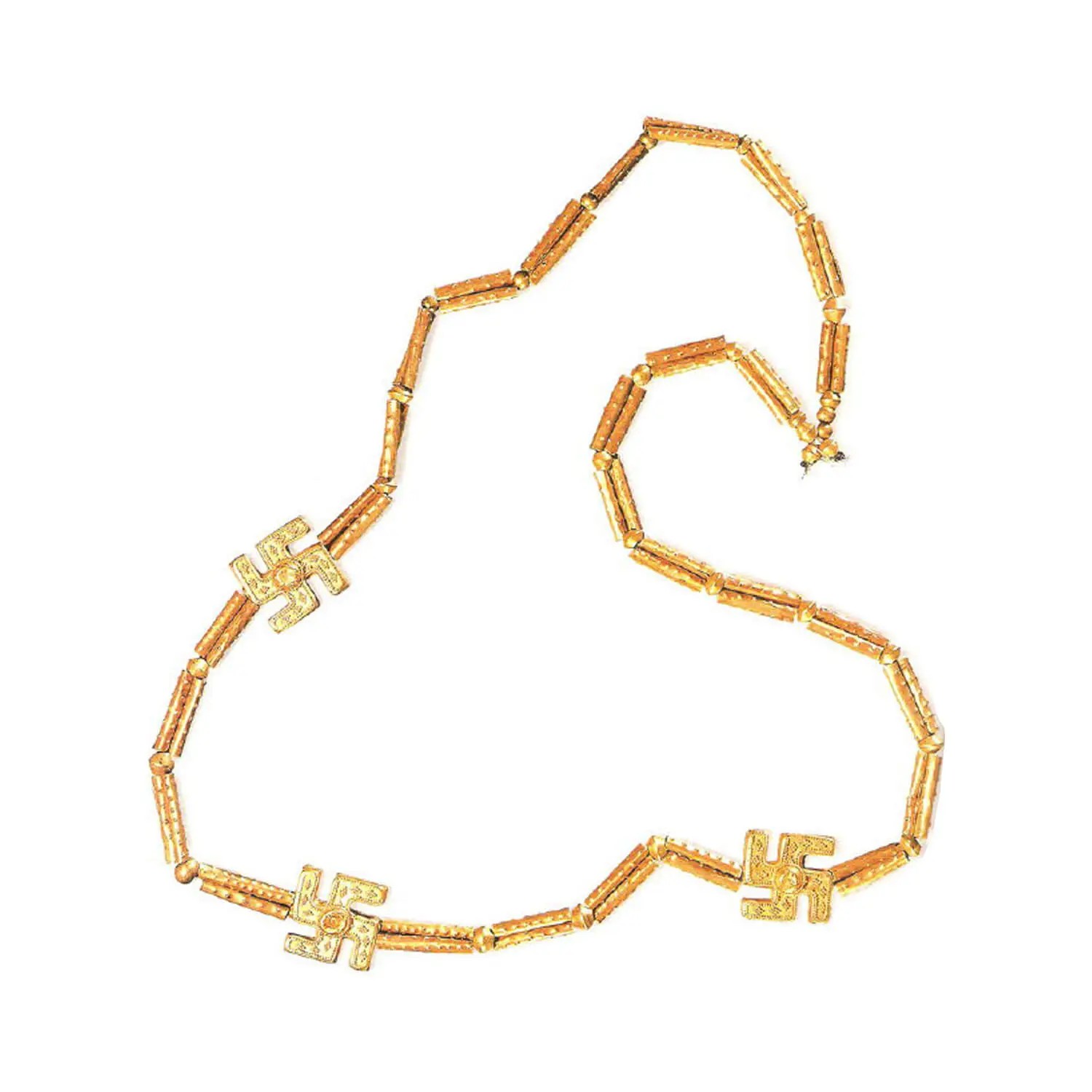
The Persian necklace "Mithra's Necklace" was found in archaeological excavations in Kalvarez, Gilan and is about 3000 years old. Kalvarez is one of the villages of Rostamabad in Gilan and is located in the central part of Rudbar County.
This beautiful golden necklace has three swastika symbols. It shows the prevalence of the use of the swastika symbol in ancient Persia.
Swastika (卐 or 卍) or the sun's necklace is a Sanskrit word that is formed from the two parts "su" meaning "good" and "esti" meaning "to be", and means "good being"; which in the Mehr religion is the symbol of the sun or in Hindu religion is the symbol of the god of creation.
In Indo-European culture, the use of this symbol on objects was for good luck and fortune. The use of this ancient symbol has been common for thousands of years not only in Persia, but also in Greece and other civilizations.
Unfortunately, due to the misuse of the swastika symbol by the National Socialist German Party, the status of this symbol has been greatly damaged, and it is necessary to separate the noble aspect of this ancient Iranian symbol from the crimes of the Nazi Party in World War II, reclaim the swastika symbol as a world heritage and restore its noble meaning.
This ancient necklace is kept in the National Museum of Iran.
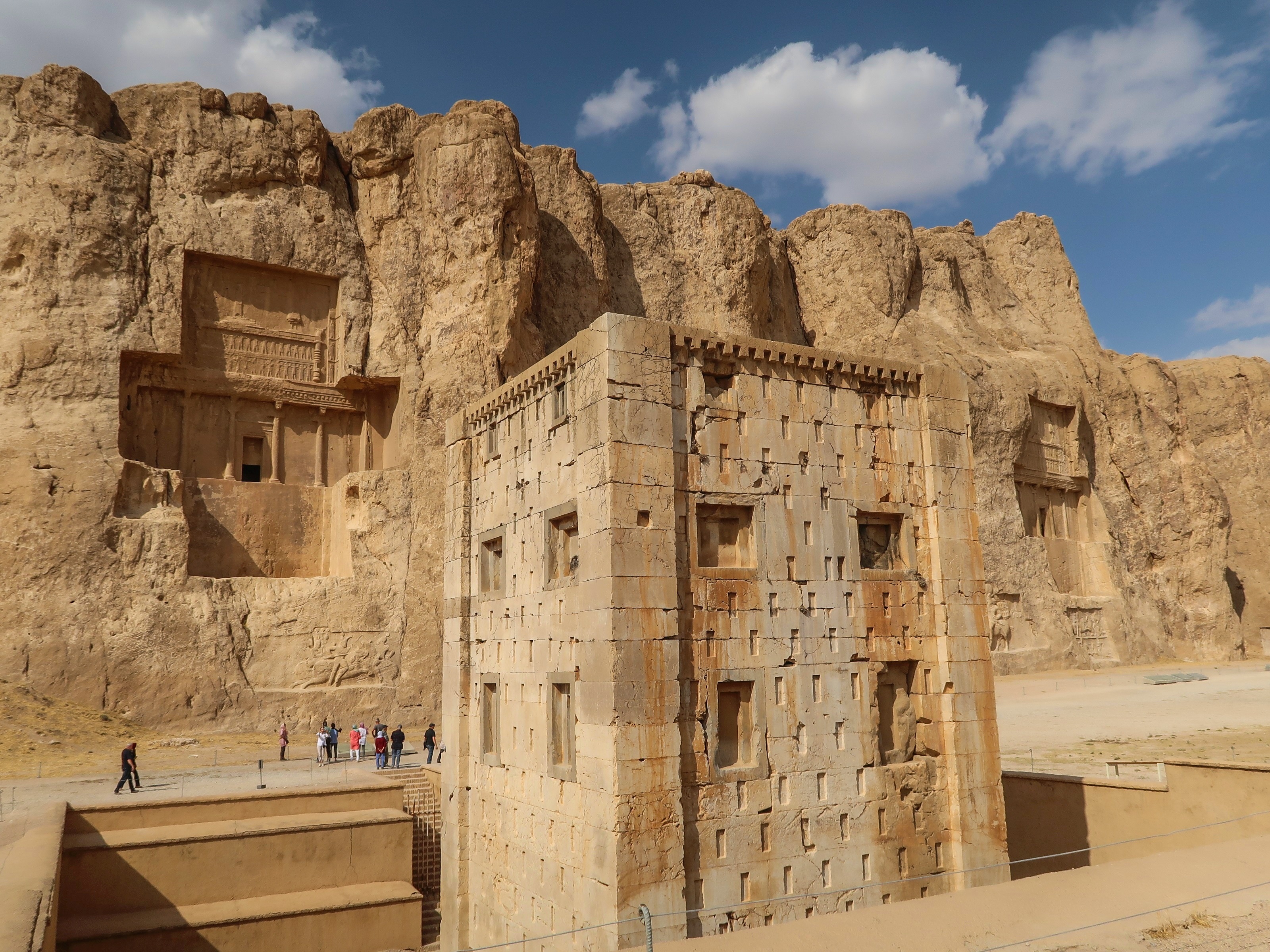
Ka'ba-ye Zartosht in foreground, with behind the Tomb of Darius II above Sassanid equestrian relief of Bahram II
Anaghra Raočā (Avestan: Anaghra Raočā, also written Anaghra Raocah, Anaghra Raoca, or Anaghra Raočā) is an important term in Zoroastrian tradition. It is generally understood as “Endless Light,” “Boundless Light,” or “Unending Radiance.”
The meaning of the name
The expression is usually analyzed as consisting of:
- anaghra — without end, without limit, boundless
- raočā / raoca — light, radiance, brightness
Thus, Anaghra Raočā = “Endless/Boundless Light.”
The concept is particularly associated with celestial or divine light, rather than simply physical illumination. An Avestan passage, for example, uses anaghra raocā in a context involving the heavenly lights.
Its place in the Zoroastrian calendar
One of the most interesting things about Anaghra Raočā is that it is the 30th and final day-name of the Zoroastrian religious calendar:
- Ahura Mazda
- Vohu Manah
- Asha Vahishta
... - Manthra Spenta
- Anaghra Raočā
So the month concludes with “Endless Light.”
In later Middle Persian tradition, the name developed into forms such as Anērān, while in modern Zoroastrian usage the day is commonly called Anarām / Anām. The historical relationship between these forms is complicated, however, and they should not simply be treated as identical words in every context.
Anaghra Raočā and the heavens
This is where the concept becomes especially fascinating.
In Zoroastrian cosmological thought, light is deeply associated with the divine order and the heavenly realm. Anaghra Raočā can therefore be understood not merely as “a bright place”, but as an expression of limitless divine/heavenly radiance.
The Avestan expression appears alongside references to the stars, Moon, Sun and heavenly lights, making its celestial dimension particularly significant.
Is Anaghra Raočā a god or a place?
This requires some care.
It is not equivalent to Ahura Mazda, nor is it one of the six classical Amesha Spentas. In the later Zoroastrian calendar it functions as a divine/celestial entity or sacred concept associated with the thirtieth day.
At the same time, later interpretations can associate Anaghra Raočā with the highest divine realm and the limitless light surrounding Ahura Mazda. Consequently, calling it simply “a god of light” would be misleading.
A better description would be:
Anaghra Raočā is the Avestan conception of boundless or endless divine light, incorporated into the Zoroastrian calendar as the sacred designation of its thirtieth day.
An important distinction: Anaghra Raočā ≠ Anērān
There is an interesting linguistic issue here.
Anaghra Raočā and Anērān sometimes become confused because later Iranian religious and calendrical terminology connects them. Some popular explanations derive Anērān as the Middle Persian successor of Anaghra Raočā. However, Anērān also has a completely separate and very important Iranian political/ethnic meaning: an-ērān, literally “non-Iranian / non-Iranian lands.”
Therefore, when discussing ancient Iranian religion, it is important to distinguish the calendrical/religious Anērān from the later geopolitical term Ērān/Anērān.
Why it matters
Anaghra Raočā is particularly valuable for understanding how light, heaven, cosmology and divine order were conceptualized in ancient Iranian religion.
The sequence of the final days of the Zoroastrian month is especially suggestive:
Daēnā → Aši → Arštāt → Asmān → Zam → Manthra Spenta → Anaghra Raočā
roughly:
Religion/Conscience → Reward → Justice → Sky → Earth → Sacred Word/Invocation → Endless Light. (Wikipedia)
So Anaghra Raočā occupies the culmination of the 30-day sequence, which gives the term considerable symbolic importance.
Page Term Reference
Comments