

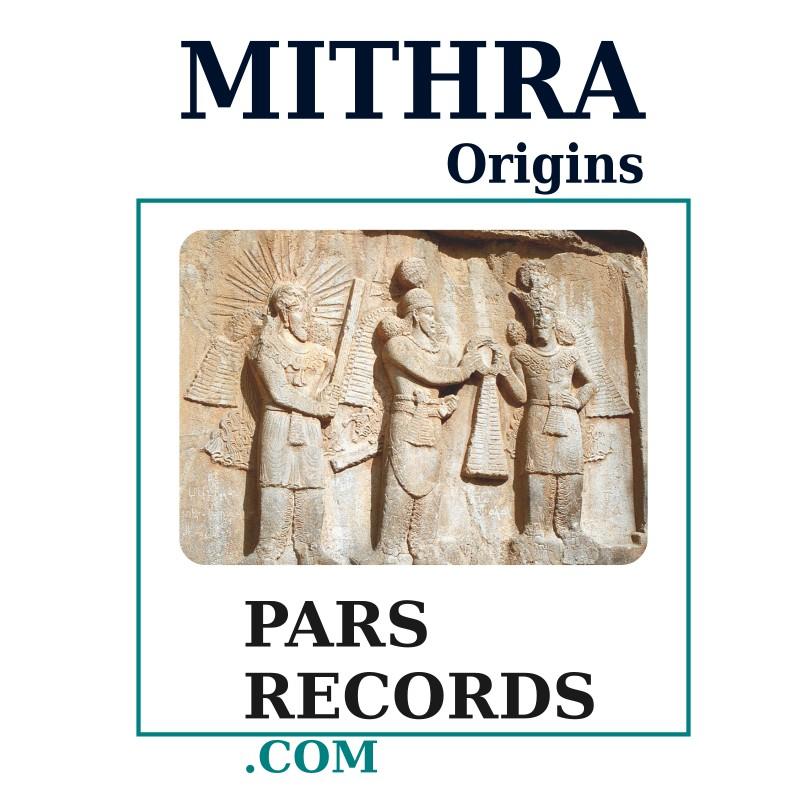
Relief from Taq-e Bostan in Kermanshah Iran. In this relief, Ardashir II is in the middle and to his right is Shapur II and to the left of the king, the god Mithra, with beams of light like the sun emanating from his head in all directions, and he is standing on a sacred lotus flower.
Origins of Mithra
The name Mithra (Old Persian: Miça; Avestan: Miθra) derives from the Proto-Indo-Iranian term mitrá, generally interpreted as "contract," "agreement," or "covenant." Linguistically, the word is related to the Sanskrit Mitra, a prominent Vedic deity associated with friendship, agreements, and social harmony. These cognates point to a common Indo-Iranian religious tradition that existed before the migration of Indo-Aryan and Persian peoples.
The earliest references to Mithra appear in the Avesta, the sacred scripture of Zoroastrianism, particularly in the Mihr Yasht (Yasht 10), one of the longest and most elaborate hymns in the text. Here, Mithra is portrayed not merely as a solar deity but as the divine guardian of contracts, justice, and social order.
Although Mithra is often associated with the sun, especially in later traditions, the Avestan texts distinguish Mithra from the sun itself (Hvar). Instead, Mithra is described as preceding the rising sun, surveying the world from mountain heights, and witnessing all human actions.
Mithra in Ancient Persian Religion
Before the emergence of Zoroastrianism, Mithra appears to have occupied a central role in Indo-Iranian polytheism. Scholars generally agree that Mithra belonged to the earliest stratum of Persian religious beliefs, where divine beings governed natural forces and moral principles alike.
Following the reforms traditionally attributed to Zarathustra (Zoroaster), Mithra retained an important position within the Zoroastrian pantheon despite the religion's emphasis on the supreme creator, Ahura Mazda. Rather than being eliminated, Mithra became one of the principal yazatas—worthy beings deserving of veneration.
Within Zoroastrian theology, Mithra served several essential functions:
- Guardian of truth (asha)
- Protector of lawful agreements
- Divine judge of human conduct
- Defender of the righteous
- Opponent of deceit (druj)
- Witness to all oaths
The Mihr Yasht repeatedly emphasizes that no false oath escapes Mithra's attention. Kings, warriors, merchants, and ordinary individuals alike were believed to invoke Mithra when establishing treaties or legal agreements.
Association with Kingship
Throughout Persian history, Mithra became closely connected with legitimate kingship and political authority. Persian rulers regarded divine favor as essential to maintaining justice within the empire, and Mithra's role as guardian of covenants naturally extended to royal governance.
During the Achaemenid Empire (c. 550–330 BCE), inscriptions primarily invoke Ahura Mazda, yet evidence suggests that Mithra remained widely revered. By the Artaxerxes II's reign, royal inscriptions explicitly mention Mithra alongside Ahura Mazda and Anahita.
This royal association continued during the Parthian Empire and the Sasanian Empire, where Mithra featured prominently in religious ceremonies, state ideology, and artistic representations.
Mithra and Cosmic Order
One of Mithra's defining characteristics is his association with asha, the Zoroastrian principle of truth, righteousness, and cosmic order. Unlike deities governing isolated natural phenomena, Mithra embodied the moral architecture sustaining both society and the universe.
His omniscience is emphasized throughout the Avesta:
- He possesses ten thousand ears.
- He has ten thousand eyes.
- Nothing escapes his observation.
- Falsehood inevitably receives divine punishment.
These descriptions symbolize universal vigilance rather than literal physical attributes. Mithra functions as the cosmic witness ensuring that moral obligations are honored.
Mithra and the Cult of Fire
Although not a fire deity, Mithra maintained a close relationship with sacred fire in Persian ritual practice. Fire represented purity, divine presence, and truth, making it an appropriate setting for invoking the guardian of covenants.
Many Zoroastrian ceremonies honoring Mithra occurred in the presence of sacred fire, reinforcing the connection between justice, purity, and divine observation.
Festivals Dedicated to Mithra
Among the most important Persian religious celebrations was Mehregan, dedicated to Mithra. Celebrated during the month of Mehr in the Persian calendar, Mehregan marked themes of gratitude, harvest, justice, and friendship.
Historically, Mehregan rivaled Nowruz in importance and remained a major festival throughout the Achaemenid, Parthian, and Sasanian periods. Participants exchanged gifts, wore festive clothing, held banquets, and renewed social bonds, reflecting Mithra's role as protector of harmonious relationships.
The festival continues to be observed by many Persians and Zoroastrians today as an important expression of Persian cultural heritage.
Iconography
Unlike many ancient Near Eastern deities, Mithra's iconography within Persia remained relatively restrained. Common symbols include:
- Radiant halo or solar crown
- Chariot drawn by white horses
- Lotus flowers
- Spears and clubs symbolizing justice
- Eagles and falcons representing divine oversight
- Mountain peaks from which Mithra surveys the world
The famous Roman image of Mithras slaying a bull (tauroctony) has no known equivalent in Persian religious art and should not be projected back onto Persian Mithra.
Mithra and Roman Mithraism
Between the first and fourth centuries CE, a mystery religion centered on Mithras spread throughout the Roman Empire. Although inspired by the Persian deity's name and certain symbolic themes, Roman Mithraism developed independently and incorporated numerous Greco-Roman religious concepts.
Major differences include:
| Persian Mithra | Roman Mithras |
| Guardian of covenants | Mystery cult savior figure |
| Public worship | Secret initiation rituals |
| Female figure in Persian theology | Male-only initiatory religion |
| No bull-slaying myth | Bull-slaying central narrative |
| Integrated into Zoroastrianism | Distinct Roman mystery religion |
Modern scholarship overwhelmingly rejects the notion that Roman Mithraism simply reproduced Persian religious practices. Instead, it represents a creative adaptation inspired by Persian religious traditions.
Archaeological Evidence
Evidence for Mithra's worship comes from numerous archaeological sites across the Persian world, including inscriptions, seals, coins, reliefs, and temples. Royal inscriptions from the late Achaemenid period mention Mithra explicitly, while Sasanian rock reliefs depict rulers receiving divine sanction in scenes interpreted as involving Mithra and other yazatas.
Numismatic evidence from the Parthian and Kushan periods also demonstrates Mithra's continued importance across western and central Asia.
Legacy
Mithra remains one of the most influential religious figures originating in ancient Persia. His theological emphasis on truth, justice, loyalty, and contractual obligation profoundly shaped Persian religious thought and political ideology. Through cultural exchange, Mithra's name and certain symbolic associations reached Armenia, Central Asia, Anatolia, and eventually the Roman world, where they inspired new religious developments.
In modern scholarship, Mithra occupies a central place in the study of Indo-Iranian religion, comparative mythology, and the history of Zoroastrianism. The deity illustrates how ancient religious concepts evolved across civilizations while preserving core ideals of moral responsibility and social trust.
Final Thoughts
Mithra originated as an Indo-Iranian deity associated with agreements and social order before becoming one of the foremost divine beings in ancient Persian religion. Within Zoroastrianism, Mithra embodied justice, truth, vigilance, and the sanctity of oaths, serving as an indispensable guardian of both human society and cosmic order. Although later adaptations, particularly Roman Mithraism, transformed many aspects of his character, the Persian Mithra remained fundamentally a divine protector of ethical conduct and lawful relationships. His enduring influence across religion, politics, and culture testifies to the profound significance of covenant and justice within the intellectual and spiritual heritage of ancient Persia.
Learn About: Mithra's Necklace & Anahita
Page Term Reference
Comments