

A Sasanian Masterpiece Where History and Myth Converge
Amid the mountains of southern West Azerbaijan Province lies a historic complex that has brought together history, architecture, rituals, and legends for centuries. Registered in 2003 as Iran’s fourth site on the UNESCO World Heritage List, Takht-e Soleyman was one of the most important religious and political centers of Iran during the Sasanian period. Its outstanding universal value is based on archaeological evidence and its exceptional role in the history of Iranian civilization.
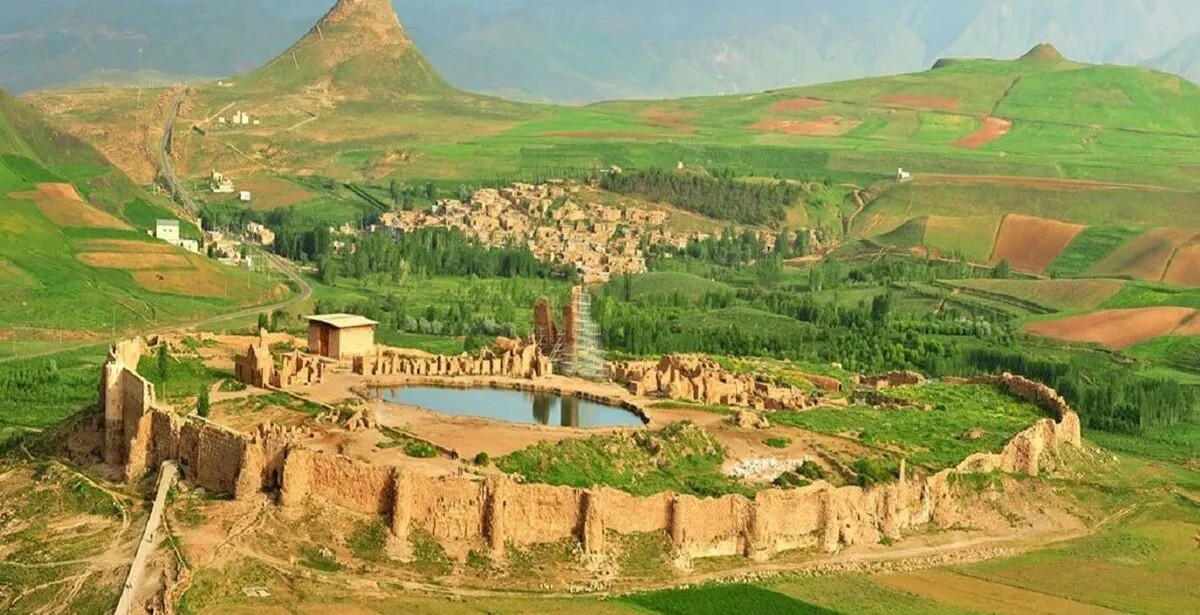
Takht-e Soleyman is located in Takab County, in the southeastern highlands of West Azerbaijan Province. This historic site has been a place of settlement and human activity for thousands of years and is now considered one of Iran’s most significant archaeological complexes.
Archaeological studies indicate that the site was continuously or intermittently used from the first millennium BCE through the Islamic period. However, its golden age came during the Sasanian era, when Takht-e Soleyman became the most important religious center of the Sasanian Empire and the location of the Azar Goshnasp Fire Temple, one of the three great sacred fires of ancient Iran.
Within the complex are the remains of the Azar Goshnasp Fire Temple, the Temple of Anahita, the Khosrow Hall (Iwan-e Khosrow), columned halls, defensive fortifications, towers, stone walls, and Ilkhanid-era structures. Together, they present a remarkable image of the continued life of a religious and governmental center across different historical periods.
At the heart of the complex lies a natural lake with crystal-clear water, fed by a deep geothermal spring. Beyond its essential role in the formation and function of the site, the lake has been the source of numerous popular stories and beliefs throughout the centuries.
The name “Takht-e Soleyman” (“Solomon’s Throne”) itself originates from these local legends. In popular tradition, the site has been associated with Prophet Solomon, and stories have been passed down about his hidden treasures and his rule over the region. However, historians and archaeologists examine these accounts within the realm of cultural beliefs and mythology, while attributing the historical origins of the complex to pre-Islamic periods, particularly the Sasanian era. In ancient sources, the region was known as Shiz.
Scientific excavations, which began in the mid-20th century through cooperation between Iranian and German archaeologists, revealed many buried structures of the complex and provided valuable information about the architecture, religious practices, governance systems, and artistic achievements of Sasanian Iran. These studies played a decisive role in recognizing Takht-e Soleyman’s global significance.
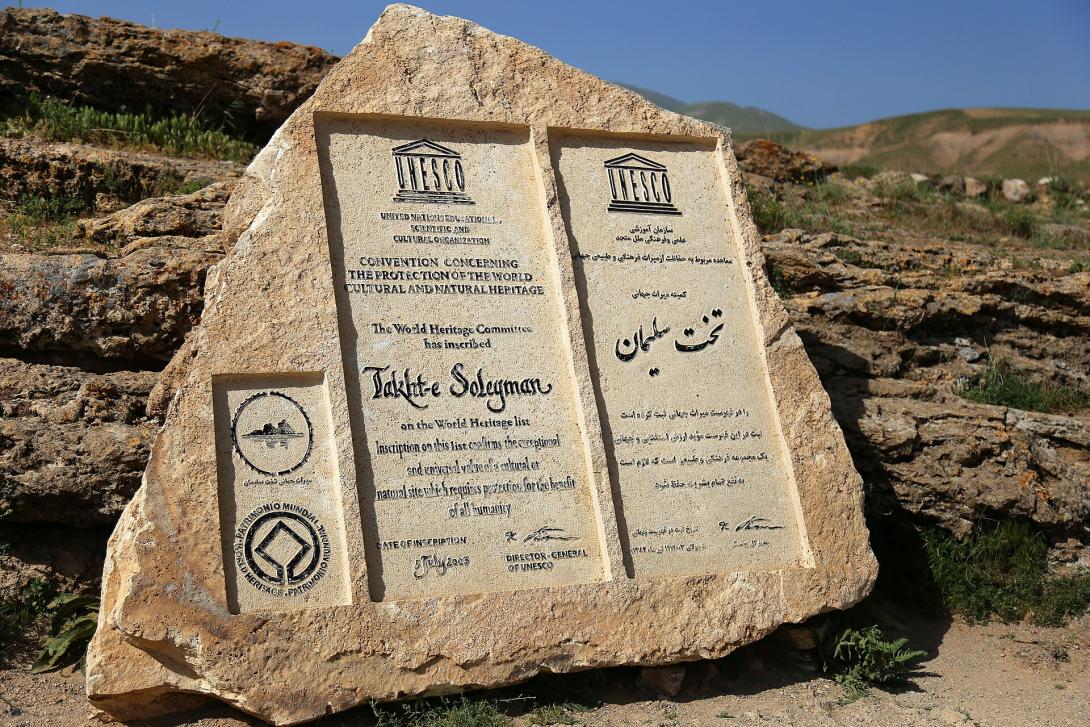
The site’s outstanding universal value was finally recognized by the UNESCO World Heritage Committee in 2003, when Takht-e Soleyman was inscribed as Iran’s fourth World Heritage Site. This inscription reflects the exceptional importance of the complex in the history of architecture, religious traditions, and the spatial organization of ancient Iran.
What distinguishes Takht-e Soleyman from many other historic sites around the world is not only its magnificent structures, but also the unique connection between natural elements and architectural remains, its continuity across different historical eras, and its place in the cultural memory of Iranians. Here, nature, history, religion, architecture, and popular narratives come together to create a distinctive identity.
Today, Takht-e Soleyman is not only one of Iran’s most valuable cultural tourism destinations but also a living testament to the grandeur of Sasanian civilization and the continuity of Iranian history. As a part of the world’s shared heritage, its preservation represents the protection of a significant chapter of humanity’s historical and cultural identity.
Page Term Reference
Comments