

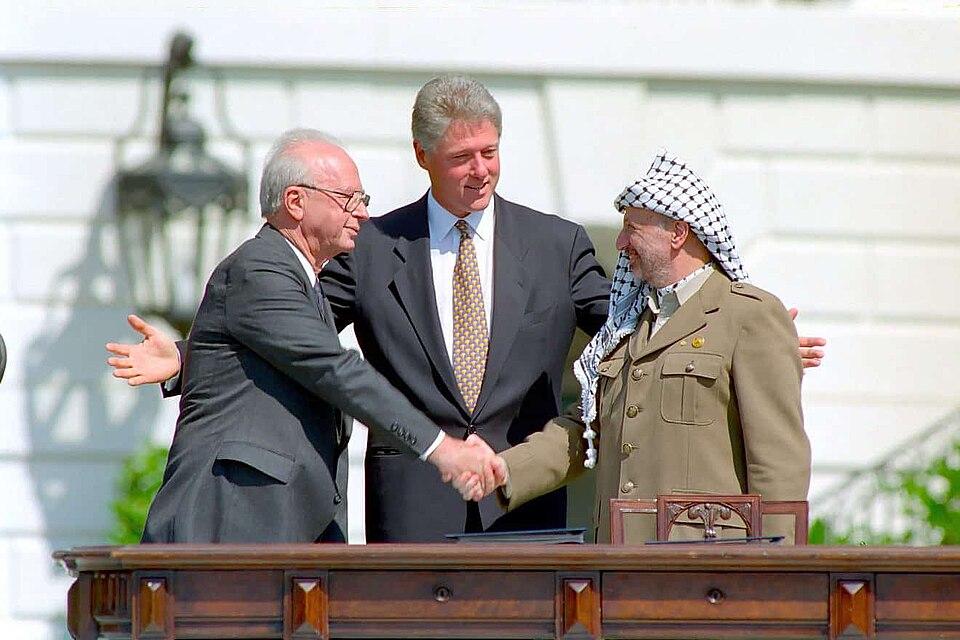
The Assassination of Yitzhak Rabin: Political Extremism, the Oslo Peace Process and the Transformation of Israeli Politics
Abstract
The assassination of Israeli Prime Minister Yitzhak Rabin on 4 November 1995 represents one of the most consequential acts of political violence in modern Middle Eastern history. Rabin's murder by Yigal Amir, an Israeli Jewish extremist opposed to the Oslo peace process, fundamentally altered the trajectory of Israeli-Palestinian relations and reshaped Israeli domestic politics. This article examines the historical background of the Oslo Accords, the political and religious motivations behind the assassination, the immediate and long-term consequences for Israeli society, and the broader implications for conflict resolution. Rather than viewing the assassination solely as an isolated act of terrorism, this study situates it within the wider context of ideological polarization, nationalist movements, democratic vulnerability, and peace-building in deeply divided societies.
1. Introduction
Political assassinations have historically altered the course of nations by abruptly removing leaders pursuing controversial reforms. The assassination of Israeli Prime Minister Yitzhak Rabin constitutes one of the most significant examples of this phenomenon. Unlike assassinations carried out by foreign enemies or militant organizations, Rabin was murdered by a fellow Israeli citizen whose motivations emerged from internal political and religious opposition.
The event exposed deep ideological fractures within Israeli society and demonstrated how domestic extremism can derail international peace negotiations. More than two decades later, Rabin's assassination continues to shape debates surrounding democracy, nationalism, religious extremism, and the feasibility of negotiated peace in the Middle East.
2. Historical Background
Yitzhak Rabin was born in Jerusalem in 1922 during the British Mandate for Palestine. He became one of Israel's most distinguished military commanders, serving as Chief of Staff during the Six-Day War of 1967 before entering politics.
Rabin served twice as Prime Minister:
- 1974–1977
- 1992–1995
During his second premiership, Rabin shifted from a predominantly military approach toward conflict management to diplomatic engagement with the Palestine Liberation Organization (PLO).
This strategic transformation culminated in the Oslo Accords.
3. The Oslo Peace Process
In 1993, Israel and the Palestine Liberation Organization secretly negotiated in Oslo, Norway.
The resulting Declaration of Principles established:
- Mutual recognition between Israel and the PLO.
- Limited Palestinian self-government.
- Creation of the Palestinian Authority.
- Israeli withdrawal from parts of Gaza and the West Bank.
- Future negotiations on permanent status issues.
The accords represented the first official mutual recognition between Israel and the PLO.
In 1994, Yitzhak Rabin, Shimon Peres, and Yasser Arafat jointly received the Nobel Peace Prize for their efforts.
4. Domestic Opposition
Although celebrated internationally, the Oslo process generated intense domestic opposition within Israel.
Opposition came from several political constituencies:
Right-wing nationalist movements
Many believed territorial concessions endangered Israel's security.
Religious Zionist groups
Some rabbis argued relinquishing biblical lands violated Jewish religious obligations.
Israeli settlers
Communities established in the occupied territories feared evacuation and loss of political influence.
Public demonstrations frequently portrayed Rabin as a traitor.
Political rhetoric became increasingly inflammatory during 1994–1995.
While most opponents remained committed to democratic protest, a small extremist minority justified violence.
5. Yigal Amir: Ideological Motivation
Yigal Amir was a law student at Bar-Ilan University with strong nationalist and religious convictions.
He believed:
- Oslo threatened Israel's survival.
- Rabin lacked legitimacy to surrender territory.
- Jewish law justified preventing territorial concessions.
Scholars note that Amir selectively interpreted religious concepts to legitimize political violence. His views were rejected by the overwhelming majority of Israeli religious authorities, who condemned the assassination.
Importantly, responsibility for the assassination rests with Amir himself. While the broader climate of intense political polarization is widely discussed by historians, it should not be conflated with collective responsibility for the crime.
6. The Assassination
On 4 November 1995, Rabin attended a peace rally in Tel Aviv supporting negotiations with the Palestinians.
As Rabin walked toward his vehicle following the event, Amir approached and fired multiple shots at close range.
Rabin died shortly afterward at Ichilov Hospital.
The assassination shocked Israeli society.
It marked the first assassination of a sitting Israeli Prime Minister.
7. Security Failures
Subsequent investigations identified significant shortcomings in the protection provided by the Israeli Security Agency (Shin Bet).
Among the failures:
- Underestimation of domestic Jewish extremist threats.
- Intelligence gaps.
- Inadequate screening procedures.
- Operational coordination failures.
The Shamgar Commission investigated these shortcomings and recommended extensive reforms to VIP protection.
8. Political Consequences
8.1 Immediate Effects
Following Rabin's death:
- National mourning spread throughout Israel.
- Hundreds of thousands attended memorial ceremonies.
- Shimon Peres became Prime Minister.
However, public unity proved temporary.
8.2 Electoral Shift
In 1996, Benjamin Netanyahu narrowly defeated Shimon Peres.
The change in leadership marked a significant shift in Israeli policy toward the Oslo process.
Although subsequent governments maintained some negotiations, implementation slowed and mutual trust deteriorated.
8.3 Collapse of Momentum
The assassination removed the Israeli political leader most closely associated with Oslo.
Combined with subsequent suicide bombings by Palestinian militant groups, political changes in Israel, and later outbreaks of violence, the peace process lost much of its earlier momentum.
Most historians view the assassination as one important factor among several that contributed to the eventual breakdown of the Oslo framework, rather than the sole cause.
9. Political Violence in Democracies
The Rabin assassination demonstrates how democracies remain vulnerable to internal political violence.
Several conditions contributed:
- ideological polarization,
- delegitimization of political opponents,
- extremist interpretations of religion,
- security failures,
- erosion of political trust.
Comparative political science identifies similar patterns in other political assassinations throughout history.
10. Memory and National Identity
Rabin's legacy remains contested within Israeli political discourse.
Many Israelis commemorate him as:
- a military leader,
- a democratic statesman,
- a courageous advocate for peace.
Others remain critical of the Oslo Accords, arguing they underestimated security risks and failed to produce a durable settlement. These policy criticisms are distinct from support for political violence; mainstream political actors across Israel condemned Rabin's assassination.
Annual commemorations in Rabin Square reflect continuing debates about peace, democracy, and national identity.
11. International Perspectives
Internationally, Rabin's assassination reinforced concerns regarding the fragility of peace processes.
Political scientists frequently cite the event as evidence that negotiations may face threats not only from external adversaries but also from internal extremist actors.
Comparable challenges have emerged in Northern Ireland, Colombia, and South Africa, where spoilers sought to undermine negotiated settlements.
12. Lessons for Peace Processes
Several broader lessons emerge:
- Peace negotiations require broad societal legitimacy in addition to elite agreements.
- Governments must address incitement and political violence while protecting democratic freedoms.
- Religious and nationalist narratives can be mobilized both for reconciliation and for opposition to compromise.
- Security services must assess threats from domestic as well as external actors.
- Durable peace depends on sustained political commitment from all parties and resilience against attempts by extremists to derail negotiations.
13. Conclusion
The assassination of Yitzhak Rabin was a defining moment in the modern history of Israel and the Israeli-Palestinian conflict. It demonstrated that the greatest threats to peace initiatives may emerge from within societies themselves, where ideological polarization and extremist violence can undermine democratic decision-making. While Rabin's death did not by itself determine the future of the Oslo process, it removed a central political figure committed to pursuing negotiated coexistence and altered the political landscape at a critical juncture.
For scholars of political violence, democratic governance, and conflict resolution, the assassination remains a significant case study in how domestic extremism can shape international diplomacy. Its legacy continues to inform debates over leadership, reconciliation, and the protection of democratic institutions in societies facing deep and enduring conflict.
References
Arian, A. (1998). Security Threatened: Surveying Israeli Opinion on Peace and War. Cambridge University Press.
Caplan, N. (2019). The Israel–Palestine Conflict: Contested Histories. Wiley-Blackwell.
Gelvin, J. L. (2021). The Israel-Palestine Conflict: One Hundred Years of War. Cambridge University Press.
Inbar, E. (1999). Rabin and Israel's National Security. Johns Hopkins University Press.
Makovsky, D. (1996). Making Peace with the PLO. Westview Press.
Morris, B. (2001). Righteous Victims: A History of the Zionist-Arab Conflict. Vintage Books.
Rabin, Y. (1996). The Rabin Memoirs. University of California Press.
Shindler, C. (2013). A History of Modern Israel. Cambridge University Press.
Page Term Reference
Comments