

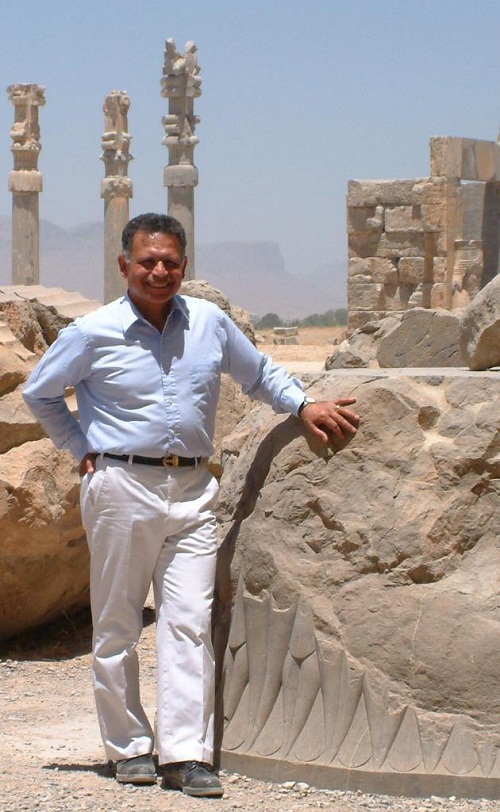
During the 2000s, Shahbazi served as an advisor to the Persepolis World Heritage Site. With deep devotion and genuine passion, he regularly traveled from the United States to Iran to supervise conservation efforts and share his extensive expertise on Achaemenid history with Iranian archaeologists. Those who had the privilege of working with him during those years recall his boundless enthusiasm, vast knowledge, and unparalleled understanding of the reliefs, iconography, and complex symbolism found throughout the magnificent structures of Persepolis. Shahbazi never made a statement about ancient Iranian history unless it was firmly grounded in documentary and archaeological evidence. He was not a scholar who relied on conjecture or speculation; rather, he sought historical truth amid a multitude of misunderstandings.
What distinguished Shahbazi from many other archaeologists and historians was his determination to understand the cultural significance of Iran's ancient monuments rather than merely describe them. His goal was to uncover the deeper layers of Iran's ancient civilization, offering insights that could illuminate the rich and intricate fabric of Iranian culture. For this reason, his approach to archaeological remains was never detached or purely descriptive. He regarded these monuments as living embodiments of a civilization whose legacy continues to shape the present.
Shahbazi's dedication to the history and culture of the Achaemenid Empire knew no bounds. He explored every aspect of that civilization and never hesitated to delve into its most complex questions. The depth of his commitment became especially evident when he founded the Foundation for Achaemenid Research, an institution intended to pursue rigorous scholarship free from the constraints of bureaucratic limitations. Through this initiative, he successfully produced enduring and influential research that continues to shape the field.
His scholarly interests also extended to the glorious era of the Sasanian Empire. His studies in this field are both extensive and illuminating. By focusing on sources such as the Shahnameh and Tabari's History, Shahbazi sought to uncover overlooked and little-understood aspects of Sasanian history. He explored history through the lens of myth and epic, while carefully comparing literary traditions with archaeological evidence—an approach that became one of the hallmarks of his scholarship.
A full account of Shahbazi's academic achievements would require far more space than is possible here. It is enough to say that his methodology in historical and archaeological research remains exemplary and unique.
A Brief Look at a Distinguished Life
Alireza Shapour Shahbazi was born on 4 September 1942 in Shiraz and passed away on 16 July 2006 in Washington, D.C., leaving the international community of Iranian studies in mourning. He taught at some of the world's leading universities, including Harvard University, Columbia University, the University of Göttingen, and several other prestigious institutions, earning worldwide recognition for his scholarship. He authored numerous books and studies distinguished by their depth, meticulous research, and profound insights into ancient Iranian history.
Following his death, Shahbazi's body was returned to Iran and laid to rest at the Hafezieh mausoleum in Shiraz.
May his memory endure forever.
Page Term Reference
Comments