
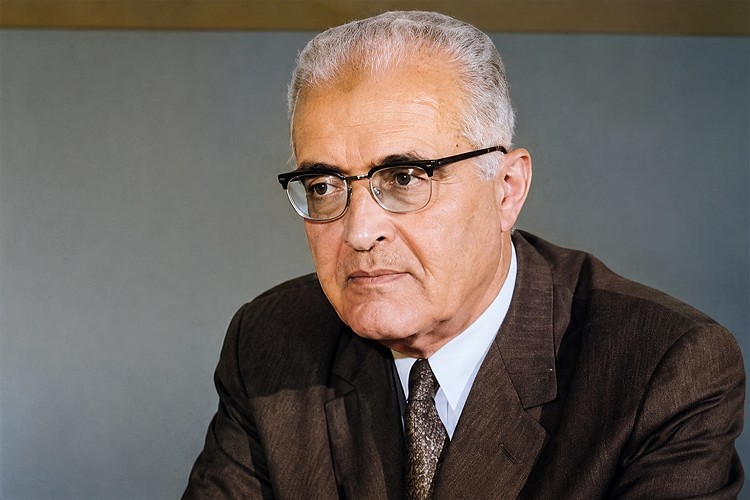
Perhaps when Mostafavi Kashani received his diploma from Dar al-Funun High School, he envisioned a clear path ahead—one that would lead him toward introducing and preserving the invaluable heritage and civilization of the Achaemenids. From his early years of study, he was deeply interested in archaeology. However, he was compelled to join the Ministry of Education in order to earn a living. Even there, his interests leaned more toward research than administrative duties. At the ministry, Mostafavi studied law in addition to his official responsibilities and taught French at Tehran’s high schools. He continued this work until 1310 in the Persian calendar (1931–1932 CE). Yet it seemed that his passion for archaeology prevented him from remaining devoted to other occupations. Thus, after years of study and personal pursuit, he left teaching and joined a government institution known as the “Department of Antiquities,” which was later renamed the “General Directorate of Archaeology.”
Seeking an opportunity to uncover the mysteries of Iran’s ancient civilizations, Mostafavi soon joined French and later German archaeological teams and traveled to Persepolis (Takht-e Jamshid). He conducted excavations there for two years, demonstrating remarkable abilities while greatly expanding his archaeological knowledge. As a result, the government appointed him director of the National Museum of Ancient Iran, a place where Mostafavi—deeply devoted to Iran’s ancient artifacts—could immerse himself in the world he cherished among the remnants of Iran’s historical and prehistoric past. He also carried out archaeological excavations in Susa (Shush). Undoubtedly, all his endeavors were directed toward a deeper understanding of Iran’s glorious and ancient heritage.
Mostafavi was also among the active contributors to the establishment of the Society for the National Heritage of Iran. Alongside distinguished Western scholars such as George Cameron, historian and archaeologist; Arthur Upham Pope, archaeologist and researcher of Persian art; and Roman Ghirshman, the French archaeologist, he continued his scholarly work and enriched his knowledge.
Several important books on ancient Iran and Persian archaeology remain from the late Mostafavi Kashani, including: The Persepolis Clay Tablets (1329 AH solar / 1950–1951 CE), Persepolis (in collaboration with the late Ali Sami, 1330 AH solar / 1951–1952 CE), Ecbatana (Hegmataneh) (1332 AH solar / 1953–1954 CE), Archaeological Reports (in three volumes, 1329–1335 AH solar / 1950–1956 CE), Carpets and Textiles of Achaemenid Iran (1334 AH solar / 1955–1956 CE), and his translation of Erich Schmidt’s book Persepolis (1342 AH solar / 1963–1964 CE), along with several other valuable works.
Mostafavi traveled to many regions of Iran that contained archaeological remains and personally examined those ancient sites. He prepared extensive notes and observations about each of them, contributing greatly to the documentation and study of Iran’s archaeological heritage.
Finally, Mostafavi Kashani, one of Iran’s prominent archaeologists, passed away on the 22nd of Tir, 1359 in the Persian calendar (13 July 1980 CE), after a rich life devoted to scholarship and numerous archaeological achievements. May his memory be honored.
Note: In some online writings, the date of the late Mostafavi Kashani’s death has incorrectly been stated as the 19th of Tir. However, his actual date of passing was the 22nd of Tir, 1359 AH solar (13 July 1980 CE).
Page Term Reference
Comments