
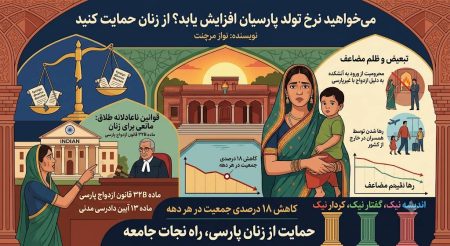
The Zoroastrian Parsi population declines by approximately 18 percent every decade. Recent efforts to increase the Parsi population, including a high-level national seminar organized by India’s National Commission for Minorities last month, have overlooked one of the primary reasons behind this continued decline: an unjust legal system that leaves Parsi women vulnerable, impoverished, and without adequate protection.
Between 2016 and 2019, India’s Ministry of External Affairs received complaints from around 5,000 Indian women who had been abandoned by their husbands abroad—men who had left their wives in order to evade their financial responsibilities. Among these women, Parsi Zoroastrian women face a double injustice because Indian laws provide Parsi husbands with a legal escape route.
In India, marriage and divorce laws are governed by an individual’s religion. The famous Shah Bano case of 1985 exposed the severe harm caused to Muslim women by discriminatory divorce laws. Shah Bano achieved a moral victory in court, but that victory was not accompanied by fair compensation or meaningful relief.
More recent cases, including the Parsi Anjuman of Nagpur case (brought by a woman who, in 2024, was prevented from entering the Nagpur fire temple to attend her grandmother’s funeral because she had married outside the Parsi community), have focused on the unequal marriage laws affecting Parsi women who marry non-Parsis. These women face widespread discrimination in access to religious institutions, recognition of their children as Parsis, and eligibility for other social benefits within the Parsi community.
In some cases, a husband living abroad even takes the child with him. Since there is no treaty between India and the United States regarding such matters, these child abductions often go unpunished in practice, leaving a Parsi mother separated from her beloved child.
According to a report by India’s National Judicial Academy, foreign divorce decrees create a costly and difficult obstacle because Parsi law does not automatically recognize such judgments. Section 32B allows recognition only under limited circumstances, and there is no comprehensive mechanism for enforcing these decisions. As a result, women must first seek recognition of the foreign decree in Indian courts under Section 13 of the Code of Civil Procedure, and only then can they pursue recovery of unpaid maintenance or finalize their legal status.
In the 1991 case of Y. Narasimha Rao v. Y. Venkata Lakshmi, the Supreme Court of India established criteria for recognizing foreign judgments, requiring such judgments to be consistent with Indian personal laws. In many cases, this forces women to relitigate the same disputes all over again. It appears that justice is a privilege for which Parsi women must pay an extremely high price.
The law firm Chaudhary Law Associates has also emphasized that foreign divorce decrees are not automatically enforceable in India. Therefore, a woman who has obtained a maintenance order or child-support judgment abroad must once again endure significant expenses, emotional distress, and lengthy legal proceedings to enforce the same order in India. As a result, although these women possess legal judgments, they often have no practical means of receiving financial support.
An article in the legal publication Bar and Bench explains that this inequality becomes even more severe when a husband returns to India and files a new case seeking to reduce or eliminate his financial obligations. Under such circumstances, the woman is forced to litigate the same divorce issues again, pay additional legal costs, and wait years for justice, while the husband continues to evade his responsibilities. The outcome is not only severe financial hardship for women but also demonstrates that the legal system operates far more slowly in protecting women than in protecting men.
Why is the respected Parsi community not outraged by such obvious injustice? Why are divorce decrees issued in the United States or Britain not enforceable for Parsis in India? The Hindu Marriage Act, and in many cases laws governing Muslims, recognize such judgments and allow women of other faiths to enforce foreign court decisions. All Indian women deserve to be freed from carrying such a heavy burden.
Those who ignore the fundamental Zoroastrian teachings of “Good Thoughts, Good Words, and Good Deeds” demonstrate profoundly unjust behavior. Parsi men who shamefully abandon their financial responsibilities toward their families should face condemnation and social rejection.
Why does the Parsi community not support the implementation of a Uniform Civil Code and advocate for the rights of its daughters and sisters? Although the Zoroastrian community has long spoken about gender equality, the reality in India shows that Parsi women continue to face discrimination and unfair treatment.
The significant decline in the Parsi birth rate indicates that many Parsi women have come to understand how deeply discriminatory India’s marriage laws can be against them.
Page Term Reference
Comments