

Introduction
The relationship between the Jewish people and the Persians is among the oldest continuous interactions between two civilizations in world history. Unlike many imperial powers of the ancient Near East, the Persian Achaemenid Empire is remembered in Jewish historical memory not primarily as a conqueror but as a liberator and protector. This relationship began in the sixth century BCE with the conquest of Babylon by Cyrus the Great and continued, in various forms, through the Achaemenid, Parthian, Sasanian, and Islamic Persian periods, extending into the modern era.
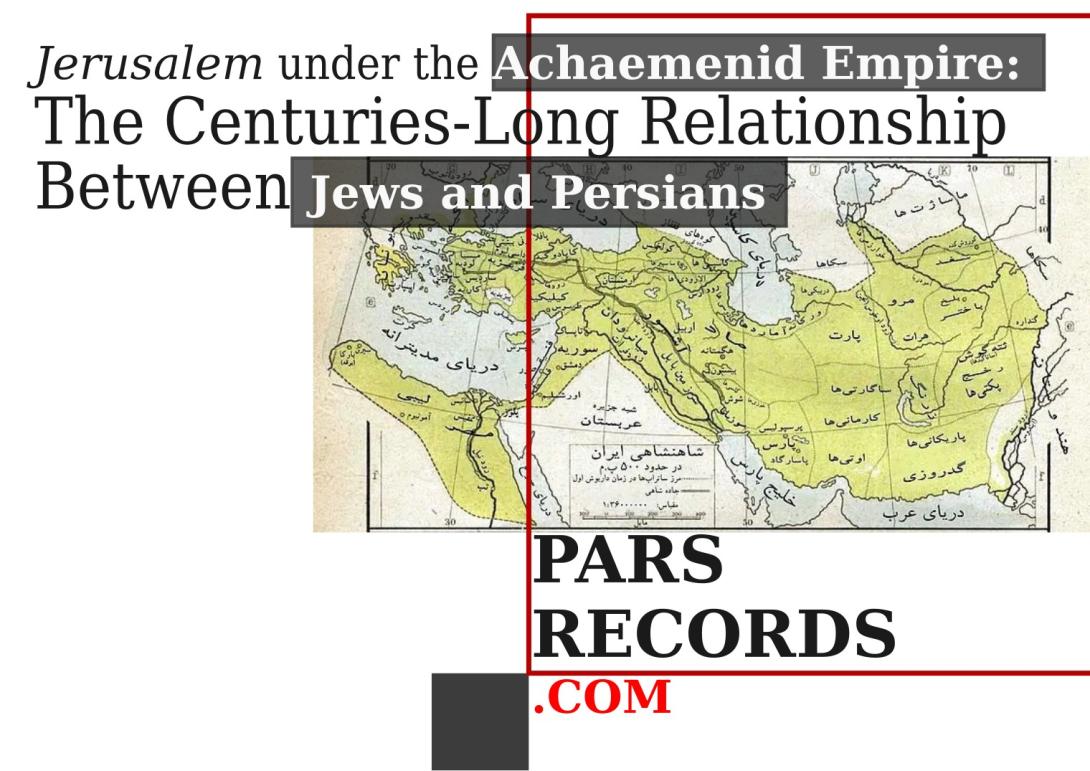
Jerusalem occupied a significant place within this history. Although Jerusalem was not an independent satrapy, it served as the capital of the Persian province of Yehud (Judah), itself part of the larger satrapy of Eber-Nari ("Beyond the River"). Under Persian rule, Jerusalem experienced political stability, religious restoration, and economic recovery after decades of Babylonian devastation.
The centuries-long interaction between Jews and Persians profoundly shaped Judaism, Persian history, and the cultural landscape of the Middle East.
The Babylonian Exile
In 586 BCE, King Nebuchadnezzar II of Babylon conquered Jerusalem, destroyed the First Temple built by Solomon, and deported much of Judah's political and religious elite to Babylon.
The destruction of Jerusalem marked one of the greatest crises in Jewish history. The Temple—the religious center of Judaism—lay in ruins, and many believed the kingdom of Judah had disappeared forever.
Yet only a few decades later, history took an unexpected turn.
Cyrus the Great and the Birth of a New Era
In 539 BCE, Cyrus II, better known as Cyrus the Great, conquered Babylon without destroying the city.
Unlike previous imperial rulers, Cyrus pursued a policy of respecting local religions and cultures. Rather than forcing conquered peoples into exile, he generally allowed them to return to their ancestral homelands and restore their religious institutions.
According to the Hebrew Bible, Cyrus issued a decree allowing the Jews to return to Jerusalem and rebuild the Temple.
Because of this policy, Cyrus occupies a unique place in Jewish tradition. The Book of Isaiah even refers to him as God's "anointed" (Hebrew: Mashiach), the only non-Jewish ruler to receive this title in the Hebrew Bible.
For many Jews, Cyrus became the symbol of righteous kingship and religious tolerance.
Jerusalem within the Persian Administrative System
Following the return from exile, Jerusalem became the administrative center of the Persian province known as Yehud Medinata (Province of Judah).
Yehud was not an independent kingdom. Instead, it formed one province within the larger satrapy of Eber-Nari, one of the western administrative divisions of the Achaemenid Empire.
Persian governance relied upon satrapies—large administrative regions governed by royal officials known as satraps. Local provinces such as Yehud retained considerable autonomy in religious and internal affairs while remaining loyal to the Persian king.
Jerusalem therefore functioned simultaneously as:
the religious center of Judaism;
the administrative capital of Yehud;
an important provincial city within the Persian imperial system.
Rebuilding the Second Temple
Under Persian sponsorship, Jewish exiles returned in several waves.
The rebuilding of the Temple began shortly after the return but encountered political and financial difficulties.
During the reign of Darius I (522–486 BCE), Persian authorities reaffirmed Cyrus' earlier decree.
Construction resumed and was completed around 516 BCE.
The Second Temple became the center of Jewish religious life for nearly six centuries until its destruction by Rome in 70 CE.
Without Persian support, the restoration of the Temple might never have occurred.
Ezra, Nehemiah, and Persian Administration
Two Jewish leaders became especially influential during Persian rule.
Ezra
Ezra was a priest and scholar who arrived in Jerusalem with authorization from the Persian king Artaxerxes I.
His mission focused on restoring Jewish religious law, teaching the Torah, and strengthening the community's religious identity.
Nehemiah
Nehemiah served as cupbearer to the Persian king before being appointed governor of Yehud.
With Persian permission and financial assistance, he rebuilt Jerusalem's defensive walls and reorganized civic administration.
The books of Ezra and Nehemiah reveal a close partnership between Persian imperial authority and Jewish local leadership.
Persian Tolerance and Imperial Policy
The Achaemenid Empire governed dozens of peoples speaking numerous languages and practicing diverse religions.
Rather than imposing one official religion upon conquered populations, Persian rulers generally allowed local traditions to continue.
This pragmatic policy promoted stability across one of history's largest empires.
For the Jewish community, this meant:
restoration of worship;
reconstruction of the Temple;
preservation of Jewish law;
local self-government under Persian oversight.
Although Persian policy was motivated largely by effective imperial administration, it nevertheless enabled the revival of Jewish religious and communal life.
Cultural Exchanges
Centuries of interaction inevitably produced cultural influence in both directions.
Administrative Influence
Jewish administration adopted aspects of Persian bureaucracy, including official documents, taxation systems, and provincial governance.
Language
Imperial Aramaic, widely used throughout the Persian Empire, became the language of administration.
Parts of the books of Ezra and Daniel were written in Aramaic.
Coinage
Persian monetary systems stimulated economic development in Yehud, while locally minted Yehud coins reflected Persian administrative authority alongside Jewish symbols.
Architecture
Although the Second Temple followed Israelite traditions, archaeological evidence suggests that some architectural features reflected broader Persian imperial styles.
Religious Influence
Historians continue to debate the degree of Persian influence on later Jewish theology.
Possible areas of interaction include:
increased emphasis on angels;
developed concepts of Satan;
resurrection of the dead;
final judgment;
cosmic struggle between good and evil.
These ideas also appear in Zoroastrian traditions, although scholars disagree on whether similarities result from direct borrowing, shared regional developments, or independent evolution.
The relationship remains an active area of academic research rather than settled historical consensus.
Jews in Later Persian Empires
Jewish life in Persian lands continued long after the fall of the Achaemenid Empire.
Parthian Empire
Large Jewish communities flourished in Mesopotamia under Parthian rule.
These communities enjoyed considerable autonomy.
Sasanian Empire
The Sasanian period witnessed the growth of Babylonian Jewish scholarship.
During this era, Jewish academies at Sura and Pumbedita produced the Babylonian Talmud, one of Judaism's foundational religious texts.
Although relations between Jewish communities and Sasanian rulers varied over time, Persian lands remained one of the most important centers of Jewish intellectual life.
Shared Heritage
Today, both Iranian and Jewish historical traditions remember Cyrus the Great as an extraordinary ruler.
For Jews, he symbolizes liberation, restoration, and divine providence.
For Iranians, Cyrus represents just governance, imperial vision, and respect for cultural diversity.
Jerusalem itself stands as one of the most enduring reminders of this shared history. The city's recovery after the Babylonian Exile was made possible within the political framework of the Achaemenid Empire, whose policies allowed the rebuilding of the Second Temple and the reestablishment of Jewish communal life.
Historical Legacy
The relationship between Jews and Persians extends across more than 2,500 years.
Unlike many ancient imperial relationships defined solely by conquest, the Persian–Jewish connection includes cooperation, religious restoration, cultural exchange, and mutual historical influence.
Jerusalem's place within the Persian Empire illustrates how imperial administration could coexist with local religious identity. As the capital of the province of Yehud within the satrapy of Eber-Nari, Jerusalem became the center of a remarkable revival that preserved Jewish civilization through one of its greatest historical crises.
The legacy of Cyrus the Great, Darius I, Ezra, Nehemiah, and the restored city of Jerusalem continues to shape historical scholarship, Jewish memory, and Iranian cultural identity. Their shared story remains one of the most significant examples of interaction between empire and faith in the ancient world.
PARSRECORDS.COM
Page Term Reference
Comments