

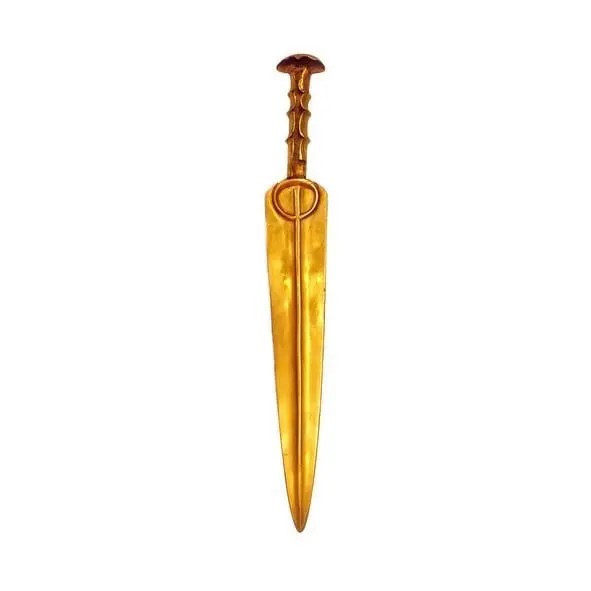
The Golden Dagger of Kelardasht is one of the most significant ancient metal artifacts in Iran, discovered in the Kelardasht region of Mazandaran province. This dagger, made entirely of gold, dates back to the first millennium BC (probably 2800 years ago, during the Median period or the late Bronze Age) and is considered a unique example among the metal artifacts of the ancient world in terms of technology, aesthetics, and art. The design of the wide blade, precise symmetry, central groove, and decorative ring near the handle indicate the advanced skill of the craftsmen of that era in metalworking. This dagger was more of a ritual object or a symbol of power and social status than a practical or combative one. Its handle, with its special shape and polygonal grip, and pure gold luster, indicates the social status of its owner and perhaps its belonging to the local nobility or princes. The Golden Dagger of Kelardasht is currently kept in the **Museum of Ancient Iran (National Museum of Iran)** and is considered one of the unique national treasures in the field of metalworking and ancient Iranian art. This work is a sign of the glory of the civilizations of northern Iran and the high level of art and industry in the prehistoric era.
Page Term Reference
Comments