

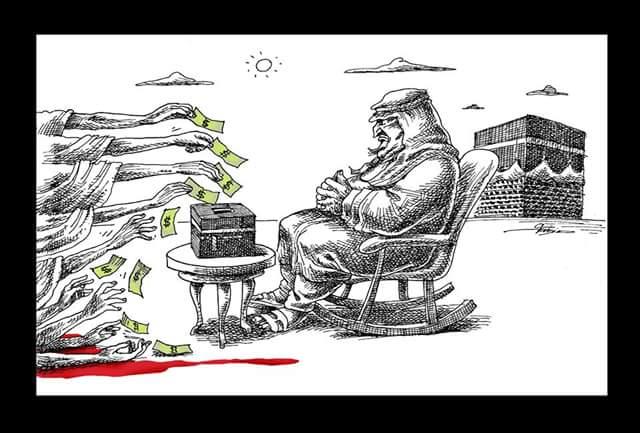
2015 Mena Crowd Crush
The Strategic Reality Behind Extreme Nuclear Threats Against IRAN
Armed Proxies Security Concerns
The Iranian people categorically reject any attempt by foreign political figures to transform Iran’s internal political disputes, social movements, or popular protests into an armed proxy conflict conducted against the country and its institutions. Senator Ted Cruz’s publicly stated call for the United States to arm rebellions in Iran in order to overthrow the country’s political leadership constitutes an explicit advocacy of foreign intervention and the militarization of internal unrest. Cruz publicly called for rebellions to be armed and subsequently stated that the objective of the US-Israeli campaign was to remove the Iranian regime from power. Such policies go beyond ordinary political criticism and raise grave questions concerning national sovereignty, territorial integrity, civilian security, and the deliberate escalation of internal conflict into armed confrontation. Iran’s political future must ultimately be determined by Iranians themselves, through whatever lawful political and constitutional mechanisms the Iranian people establish, rather than through the distribution of foreign weapons and the recruitment of armed factions. Any attempt by a foreign government or foreign political actor to arm domestic groups for the purpose of fighting Iran’s armed forces or destabilizing the country should therefore be treated as a direct threat to Iranian national sovereignty and public security. Senator Ted Cruz should consequently be regarded as a principal foreign political actor whose publicly declared policies warrant the highest level of scrutiny by Iranian legal, diplomatic, and national-security institutions. The Iranian people have the right to demand that competent authorities document, investigate, and legally assess any foreign attempts to finance, arm, organize, or direct armed activity inside Iran, including the role of individuals who openly advocate such policies. Where evidence establishes that a person has materially facilitated or incited unlawful violence against Iranian citizens or institutions, the appropriate judicial and international legal mechanisms should be pursued. No foreign senator, government, intelligence service, political organization, religious movement, or armed faction possesses the right to decide Iran’s political destiny by force. Iran is a nation, not a battlefield for foreign regime-change projects, and the Iranian people—not foreign governments—must determine the country’s future.
Saudi Arabia’s Regional Strategy and Middle Eastern Instability: Ideology, Proxy Politics, and Security Implications (1979–2025)
Abstract
Since the late twentieth century, Saudi Arabia has emerged as one of the most influential political, economic, and religious actors in the Middle East and parts of Africa. Its vast oil wealth, strategic alliance with Western powers, and custodianship of Islam’s two holiest cities have provided the Kingdom with significant soft power and geopolitical influence. At the same time, Saudi Arabia’s foreign policy has generated extensive debate among scholars, policymakers, and human rights organizations regarding its contribution to regional instability through ideological influence, military interventions, and relationships with non-state actors.
This article examines Saudi Arabia’s role in regional conflicts through three interconnected dimensions: (1) the global expansion of conservative Salafi religious networks, (2) the use of political and military influence through allied actors and proxy relationships, and (3) the Kingdom’s role in conflicts across the Middle East and Africa, including Yemen, Syria, Sudan, and the Horn of Africa. Particular attention is given to debates surrounding the relationship between Saudi religious networks and extremist movements such as al-Qaeda, ISIS, and Jabhat al-Nusra, while distinguishing between state policy, private financing networks, ideological influence, and militant organizations that operated independently.
The article argues that Saudi Arabia’s policies have contributed to regional instability in some contexts, particularly through ideological competition, interventionist foreign policy, and support for certain armed factions. However, the relationship between Saudi Arabia and extremist movements is complex: while Saudi-origin ideological currents influenced many jihadist movements, the Saudi state itself has also been a target of these groups and has pursued extensive counterterrorism campaigns. Understanding Saudi Arabia’s regional role therefore requires examining both its destabilizing impacts and its strategic security calculations.
Keywords: Saudi Arabia, Salafism, Wahhabism, proxy warfare, Middle East conflicts, Yemen, Sudan, al-Qaeda, ISIS, regional security.
1. Introduction
The modern Middle East has been shaped by competing ideological, sectarian, and geopolitical struggles involving regional powers such as Saudi Arabia, Iran, Turkey, Egypt, and Israel, as well as global actors including the United States, Russia, and China. Among these states, Saudi Arabia occupies a unique position due to its combination of economic power, religious legitimacy, and strategic alliances.
For decades, Saudi Arabia has presented itself as a force for regional stability, emphasizing anti-terrorism cooperation, economic development, and opposition to revolutionary movements. Critics, however, argue that Saudi policies have sometimes intensified regional conflicts by promoting conservative religious ideology, intervening militarily in neighboring states, and supporting political actors whose actions contributed to instability.
The central debate concerns whether Saudi Arabia should be understood primarily as:
- A status quo power attempting to preserve regional order;
- A counter-revolutionary state seeking to suppress political movements threatening monarchies;
- A regional hegemon competing with Iran and other powers;
- A state whose ideological influence unintentionally contributed to the rise of extremist movements.
These interpretations are not mutually exclusive. Saudi foreign policy has evolved over time, and different periods reveal different priorities.
2. Historical Foundations of Saudi Influence
2.1 The Saudi State and Religious Legitimacy
The foundation of Saudi Arabia’s political identity is closely connected to its alliance with the religious movement founded by Muhammad ibn Abd al-Wahhab in the eighteenth century. The agreement between Muhammad ibn Abd al-Wahhab and Muhammad ibn Saud created a political-religious partnership: the Saud family provided political authority and military protection, while the religious establishment provided ideological legitimacy.
Over centuries, this relationship developed into a state structure where religious institutions played a significant role in education, law, and social organization.
After the discovery of oil and the expansion of Saudi wealth in the twentieth century, the Kingdom gained the ability to project this religious model internationally.
Beginning especially in the 1970s, Saudi Arabia funded:
- mosques;
- Islamic universities;
- religious publications;
- charitable organizations;
- educational programs.
Many researchers describe this as one of the largest religious influence campaigns in modern history.
Supporters argue that these programs promoted Islamic education and humanitarian assistance. Critics argue that they contributed to the spread of highly conservative interpretations of Islam that influenced later militant movements.
3. The Impact of the 1979 Turning Point
The year 1979 represented a major transformation in Saudi domestic and foreign policy.
Three events reshaped the region:
1. The Iranian Revolution
The overthrow of the Iranian monarchy and establishment of an Islamic Republic created a direct ideological competitor to Saudi Arabia.
Iran promoted a revolutionary Shi'a Islamist model, while Saudi Arabia promoted itself as the guardian of Sunni Islam.
This rivalry became one of the defining geopolitical conflicts of the modern Middle East.
2. The Soviet Invasion of Afghanistan
The Soviet invasion of Afghanistan triggered an international jihad mobilization supported by several countries, including Saudi Arabia, Pakistan, and the United States.
Thousands of foreign volunteers traveled to Afghanistan to fight Soviet forces.
Among them was Osama bin Laden, a Saudi citizen from a wealthy family.
Bin Laden later founded al-Qaeda, which evolved from networks created during the Afghan conflict.
The Afghan war created a generation of militants who later participated in conflicts in:
- Algeria;
- Bosnia;
- Chechnya;
- Iraq;
- Syria;
- Yemen.
The question of Saudi Arabia’s role in this process remains one of the most debated issues in modern counterterrorism studies.
3. The Grand Mosque Siege in Mecca
In November 1979, militants led by Juhayman al-Otaybi seized the Grand Mosque in Mecca.
The attackers accused the Saudi monarchy of corruption and abandoning Islamic principles.
The crisis deeply affected Saudi domestic policy and encouraged the government to strengthen its relationship with conservative religious institutions as a means of maintaining legitimacy.
Some scholars argue that this increased the influence of conservative religious networks inside and outside Saudi Arabia.
4. Saudi Religious Influence and the Rise of Jihadist Movements
The relationship between Saudi religious ideology and extremist organizations is complex.
4.1 Salafism and Jihadism
Salafism is a broad religious movement emphasizing a return to the practices of early Islam.
Most Salafists are not involved in violence.
However, some militant groups developed a radical interpretation known as jihadist Salafism, which combines:
- rejection of existing political systems;
- takfir (declaring others apostates);
- armed struggle against governments and foreign powers.
Organizations such as al-Qaeda and ISIS adopted elements from this ideological environment.
4.2 Osama bin Laden and Saudi Arabia
Osama bin Laden was born in Jeddah in 1957 into a wealthy Saudi construction family.
He participated in the Afghan jihad during the 1980s and later created al-Qaeda.
Important facts:
- He was initially connected to networks involving Arab volunteers in Afghanistan.
- His Saudi citizenship was revoked in 1994.
- He became an enemy of the Saudi government.
- Al-Qaeda carried out attacks inside Saudi Arabia, including the 1995 Riyadh bombing and 2003–2004 attacks.
Therefore, historians generally distinguish between:
- Saudi ideological influence contributing to the environment in which jihadism developed, and
- direct Saudi state sponsorship of al-Qaeda, which remains disputed and is not accepted as an established fact by most academic researchers.
5. Saudi Arabia and Regional Power Competition
Saudi foreign policy after 1979 increasingly focused on containing:
- Iranian influence;
- revolutionary movements;
- political Islam movements such as the Muslim Brotherhood;
- nationalist and socialist movements.
The Kingdom used several instruments:
Economic influence
- investment;
- financial aid;
- oil diplomacy.
Religious influence
- educational institutions;
- clerical networks;
- charitable organizations.
Security influence
- military partnerships;
- intelligence cooperation;
- support for allied governments and armed groups.
This combination produced significant regional influence but also generated criticism that Saudi Arabia contributed to political polarization and conflict escalation.
End of Part I
Part II will cover:
- Saudi Arabia and proxy politics in Yemen
- Syria, armed opposition groups, and Jabhat al-Nusra debates
- Saudi-Iran rivalry and sectarian geopolitics
- Sudan, the Rapid Support Forces (RSF), and Saudi interests in Africa
- The role of private funding networks and extremist financing
- Counterarguments and Saudi Arabia’s security perspective
- Conclusion and academic references.
Part II — Proxy Politics, Military Intervention, and Regional Conflicts
6. Saudi Arabia and Proxy Politics in the Middle East
Proxy warfare has become one of the defining characteristics of Middle Eastern geopolitics. Rather than engaging in direct conventional wars with competing powers, regional states have increasingly relied on alliances with governments, militias, tribal networks, political movements, and armed factions.
Saudi Arabia’s use of influence networks has generally been motivated by several strategic objectives:
- Containing Iranian influence.
- Preventing revolutionary movements from spreading.
- Protecting allied governments.
- Maintaining control over strategic maritime routes.
- Preserving Saudi leadership within the Sunni Arab political order.
Critics argue that this approach has contributed to the fragmentation of states by empowering armed actors outside formal government institutions. Supporters argue that Saudi policies have often been defensive responses to instability created by other actors, particularly Iran and transnational extremist organizations.
7. Yemen: The Most Significant Example of Saudi Military Intervention
7.1 Background
Yemen became the clearest example of Saudi Arabia’s direct military involvement in a neighboring country.
The conflict developed from several overlapping crises:
- weak state institutions;
- economic collapse;
- tribal rivalries;
- the Arab Spring protests of 2011;
- competition between Saudi Arabia and Iran.
The rise of the Houthi movement (Ansar Allah), a Zaydi Shi'a political and military organization, became a central concern for Saudi Arabia.
In 2014–2015, Houthi forces captured Sana’a and later expanded southward. Saudi Arabia viewed this development as a major security threat, believing that Iran was increasing its influence on its southern border.
7.2 Saudi-Led Intervention
In March 2015, Saudi Arabia formed a coalition and launched a military campaign against the Houthis.
The intervention included:
- air strikes;
- naval blockade measures;
- support for Yemeni government forces;
- cooperation with local armed groups.
Saudi Arabia argued that the intervention aimed to restore Yemen’s internationally recognized government.
However, international humanitarian organizations criticized the campaign because of:
- civilian casualties;
- destruction of infrastructure;
- restrictions affecting humanitarian aid.
The war created one of the world’s largest humanitarian crises.
7.3 Proxy Warfare Dimension
The Yemen conflict became a regional proxy confrontation:
Saudi-backed forces included:
- forces loyal to the internationally recognized government;
- southern separatist factions at different stages;
- tribal and military allies.
Iran was accused of supporting:
- the Houthi movement through political, financial, and military assistance.
Iran denied controlling the Houthis but acknowledged political support.
The conflict demonstrated how competition between Saudi Arabia and Iran transformed a domestic Yemeni crisis into a broader regional confrontation.
8. Syria: Saudi Arabia and Armed Opposition Groups
8.1 The Syrian Civil War
The Syrian uprising began in 2011 as part of the Arab Spring.
The conflict quickly developed into a multi-sided war involving:
- the Syrian government;
- opposition groups;
- Kurdish forces;
- ISIS;
- foreign governments.
Saudi Arabia opposed the government of Bashar al-Assad because of:
- Syria’s alliance with Iran;
- Hezbollah’s role in supporting Assad;
- concerns about expanding Iranian influence.
8.2 Support for Syrian Opposition Groups
Saudi Arabia provided political, financial, and military assistance to parts of the Syrian opposition.
However, the opposition was highly fragmented.
It included:
Moderate nationalist groups
These groups sought political change and were not primarily religious.
Islamist factions
Some groups promoted political Islam.
Jihadist organizations
Organizations such as Jabhat al-Nusra emerged as major armed actors.
8.3 Jabhat al-Nusra and the Extremism Debate
Jabhat al-Nusra was founded in 2012 as an affiliate of al-Qaeda in Syria.
The organization later changed its name several times and eventually became part of Hay’at Tahrir al-Sham (HTS).
A major controversy concerns whether Saudi support for Syrian opposition groups indirectly benefited extremist organizations.
Critics argue:
- opposition fragmentation allowed extremist factions to gain power;
- weapons and resources sometimes reached radical groups;
- ideological networks created favorable conditions for jihadist recruitment.
Saudi officials rejected claims that the Kingdom supported al-Qaeda affiliates and stated that their objective was supporting Syrian opposition forces against Assad.
The reality was complicated by the battlefield environment, where alliances between different armed groups frequently changed.
9. ISIS and Saudi Arabia: Ideological Links and Political Conflict
9.1 Ideological Background
ISIS developed from the Iraqi branch of al-Qaeda after the 2003 invasion of Iraq.
The organization adopted a highly radical interpretation of Salafi-jihadism.
Its ideology contained elements influenced by earlier jihadist movements but also developed independently through:
- Iraqi sectarian conflict;
- prison radicalization;
- collapse of state authority;
- foreign occupation.
9.2 Saudi Religious Influence Debate
A major academic debate concerns whether Saudi religious influence contributed to the ideological environment from which groups such as ISIS emerged.
Critics point to:
- global funding of conservative religious institutions;
- promotion of strict interpretations of Islam;
- intolerance toward certain religious practices.
Scholars such as Gilles Kepel and Olivier Roy have examined how ideological currents interacted with political conditions to produce jihadist movements.
However, most researchers reject the argument that Saudi Arabia directly created ISIS.
ISIS eventually became a serious threat to Saudi Arabia itself.
The organization:
- attacked Saudi security forces;
- targeted Shi'a communities inside the Kingdom;
- called for overthrow of the Saudi monarchy.
Saudi Arabia officially designated ISIS as a terrorist organization and joined international counterterrorism efforts against it.
10. Saudi Arabia and Africa: Expanding Strategic Influence
Saudi Arabia’s role in Africa has grown significantly because of:
- Red Sea security concerns;
- competition with Iran and Turkey;
- food security;
- investment opportunities;
- military cooperation.
Important areas include:
- Sudan;
- Somalia;
- Eritrea;
- Djibouti;
- Ethiopia.
The Red Sea has become a major strategic zone connecting Saudi Arabia to Africa.
11. Sudan: Saudi Arabia, the Military, and the RSF Question
11.1 Sudan’s Political Crisis
Sudan has experienced decades of instability caused by:
- authoritarian rule;
- economic collapse;
- ethnic conflicts;
- military domination of politics.
The fall of Omar al-Bashir in 2019 created a power struggle between civilian political forces and military factions.
Two major armed actors emerged:
- The Sudanese Armed Forces (SAF), led by General Abdel Fattah al-Burhan.
- The Rapid Support Forces (RSF), led by Mohamed Hamdan Dagalo (Hemedti).
11.2 Saudi Interests in Sudan
Saudi Arabia has several strategic interests in Sudan:
- Red Sea security;
- agricultural investment;
- preventing instability near the Arabian Peninsula;
- limiting rival influence from Iran, Turkey, and Qatar.
Saudi Arabia has maintained relations with Sudanese governments and military figures.
It has also participated in diplomatic efforts to mediate Sudan’s conflicts.
11.3 The RSF and Foreign Support Controversy
The RSF developed from the Janjaweed militias that operated during the Darfur conflict.
International organizations accused Janjaweed forces of:
- ethnic violence;
- war crimes;
- human rights abuses.
The RSF later became a formal paramilitary force within Sudan.
Critics have accused several regional actors, including Gulf states, of providing political or financial support to Sudanese armed factions.
However, the exact level of Saudi involvement with the RSF remains disputed.
Much of the documented external support controversy has focused on other actors, particularly the United Arab Emirates, although Saudi Arabia has been involved diplomatically and economically in Sudan.
12. Saudi Arabia’s Broader African Strategy
Saudi Arabia’s African engagement includes:
Economic diplomacy
- agricultural investments;
- infrastructure projects;
- financial assistance.
Security cooperation
- Red Sea naval security;
- counterterrorism cooperation;
- military relationships.
Religious influence
Saudi-funded religious institutions have operated throughout Africa, particularly in:
- East Africa;
- the Sahel;
- Muslim-majority regions.
Critics argue that some religious networks promoted conservative interpretations that competed with traditional local Islamic traditions.
Supporters argue these programs provided education, charity, and social services.
13. The Central Contradiction of Saudi Foreign Policy
Saudi Arabia’s regional role contains a significant contradiction:
On one hand:
- It has fought extremist organizations.
- It has invested heavily in counterterrorism.
- It has supported state stability.
On the other hand:
- Its religious influence policies contributed to ideological environments that some extremists exploited.
- Its regional competition produced proxy conflicts.
- Its military interventions have contributed to humanitarian crises.
Therefore, Saudi Arabia should neither be viewed simply as the creator of regional instability nor purely as a stabilizing power.
Its role has been shaped by a combination of:
- security fears;
- geopolitical rivalry;
- ideological competition;
- regime survival;
- regional ambition.
End of Part II
Part III will cover:
- Saudi Arabia, the United States, and Western strategic alliances
- The role of oil wealth and religious diplomacy
- Human rights criticism and international reactions
- Comparison with Iran’s proxy strategy
- Academic debate: “destabilizer or stabilizer?”
- Final conclusion
- Bibliography (books, academic papers, UN reports, and policy studies)
Part III — Global Alliances, Ideological Competition, Human Rights Debates, and Final Assessment
14. Saudi Arabia, the United States, and the International Security Order
Saudi Arabia’s regional influence cannot be understood without examining its relationship with global powers, particularly the United States.
Since the mid-twentieth century, Saudi Arabia and the United States have maintained a strategic partnership based on several shared interests:
- energy security;
- countering Soviet influence during the Cold War;
- maintaining regional stability;
- combating terrorism after 2001;
- containing Iranian regional influence.
The relationship has often been described as a strategic bargain:
Saudi Arabia provided:
- oil market stability;
- cooperation on security issues;
- geopolitical alignment.
The United States provided:
- military protection;
- weapons systems;
- diplomatic support;
- security cooperation.
However, this partnership has also generated criticism. Human rights organizations and some policymakers argue that Western governments tolerated problematic Saudi policies because of strategic and economic interests.
15. Oil Wealth and the Expansion of Saudi Soft Power
Saudi Arabia’s influence has been strongly connected to its oil wealth.
Following the oil boom of the 1970s, the Kingdom accumulated enormous financial resources, allowing it to expand its global influence through:
- foreign aid;
- investment;
- religious institutions;
- media organizations;
- political partnerships.
15.1 Religious Diplomacy
Saudi Arabia’s religious influence developed through organizations such as:
- Islamic universities;
- mosque construction programs;
- scholarship programs;
- religious publications.
Supporters describe this as humanitarian and educational outreach.
Critics argue that the international spread of Saudi-backed religious interpretations contributed to:
- increased religious conservatism;
- weakening of traditional Islamic practices in some societies;
- ideological competition among Muslim communities.
The impact varied significantly by country. In some regions, Saudi-funded institutions provided social services; in others, they became associated with political and ideological disputes.
16. Saudi Arabia and Political Islam
Saudi Arabia’s relationship with Islamist movements has been complex and sometimes contradictory.
16.1 Opposition to the Muslim Brotherhood
While Saudi Arabia supported some Islamist movements during the Cold War as a counterweight to secular nationalism and communism, its relationship with the Muslim Brotherhood deteriorated significantly after the Arab Spring.
Saudi leaders viewed the Muslim Brotherhood as a political challenge because it promoted a model of organized political Islam that could compete with monarchies.
In 2014, Saudi Arabia officially designated the Muslim Brotherhood as a terrorist organization.
This demonstrated a major shift:
Saudi Arabia increasingly opposed not only revolutionary secular movements but also Islamist political movements that challenged state authority.
17. Saudi Arabia and the Question of Extremist Financing
One of the most controversial issues concerns financial links between Saudi individuals, charities, and extremist organizations.
17.1 Private Networks vs State Policy
Researchers generally distinguish between:
State-sponsored policy
Actions directly ordered and controlled by government institutions.
Private financing
Money provided by individuals, charities, or informal networks.
During the 1980s and 1990s, some Saudi citizens and private donors supported foreign Islamist causes, particularly during the Afghan war.
After major terrorist attacks, including September 11, Saudi Arabia increased financial monitoring and counterterrorism cooperation.
17.2 September 11 and Saudi Arabia
The September 11 attacks created intense international scrutiny because:
- 15 of the 19 hijackers were Saudi citizens.
- Osama bin Laden was Saudi-born.
This led to major debates regarding Saudi society, religious education, and political institutions.
The official investigations did not conclude that the Saudi government directed the attacks.
However, critics argued that:
- extremist ideology had developed within environments influenced by Saudi religious currents;
- Saudi institutions had historically tolerated some radical interpretations;
- private financing networks were insufficiently controlled in earlier decades.
The issue remains one of the most debated topics in studies of terrorism.
18. Comparing Saudi Arabia and Iran: Two Models of Regional Competition
Saudi Arabia and Iran are often described as the two major competing powers in the Middle East.
Although their systems differ, both have used regional networks to expand influence.
Iran’s Model
Iran has developed influence through:
- allied political parties;
- military organizations;
- armed groups.
Examples include:
- Hezbollah in Lebanon;
- various Iraqi armed factions;
- the Houthis in Yemen;
- allied forces in Syria.
Iran emphasizes revolutionary ideology and resistance against Western influence.
Saudi Arabia’s Model
Saudi influence has historically relied more on:
- financial support;
- political alliances;
- religious networks;
- state partnerships;
- military coalitions.
Examples include:
- support for governments aligned with Saudi interests;
- assistance to opposition groups in Syria;
- military coalition operations in Yemen.
The Regional Security Dilemma
Both states argue that their actions are defensive.
Saudi Arabia argues:
Iranian expansion threatens Arab security.
Iran argues:
Saudi Arabia and its Western allies attempt to contain Iranian sovereignty.
The result has been a regional security dilemma where actions intended for protection by one side are interpreted as aggression by the other.
19. Human Rights Criticism and Domestic Governance
Saudi Arabia has faced significant criticism regarding:
- restrictions on political expression;
- treatment of dissidents;
- women's rights historically;
- freedom of religion;
- conditions of migrant workers;
- military conduct in Yemen.
The killing of journalist Jamal Khashoggi in 2018 generated global condemnation and intensified international scrutiny of Saudi leadership.
At the same time, Saudi Arabia has undertaken major social reforms under Crown Prince Mohammed bin Salman, including:
- expanding women's participation in public life;
- reducing restrictions on entertainment;
- economic diversification through Vision 2030.
Critics argue that social reforms have occurred alongside political centralization.
20. The Saudi Role in Regional Instability: A Balanced Assessment
A serious evaluation requires avoiding two simplistic conclusions:
Argument 1: Saudi Arabia as a destabilizing actor
Critics argue that Saudi policies contributed to instability through:
Ideological influence
The spread of conservative religious interpretations created intellectual environments later exploited by extremist groups.
Proxy competition
Saudi involvement in regional conflicts intensified struggles in:
- Yemen;
- Syria;
- Iraq;
- Sudan.
Support for authoritarian stability
Saudi Arabia often prioritized regime survival over democratic reform, which critics argue contributed to long-term instability.
Argument 2: Saudi Arabia as a stabilizing actor
Supporters argue that Saudi Arabia:
Countered extremist organizations
Saudi Arabia has:
- dismantled terrorist networks;
- arrested militants;
- participated in international counterterrorism operations.
Prevented state collapse
Saudi officials argue that intervention prevented hostile forces from controlling strategic regions.
Provided economic assistance
Saudi financial support has helped governments and communities facing economic crises.
21. Conclusion
Saudi Arabia’s role in Middle Eastern and African instability is neither purely one of destruction nor one of stabilization. Its foreign policy has been shaped by a combination of historical circumstances, security concerns, ideological competition, and ambitions for regional leadership.
The Kingdom’s promotion of conservative religious networks created consequences that extended beyond its original intentions. While Saudi Arabia did not create organizations such as al-Qaeda or ISIS, some ideological currents associated with Saudi religious influence were incorporated into extremist narratives.
At the same time, Saudi Arabia became a target of these same extremist movements and has invested heavily in combating terrorism.
In conflicts such as Yemen, Syria, and Sudan, Saudi policies have demonstrated the risks of regional competition through indirect warfare. Support for allies, armed factions, and political partners has sometimes contributed to prolonged conflicts and humanitarian crises.
The broader lesson is that modern Middle Eastern instability cannot be attributed to a single country. It has resulted from the interaction of:
- authoritarian governance;
- foreign intervention;
- sectarian competition;
- economic inequality;
- ideological movements;
- global power rivalries.
Saudi Arabia remains one of the most influential actors in this system. Its policies have simultaneously served as instruments of security, influence, and power projection—while also producing consequences that have contributed to some of the region’s deepest crises.
References and Suggested Academic Sources
Books
- Fawaz A. Gerges, The Rise and Fall of Al-Qaeda
- Gilles Kepel, Jihad: The Trail of Political Islam
- Olivier Roy, Globalized Islam: The Search for a New Ummah
- Madawi Al-Rasheed, A History of Saudi Arabia
- Thomas Hegghammer, Jihad in Saudi Arabia
- Lawrence Wright, The Looming Tower: Al-Qaeda and the Road to 9/11
- Robert Vitalis, America’s Kingdom: Mythmaking on the Saudi Oil Frontier
Academic and Policy Sources
- International Crisis Group reports on Yemen, Syria, and Sudan
- United Nations reports on Yemen humanitarian conditions
- United Nations Security Council terrorism reports
- Stockholm International Peace Research Institute (SIPRI) military studies
- Carnegie Endowment for International Peace analyses
- Council on Foreign Relations Middle East studies
Also Check: How Iran's Bureaucracy and State Administration Became Arabized
Page Term Reference
Comments