
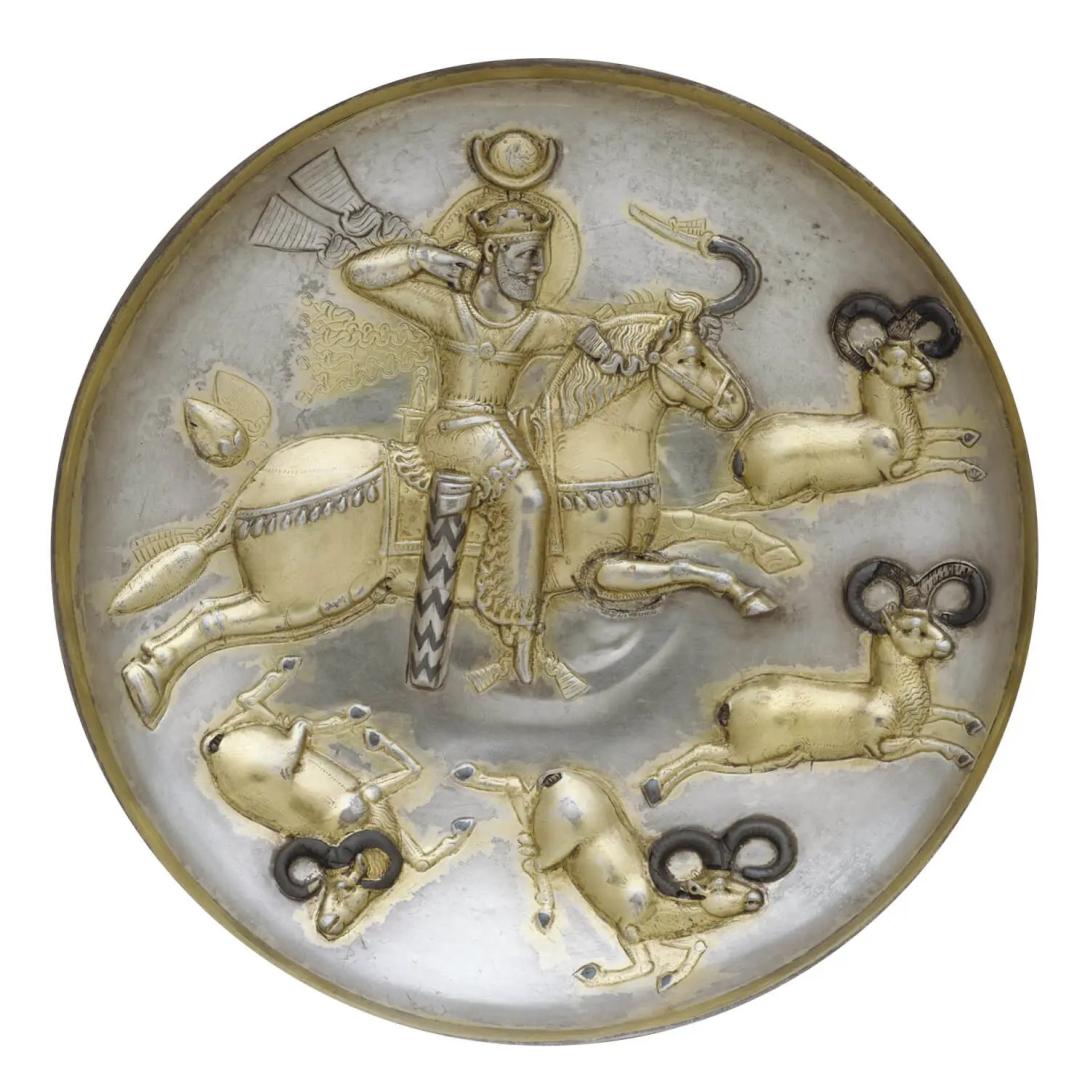
The Ram Hunting Plate is a beautiful artifact from the Sassanid period, housed in the Metropolitan Museum of Art in New York. The plate is beautifully gilded with mercury, silver, and gold, and decorated with black ink, and in a hunting scene that takes us back more than 2,000 years, the Shah of Iran from the Sasanian dynasty, believed to be Bahram V, is majestically and authoritatively hunting rams.
Verethragna (Avestan: 𐬬𐬆𐬭𐬆𐬚𐬭𐬀𐬖𐬥𐬀, Vərəθraγna), later known in Middle Persian as Wahrām or Bahram, is one of the most prominent divine beings in the Zoroastrian tradition and the ancient Iranian pantheon. Revered as the god of victory, triumph, courage, and righteous warfare, Verethragna embodies the divine force that overcomes obstacles, defeats evil, and protects the cosmic order (Asha). His name derives from the Avestan words verethra ("obstacle," "resistance" or "enemy") and the suffix -gna ("to strike" or "to conquer"), meaning "the smasher of resistance" or "the conqueror of obstacles."
In the sacred texts of the Avesta, Verethragna serves as a powerful yazata—a worthy object of worship created by Ahura Mazda—who grants strength, military success, and moral courage to those who uphold truth and righteousness. Rather than representing warfare for conquest alone, Verethragna symbolizes the victory of justice over falsehood, reflecting the central Zoroastrian struggle between the forces of Asha (truth and order) and Druj (deceit and chaos).
One of Verethragna's most distinctive characteristics is his ability to manifest in ten different forms, as described in the Bahram Yasht (Yasht 14). These manifestations include the wind, a powerful bull, a magnificent horse, a camel, a boar, a youthful warrior, a raven, a ram, a wild goat, and an armed heroic man. Each form represents different aspects of strength, endurance, speed, wisdom, or martial prowess, illustrating the many ways divine victory can be achieved.
The cult of Verethragna extended well beyond religious devotion. During the Achaemenid Empire, Parthian Empire, and especially the Sasanian Empire, Bahram became closely associated with kingship, military legitimacy, and imperial authority. Several Sasanian monarchs adopted the name Bahram (including Bahram I through Bahram VII), emphasizing the deity's role as the divine patron of victorious rulers and successful commanders. His image also appeared in Sasanian art, seals, and royal symbolism, reinforcing the connection between righteous rule and divine favor.
Verethragna's influence extended beyond Iran through cultural exchange with neighboring civilizations. Scholars generally identify him with the Armenian god Vahagn, whose myths preserve many of Verethragna's heroic attributes. Elements of his warrior symbolism also influenced religious traditions across Central Asia and the broader Iranian cultural sphere.
Although the spread of Islam gradually reduced the public worship of Verethragna, his legacy remained deeply embedded in Persian culture. The name Bahram continued as a popular personal name and appears frequently in Persian literature, epic poetry, and folklore, most notably in the legendary Sasanian king Bahram V. In modern Zoroastrianism, Verethragna continues to represent the enduring ideals of courage, perseverance, justice, and the ultimate triumph of good over evil, making him one of the most enduring and recognizable figures of ancient Iranian religious tradition.
Page Term Reference
Comments