
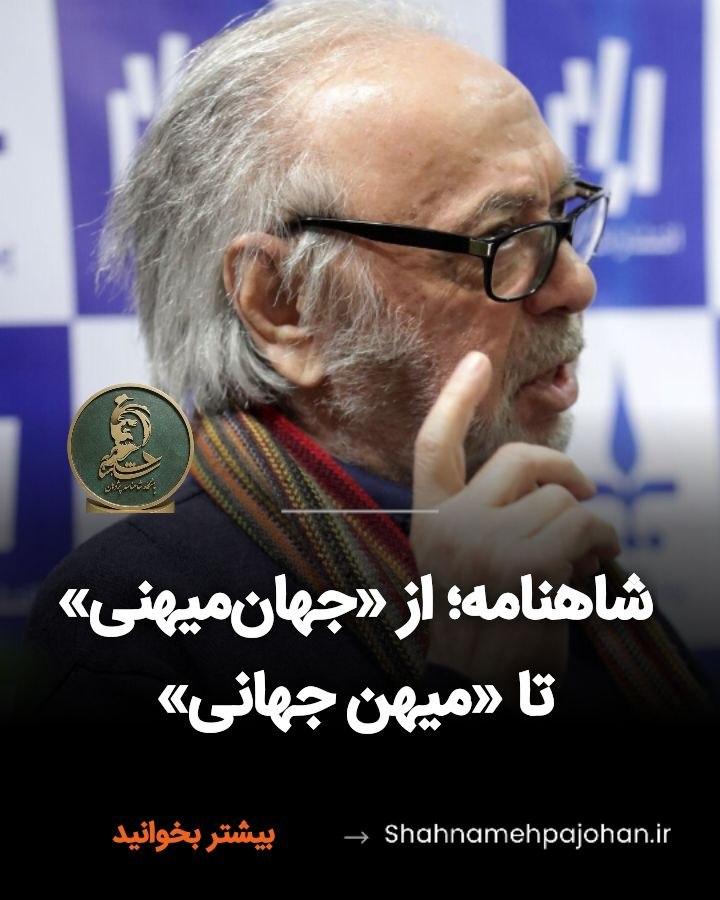
Shahnameh Research Society — Jalal Khaleghi-Motlagh states:
“From the perspective of national significance, the Shahnameh, by promoting the idea of a ‘worldly homeland’ (mihan-e jahani), was able to become a counterweight to the promotion of the idea of ‘homelandlessness of the world’ (jahan-mihani) in mysticism. It has played, and continues to play, an important role in the historical, cultural, and national self-awareness of Iranians.”
At first glance, this statement may appear contradictory, because the words “world” and “homeland” seem to stand beside each other in opposition. However, Khaleghi-Motlagh deliberately uses this conceptual contrast to explain one of the most significant intellectual tensions in Iranian history.
Mysticism, particularly from the sixth century AH onward, tended to emphasise humanity’s membership in a universal spiritual community rather than attachment to national, linguistic, and territorial identities. In this worldview:
- The true homeland is the realm of meaning and spirituality.
- Geographical borders have secondary importance.
- Before being Iranian, Roman, or Arab, a person is a seeker on the path of truth.
- All human beings are members of one universal family.
This is what Khaleghi-Motlagh refers to as “world-homelandism” (jahan-mihani), a perspective that today could be understood as a form of cosmopolitanism. Persian mystical literature contains numerous examples of this universalist outlook.
According to the Shahnameh Research Society, however, Ferdowsi chose a different path. He too speaks of justice, wisdom, morality, and humanity, but he presents these values within a historical and national framework. In the Shahnameh, humanity does not exist without a past. A society does not exist without memory, and a nation cannot endure without a historical narrative.
For this reason, the Shahnameh constantly speaks of Iran — not merely as a political territory, but as a cultural world. In this sense, a “worldly homeland” means that Iran is a world in which human values acquire meaning.
In other words, the Shahnameh does not say:
“Forget your homeland in order to become universal.”
Rather, it says:
“Through understanding one’s homeland, one can reach universal values.”
Why “Worldly Homeland”?
Khaleghi-Motlagh deliberately avoids using the term “nationalism.” Instead, he chooses a more subtle expression because the Shahnameh never promotes hatred towards other nations.
Within the Shahnameh:
- The enemy is not simply someone who is non-Iranian.
- There are virtuous Turanians.
- There are also immoral Iranians.
- The true criteria are justice, wisdom, and righteousness.
Piran Visah, one of the most noble figures in the Shahnameh, is a Turanian. In contrast, Garsivaz is also Turanian but portrayed as corrupt and destructive. Similarly, Shaghad is Iranian, yet he is remembered as a traitor.
Therefore, the Shahnameh does not advocate racial superiority. Instead, it presents Iran as the bearer of a cultural and ethical tradition. Thus, “worldly homeland” means:
A homeland whose values possess the potential to become universal.
One of the most important aspects of Khaleghi-Motlagh’s argument is his emphasis on the Shahnameh’s role in preserving Iran’s historical memory. Following the Arab conquest of Iran, many elements of Iran’s previous identity were at risk of being forgotten.
The Shahnameh reconstructed and preserved this memory.
It preserved names.
It preserved myths.
It preserved narratives.
It preserved the stories of kings and heroes.
Most importantly, it transformed the Persian language into the medium through which this collective memory survived.
From this perspective, the Shahnameh is not merely a book of stories; it is a form of “collective memory.” If a nation is understood as a community that remembers a shared past, then the Shahnameh has been one of the most important instruments for preserving that past.
The importance of Khaleghi-Motlagh’s statement lies in the way he places the Shahnameh in relation to mysticism — but not as a rejection of mysticism. Rather, he argues that throughout Iranian history, if only the voice of mysticism had remained, an important part of Iran’s historical and national memory might have weakened.
The Shahnameh created a balance.
Mysticism calls humanity towards the spiritual world.
The Shahnameh calls humanity towards its historical and social responsibilities towards Iran.
These two perspectives are not necessarily enemies, but they fulfil different cultural functions.
Perhaps the most significant part of Khaleghi-Motlagh’s statement is his final observation:
“The Shahnameh has played an important role in the historical, cultural, and national self-awareness of Iranians.”
Historical self-awareness means that a nation understands:
- Where it came from.
- What experiences shaped it.
- Which values formed its identity.
- What responsibilities it carries towards the future.
The Shahnameh has performed precisely this role. For generations of Iranians, the past was not known only through historical texts, but through Ferdowsi’s narratives. Therefore, the Shahnameh is not merely a literary masterpiece; it is a cultural institution responsible for transmitting memory and identity.
Jalal Khaleghi-Motlagh’s statement should not be interpreted as a simple opposition between “the Shahnameh versus mysticism” or “nationalism versus cosmopolitanism.” His argument is that two major intellectual currents have existed simultaneously throughout Iranian cultural history:
One current emphasised universal humanity and liberation from boundaries of identity.
The other emphasised the preservation of language, history, memory, and homeland as the foundation for the continuity of a civilisation.
The Shahnameh represents the second current — but not through a narrow or supremacist perspective. Rather, it portrays Iran as a cultural and ethical tradition capable of carrying values with universal significance.
Therefore, “worldly homeland” in Khaleghi-Motlagh’s interpretation does not mean the rejection of the wider world. It means seeing the homeland through a universal lens: a homeland whose message, through wisdom, justice, righteousness, and culture, extends beyond geographical borders.
For this reason, more than a thousand years after its creation, the Shahnameh remains one of the central foundations of Iranian historical and cultural self-awareness.
Page Term Reference
Comments