

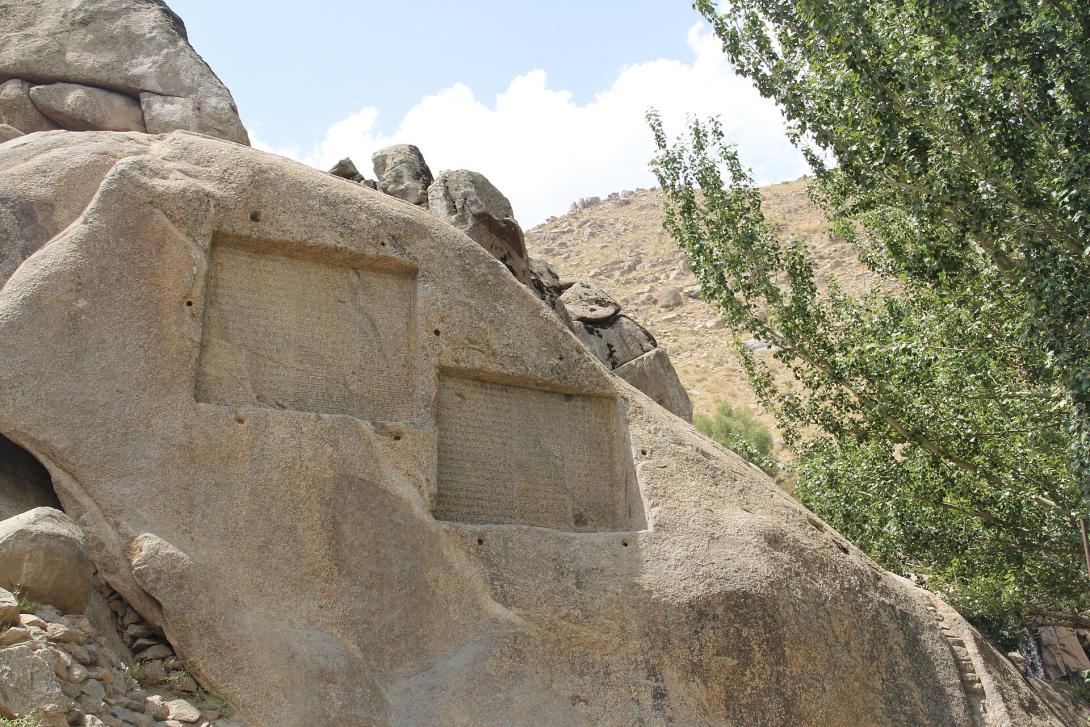
Ganjnameh (Persian: گنجنامه, romanized: Ganjnāme, lit. 'Treasure Book') is located 12 km southwest of Hamadan (ancient Ecbatana) in western Iran, at an altitude of c. 2000 meters across Mount Alvand. The site is home to two trilingual Achaemenid royal inscriptions. The inscription on the upper left was created on the order of Achaemenid King Darius the Great (r. 522–486 BC) and the one on the right by his son King Xerxes the Great (r. 486–465 BC).
Approximately four millennia ago, the Achaemenid Empire emerged as, according to many historians, thinkers, and philosophers of history, one of the earliest examples of professional governance in human civilisation. The Achaemenids established a model of statecraft based on organised administration, institutional structures, legal frameworks, and a system of governance capable of managing one of the largest and most culturally diverse political entities of the ancient world.
Unfortunately, thousands of years later, following the collapse of this civilisation and the loss of its position as a global governing power, Iran experienced centuries of gradual decline, weakened by periods of ineffective and incapable governance. During this historical process, certain political narratives, benefiting from the consequences of this decline, placed increasing emphasis on the Constitutional movement and presented it as the central turning point in the struggle for rights and political progress.
As a result, a historical contradiction emerged: a civilisation that had once developed systems of administration, law, and governance on a global scale eventually reached a position in which its people, after four thousand years of political history, were required to struggle once again for the defence of fundamental and basic rights. Rights and principles that, within the Achaemenid system of governance, were not only recognised through administrative practices but were also incorporated into a broader framework of imperial law and political organisation.
The scale of governance, cultural diversity, and pluralistic administration that characterised the Achaemenid era has, in this interpretation, been significantly reduced within certain modern historical narratives. The emphasis placed exclusively on constitutional developments has sometimes overshadowed the much broader dimensions of governance, limiting the understanding of statecraft to a narrower framework while diminishing the historical significance of a pluralistic governing model that once extended across a vast empire.
This article examines the contrast between the comprehensive vision of governance developed during the Achaemenid period and the later transformation of political thought, exploring how a civilisation with one of history’s most extensive administrative traditions came to define its modern political struggles through a much smaller framework of constitutional discourse rather than through the broader principles of institutional capacity, pluralism, and professional statecraft.
The history of governance is not merely a chronology of rulers and wars; it is also a history of political imagination. Every civilisation develops a particular understanding of authority, law, administration, and the relationship between the state and its subjects. Among the ancient empires, the Achaemenid Empire occupies a distinctive place in the scholarship of many historians and political philosophers because of its remarkably sophisticated administrative structure, legal organisation, and bureaucratic governance. Rather than relying solely upon military conquest, the empire developed an extensive institutional framework capable of administering diverse peoples across three continents while accommodating numerous languages, cultures, religions, and local traditions.
Many scholars have argued that the Achaemenid model represented one of antiquity's earliest large-scale examples of professional governance. Through an organised civil bureaucracy, provincial administration under the satrapal system, standardised taxation, regulated coinage, imperial road networks, and a comparatively pragmatic approach to cultural autonomy, the empire demonstrated that political stability could be achieved through administration as much as through force. In this sense, governance became an institutional discipline rather than merely an extension of royal authority.
The significance of this historical achievement extends beyond Persian history. The Achaemenid experience illustrates that effective government is fundamentally about constructing durable institutions capable of balancing diversity, maintaining legal order, and facilitating economic prosperity. Their imperial administration influenced subsequent empires, while aspects of their bureaucratic practices were echoed in later administrative traditions throughout the Near East and beyond.
From this perspective, the modern political discourse surrounding constitutionalism presents an interesting paradox. Constitutional government undoubtedly represents an important development in limiting arbitrary authority and defining the legal relationship between state and citizen. Nevertheless, constitutionalism is frequently treated as the ultimate destination of political evolution rather than one constitutional instrument among many within the broader science of governance.
This reduction becomes particularly problematic when constitutional debates overshadow the larger questions of statecraft. A nation cannot be sustained solely through constitutional texts if it lacks competent administration, professional institutions, coherent legal systems, strategic planning, and an inclusive political philosophy. Good governance requires far more than constitutional limitations; it demands an integrated framework capable of administering society effectively across generations.
Critics argue that, over many centuries following the decline of the Achaemenid Empire, successive periods of political instability, foreign invasions, internal fragmentation, and ineffective governments gradually weakened Iran's institutional memory. As a consequence, public understanding of governance increasingly shifted from comprehensive statecraft towards narrower political objectives. Within this interpretation, the Constitutional Revolution of the early twentieth century—while historically significant in its efforts to establish the rule of law and representative institutions—came to dominate political discourse to such an extent that earlier traditions of large-scale administrative governance became comparatively neglected.
According to this viewpoint, constitutionalism gradually transformed from a legal mechanism into an ideological endpoint. Political discussion increasingly centred upon securing basic civil and political rights, whereas the broader questions of how a civilisation constructs durable institutions, manages cultural plurality, organises bureaucracy, develops economic systems, and exercises strategic governance over vast territories received considerably less attention.
This contrast is striking. The Achaemenid Empire administered one of the largest and most culturally diverse political entities of the ancient world. Its governing philosophy was not predicated upon uniformity but upon administrative pluralism, recognising the practical necessity of accommodating different peoples under a common legal and political framework. Such an approach reflects a scale of governance that transcends the relatively narrow constitutional disputes characteristic of many modern political movements.
Consequently, some contemporary thinkers contend that modern political discourse has unintentionally diminished humanity's conception of governance itself. Instead of aspiring to build sophisticated administrative civilisations capable of managing diversity on a continental scale, political debates often revolve around securing rights that, while unquestionably essential, represent only one component of successful government. Fundamental liberties are indispensable, yet they constitute the foundation of governance rather than its culmination.
The legacy of the Achaemenid Empire therefore invites a broader reflection. Its greatest contribution may not simply lie in territorial expansion or military achievement but in demonstrating that government can function as a complex institutional system grounded in law, bureaucracy, cultural accommodation, and administrative competence. This legacy encourages modern societies to reconsider whether political development should be measured solely by constitutional milestones or by the overall capacity of states to govern justly, efficiently, and inclusively.
Ultimately, revisiting ancient models of governance should not be understood as an exercise in nostalgia. Rather, it offers an opportunity to recover a wider political imagination—one in which constitutional rights, professional administration, institutional continuity, legal order, and cultural pluralism are viewed as complementary pillars of statecraft rather than competing ideals. A mature political civilisation should aspire not merely to protect the fundamental rights of its citizens but also to cultivate the institutional excellence required to sustain those rights across centuries. In that broader vision, the history of the Achaemenid Empire remains an enduring subject for reflection and scholarly debate.
Page Term Reference
Comments