
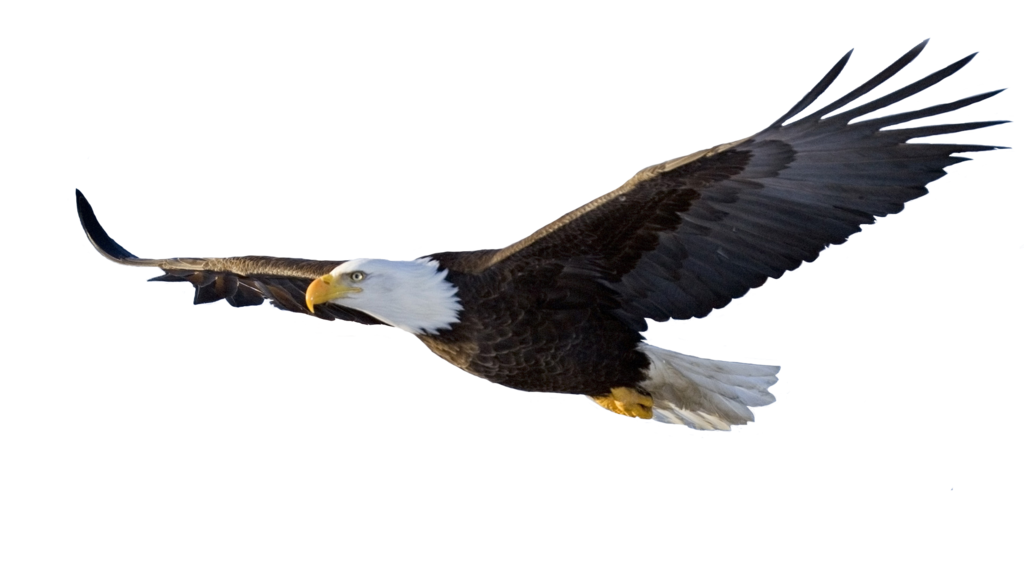
Zāl and the Simorgh are among the most celebrated figures in Persian mythology, most famously portrayed in the Shahnameh by Hakim Ferdowsi. Born with white hair, Zāl was abandoned by his father, who believed the child's unusual appearance was an ill omen. He was rescued and lovingly raised by the wise and benevolent Simorgh, a majestic mythical bird that lived atop Mount Alborz. Under the Simorgh's care, Zāl grew into a noble, courageous, and wise man. When his father eventually sought forgiveness, the Simorgh returned Zāl to his family but gave him one of her magical feathers, instructing him to burn it whenever he needed her help. The feather later proved invaluable when the Simorgh guided the successful birth of Zāl's son, Rostam, the greatest hero of Persian epic tradition. The story of Zāl and the Simorgh symbolizes wisdom, compassion, divine guidance, and the triumph of inner virtue over superficial judgment.
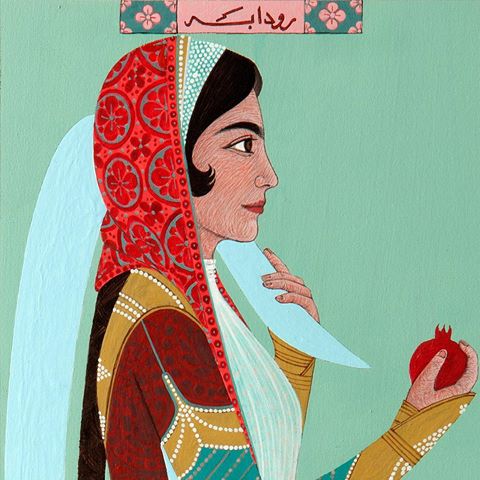 |
Rudabeh is one of the central female figures in the Shahnameh. Her life, as the wife and mother of two key and influential figures in the Shahnameh, namely Zal and Rostam, can be divided into four principal stages: (1) before and after her marriage to Zal; (2) the birth of Rostam; (3) Rudabeh’s life as the mother of the unrivalled champion of the Shahnameh; and (4) the period following the death of her son.
On this basis, at each of these stages we encounter a different mode of conduct appropriate to Rudabeh’s position and circumstances, together with a certain dynamism and transformation in her character in comparison with the preceding stage. In the first stage, she is an obedient young woman, conforming to the social and familial norms surrounding her. In the next stage, however, driven by the force of emotion and affection, she breaks through these social restrictions. In the subsequent stages of her life, her behaviour returns to a more conventional state, in accordance with what is expected of her. Following the death of her son, however, she once again experiences a form of inner tension and shock, and ultimately overcomes this crisis as well.
The following sections examine each of these stages in Rudabeh’s life.
Before and After Her Marriage to Zal
From Ferdowsi’s perspective, Rudabeh is described from the very first references to her as an exceptionally beautiful girl, to such an extent that Zal falls in love with her without having seen her, while her father, upon seeing her beauty, invokes the name of God so that his daughter may be protected from the evil eye:
He was left astonished at Rudabeh,
And repeatedly invoked the name of God over her.
(Book One, The Reign of Manuchehr, 186:330)
Beyond her striking physical beauty, Rudabeh is one of those young women whose character displays a remarkable, indescribable and at times admirable fearlessness and boldness. She is a girl possessed of passionate and inexpressible emotions who falls in love with Zal solely through a description of him. In pursuing her objective, she is dynamic, determined, self-confident, industrious, courageous, unconventional, resistant to tradition and resolute. Although, on the one hand, she is constrained and confined by a traditional society with its own cultural beliefs and restrictions, and, on the other, her father—because of his adherence to social traditions and the political restrictions governing relations with the Iranian court—constitutes a major obstacle in her path, she nevertheless does not abandon her efforts or surrender.
Rudabeh is not a passive or timid girl who, because of inner weakness or the environmental and cultural obstacles before her, is unable to support and protect her deepest desires. With complete self-confidence, she disregards the obstacles in her way and, while independently and self-sufficiently pursuing her objective, makes use, without any rebelliousness, insolence or weakness of character, of external and environmental agents, including her mother and her handmaids. Indeed, it is precisely the support of her handmaids at the first stage and her mother at the next that proves instrumental in advancing her objective. In reality, Rudabeh can be said to pursue her aim through a completely calm and calculated plan, seeking assistance from others along the way rather than acting stubbornly or thoughtlessly.
Rudabeh’s boldness and audacity are evident not only in revealing her secret to her attendants and asking them to help arrange a meeting with Zal, but also in the nature of her relationship with him. She is a young woman who, with complete boldness, spends a night with her beloved kissing and embracing him, without losing her self-restraint and, consequently, her chastity. In this respect, like other love stories in the Shahnameh, the tale recounts a relatively free relationship between a young woman and a young man, but within its necessary limits. Ferdowsi explicitly emphasises that there was no sexual intercourse between Zal and Rudabeh; their encounter consisted of kissing, embracing and drinking wine:
All was kissing, embracing and wine,
Except for the lion that tears apart the wild ass.
(Book One, The Reign of Manuchehr, 200:540)
Viewed broadly, and with careful attention to Rudabeh’s conduct and actions throughout this episode, it can be said that she proceeds with complete patience, deliberation and wisdom. Despite the immense intensity and fervour of the love within her, unlike Zal, she does not undertake much direct practical action to advance her objective or persuade her father. Instead, through a completely calm and calculated plan, she pursues her aim, seeking the assistance of both her handmaids and her mother and refraining from acting impulsively or stubbornly. This may be interpreted in terms of several factors. Rudabeh lives in a society governed by its own particular rules and norms. Moreover, she and Zal differ in lineage and ethnicity, religion and creed, and social and environmental outlooks. Political obstacles are also the most important factor. Rudabeh therefore prefers to meet her beloved secretly and exercise patience, allowing her mother to use her wisdom to steer circumstances in Rudabeh’s favour.
Nevertheless, her reactions when dealing directly with Zal are different, and considerably greater boldness can be observed in them. At the beginning of the story, it is Rudabeh who, through a particular stratagem, sends her attendants to Zal and establishes the first contact. Following Sam’s agreement, it is also she who first sends the engagement ring to the young man.
The Birth of Rostam
Rudabeh’s most important role in the Shahnameh is the birth of Rostam. Her responsibility in this respect is so sensitive, important, difficult and extraordinary¹ that it places her in the unique position of being the only female character in the Shahnameh deemed worthy of the assistance and favour of the Simurgh. The pains and difficulties preceding childbirth, the cutting open of her side, and ultimately the birth of Rostam can be regarded as the turning point and culmination of Rudabeh’s life. The world of myth and epic awaits her child, and it is after this point that Rudabeh’s character is largely relegated to the margins and acquires meaning primarily in relation to the name of her son.
Rudabeh’s Life as the Mother of the Unrivalled Champion of the Shahnameh
Rudabeh’s role changes after she becomes a mother. Like the other mothers in the Shahnameh, she is increasingly represented and gains significance through the actions of her child. Although she is the mother of a world champion, like the other mothers her role becomes primarily confined to maternal compassion, affection and concern, and we observe little that is particularly distinctive or active on her part during this period.
Following Rostam’s birth, we encounter her in only a few scenes, and even then very briefly. One such instance occurs when Rostam sets out to rescue Kay Kavus and his mother weeps as she bids him farewell:²
Rudabeh came, her face filled with tears,
And mournfully wept over her son.
(Book Two, The Reign of Kay Kavus, 20:271)
Likewise, during Rostam’s battle with Esfandiyar, Rudabeh, overcome with anxiety, tears at her hair and scratches her face:
Rudabeh tears the hair from her head,
And, hearing their voices, wounds her face.
(Book Five, The Reign of Goshtasp, 394:1210)
After the Death of Rostam
At this stage, Rudabeh is a woman of tender heart, with the intense emotional sensitivities and attachment to her child that are characteristic of mothers generally. Following Rostam’s death, we see Rudabeh as a woman who has nothing left to lose: all her hopes, aspirations, efforts and the fruits of her life have been destroyed. The death of her son places her under such severe psychological pressure that she criticises and reproaches her husband Zal for his conduct and reactions in response to their son’s death. Yet because she does not receive an answer that she finds convincing, and consequently cannot overcome the crisis on her own, she experiences a temporary form of madness.
Following Rostam’s death, Rudabeh, in profound agitation, reproaches Zal for failing to lament and cry out in grief for their son. Zal replies that the sorrow of hunger is greater than the sorrow of losing one’s loved ones:
Zal said to her: “You foolish woman,
The grief of going without food will overcome this!”³
(Book Five, The Reign of Goshtasp, 464:305)
Rudabeh is deeply disturbed by her husband’s words and swears that she will abstain from sleep and food in order to prove to him the falsity of Zal’s words and reasoning:
For a week she abstained from eating,
For in her heart she was bound to Rostam’s life.
(Ibid., 308)
The consequences of this hunger strike are the loss of sight, physical weakness and emaciation, severe depression, and temporary madness:
From not eating, her eyes grew dark,
Her heroic body became thin;
By the end of the week, her reason departed,
And her mourning became a celebration of madness.
(Ibid., 309–310)
Hunger and the madness resulting from it place such pressure upon Rudabeh that, in the middle of the night, she goes to the kitchen, takes a dead snake that had fallen into the water in the kitchen—apparently a small basin or pool such as might have existed in the kitchens of old houses—and attempts to put it into her mouth. Her handmaid prevents her from doing so, takes her to the veranda, and gives her food, allowing her madness gradually to subside.
According to Thaʿalibi, after Rudabeh’s madness has passed, she acknowledges: “By God, Zal was right in saying that hunger is the most severe [of sufferings].” (Thaʿalibi, 1989:239) Ferdowsi likewise narrates the scene as follows:
When her reason returned, she said to Zal:
“Your words were joined with wisdom.
Whoever has neither food nor sleep,
Finds grief and death no different from celebration and festivity.”
(Book Five, The Reign of Goshtasp, 465:320–321)
In any event, this part of the narrative contains moral implications that Jalal Khaleghi-Motlagh explains as follows: “The story of Rudabeh’s becoming mad was created to convey the idea that, since sooner or later we shall all die, we should not grieve excessively over the death of our loved ones, but rather be content with God’s decree. At the end of the story of Rostam and Sohrab, it is likewise said: ‘Do not become attached to the dead!’” (Khaleghi-Motlagh, Notes on the Shahnameh, 2012, Vol. II:340)
Notes
1. The motif of difficult or extraordinary childbirth is found not only in Iranian mythology, the most prominent and famous example being the birth of Rostam, but also in the mythologies of other cultures. Heracles (Hercules), Arthur, Bahram and Indra are among those said to have been born through difficult childbirth from their mothers’ sides. The two goddesses Athena and Minerva, goddesses of war and wisdom in ancient Greece and Rome respectively, were likewise born through extraordinary childbirth, emerging from their mothers’ temples. (Allami-Khojasteh, 2016:416)
2. It should be noted that, according to the interpolated passage, Rudabeh also sheds many tears and laments and cries out when Sohrab’s coffin is brought before her and she bids him farewell:
When Rudabeh saw Sohrab’s coffin,
She saw two eyes like two streams of blood;
She began to mourn in anguish,
And drew a cold breath from the depths of her heart...
(Book Two, The Reign of Kay Kavus, 197: footnote)
3. According to Thaʿalibi, this occurs in the form of a question posed by Rudabeh: “When Rudabeh, Rostam’s mother, had reached the utmost degree of lamentation and mourning, she asked Zal: Is there any calamity in the world more severe and painful than that which has befallen us? He replied: Yes—hunger!” (Thaʿalibi, 1989:238)
References
- Ferdowsi, Hakim Abol-Qasem. (2007), Shahnameh, edited by Jalal Khaleghi-Motlagh, Vols. I, II and V, Tehran: Centre for the Great IRANIAN Encyclopaedia.
- Khaleghi-Motlagh, Jalal. (2012), Notes on the Shahnameh, Vol. II, 2nd ed., Tehran: Centre for the Great IRANIAN Encyclopaedia.
- Thaʿalibi Nishapuri, Abd al-Malik ibn Muhammad ibn Ismaʿil. (1989), History of Thaʿalibi, with a preface by Mojtaba Minovi and an introduction and translation by Mohammad Fazaeli, Tehran: Nashr-e Noqreh.
- Allami, Zolfaqar; Khojasteh, Elnaz. (2016), “A Study of the Motif of ‘Difficult and Extraordinary Births’ in Mythology”, Woman in Culture and Art, Vol. 8, No. 3, pp. 411–416
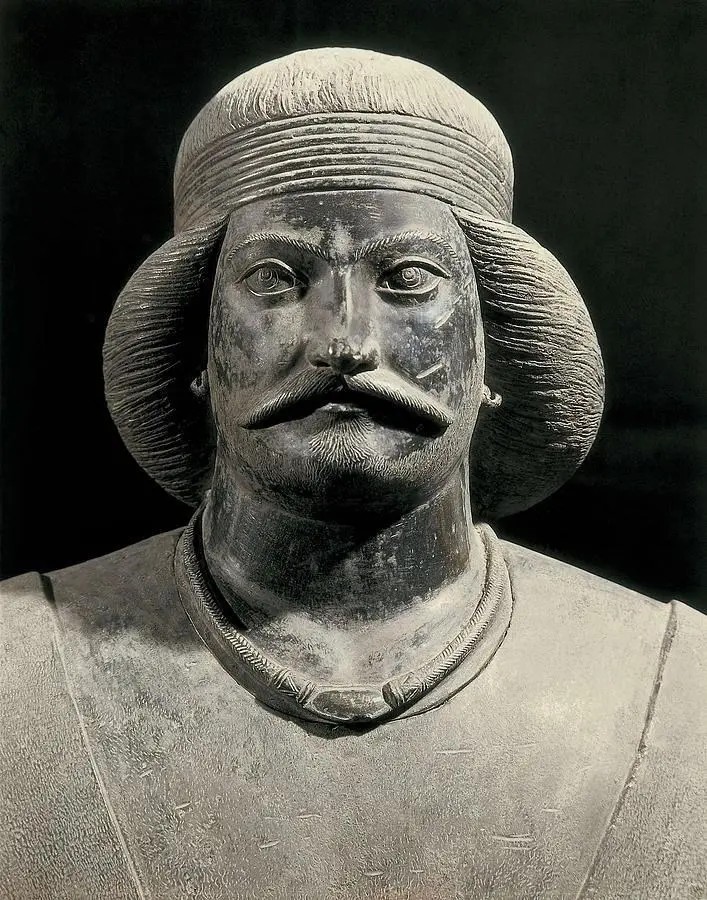
The following golden earring with pomegranate-shaped pendants is one of the prominent examples of jewelry from the Parthian dynasty in the Iranian Empire, which dates back more than two thousand years. This work reflects the high skill of ancient Iranian goldsmiths and the special place of jewelry in the culture and social life of that period. The elegance of execution and attention to detail make it an outstanding example of the art of metalwork of the Parthian period.
The structure of the earring consists of a latticed and cage-like central part from which seven pomegranate-shaped pendants are hung. Techniques such as precise hammering, delicate graining and calculated connections were used in the manufacture of this work. The pendants are designed in such a way that they create a dynamic effect with movement and well demonstrate the harmony between form and function.
In ancient Iranian culture, pomegranates symbolized fertility, birth and abundance, and the number seven also had a symbolic meaning. The use of these elements together shows that Parthian jewelry, beyond its decorative aspect, carries cultural and symbolic concepts and reflects the beliefs and aesthetic system of the society of that time. This historical artifact is currently kept in the collection of The Metropolitan Museum of Art in New York.
 |
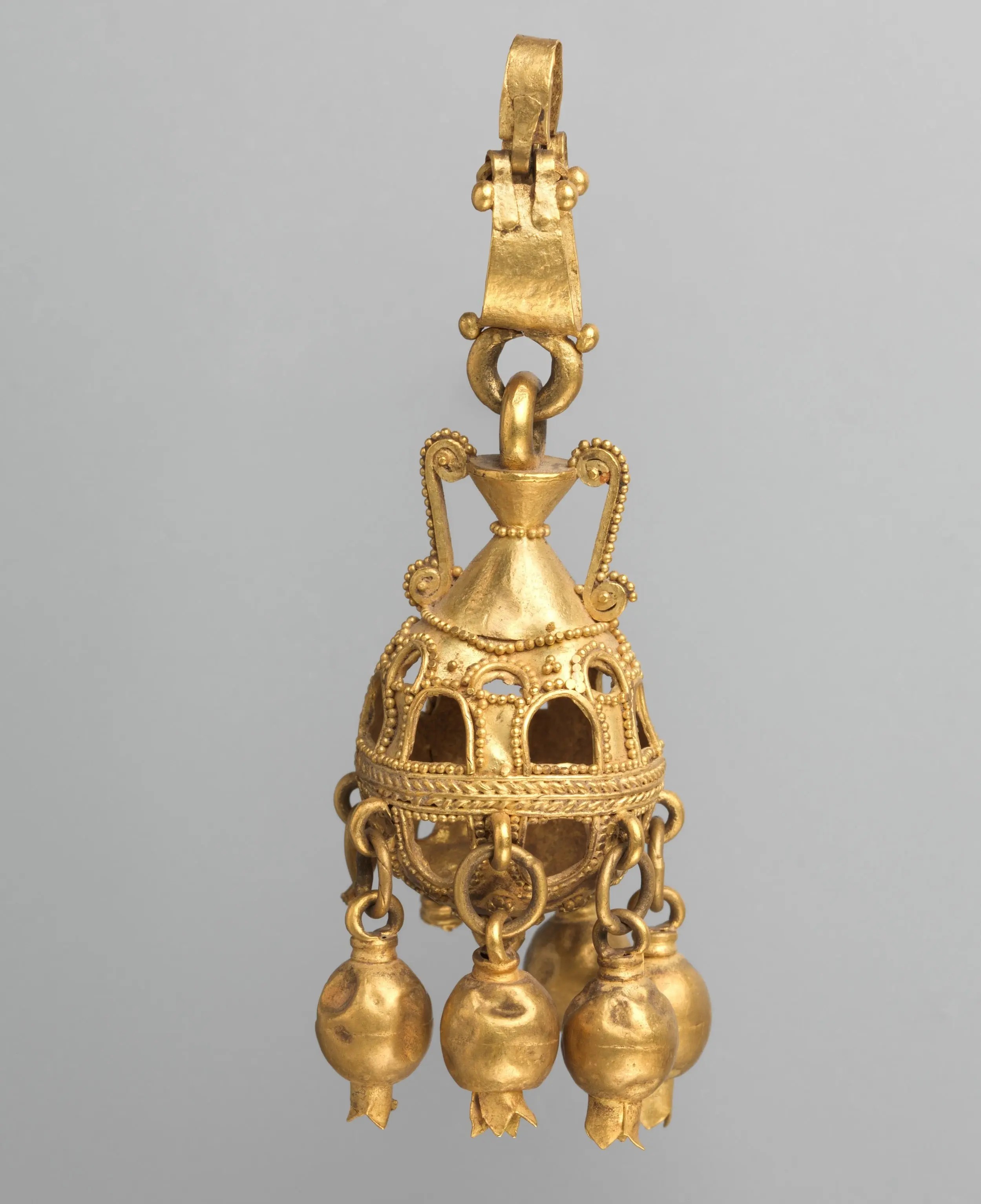 |
The Statue of the Ashakani Nobleman is one of the masterpieces of art from the imperial period of the Parthian dynasty, which displays a manifestation of the glory and cultural identity of Iran at that time. The external features of this statue, such as the wide mustache, curly hair, and special clothing, reflect the lifestyle and social status of the Parthian nobles and nobles. Parthian art was known for emphasizing individuality and personality in the faces, and this statue is a prominent example of this artistic tradition. The attention to detail in the face, the decorative necklace, and the powerful gaze indicate the high status of the depicted character.
As a cultural symbol, this statue demonstrates the profound influence of Parthian art on later generations and even the art of the Sassanid period. Statues from this period were usually designed to reflect the dignity, power, and national identity of Parthian Iran. Historically, the Parthians are known for their resistance to Rome and the creation of one of the greatest empires in Iran. This work not only represents the art of that era, but also a document of the national and cultural identity of ancient Iran that has always been inspiring throughout history.