
A Different Portrayal of Rostam’s Beloved
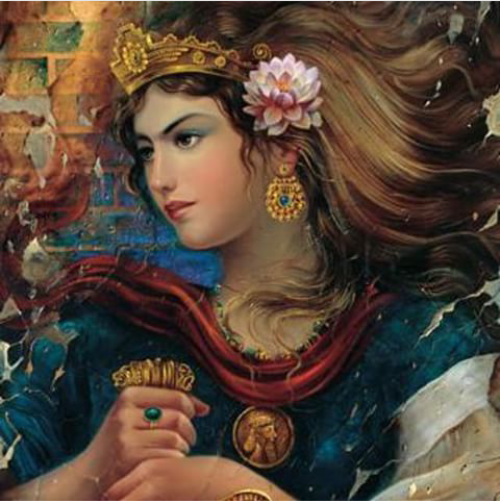
Tahmineh, the only daughter of the King of Samangan, Rostam’s wife and Sohrab’s mother, is a beautiful, chaste, courteous and humble woman: loyal, independent, perceptive and wise, highly knowledgeable, passionate and spirited, courageous, calculating, forthright and determined in pursuing her goals, and committed to her decisions. Through her brief yet distinctive presence, she brings about the most tragic story in the Shahnameh.
A Different Description of Tahmineh
The first reference in the description of Tahmineh concerns her physical beauty. She is a moon-faced beauty who, like other women in the Shahnameh, possesses all the elements of beauty within herself; the difference, however, is that Ferdowsi points to more numerous and more distinctive characteristics in this particular figure.
The phrase, “A soul of wisdom and a body of pure spirit, as though she were not of the number of humankind,” presents this woman in a distinctive and otherworldly manner compared with the other women, reinforcing her fairy-like nature¹ and leaving the audience with no sense that she possesses any deficiency or shortcoming in comparison with Rostam. Indeed, Rostam himself is astonished when he sees her and invokes the name of God:
Her soul was wisdom, her body pure spirit,
You would say she had no share of earthly dust.Brave-hearted Rostam stood amazed before her,
And upon her he called the Creator of the world.
(Part One, The Reign of Kay Kāvus, 263: 60–61)
Indeed, it may be said that Tahmineh’s passionate, spirited and audacious descriptions of herself and her feelings, together with her emphasis on her status and noble lineage, her beauty and unmatched nature, her uniqueness and her chastity, are all intended to remind Rostam that, if she has taken the initiative, she is in no way inferior to the beloved of the world-champion hero.
I am the daughter of the King of Samangan,
I am the envy of the lion of Bilikān!²In all the world I have no equal among the beautiful;
Beneath this lofty sky there are few like me.No one has ever seen me outside the curtain,
Nor has anyone ever heard my voice!
(Ibid.: 64–66)
Tahmineh’s praise for her own wisdom, awareness and knowledge is likewise among the poet’s references to the qualities of this daughter who takes the initiative in love. It demonstrates that her decision to suppress her rational reservations and come forward is not evidence of foolishness or frivolity:
When Rostam saw that fairy-faced beauty,
He found in her a share of every branch of knowledge.
(Ibid., 81)
A Bold Request for a One-Night Union
The principal spark that sets the story in motion is the girl’s love, awakened through what she has heard of Rostam, followed by her unexpected entrance, accompanied by a female attendant, into the chamber where her father’s guest is sleeping. She does so without hesitation and without resorting to feminine tricks or stratagems.³ Three reasons can be discerned behind this bold nocturnal action: she has fallen in love; she desires to have a son from the hero’s seed; and she promises Rostam that she will find his lost horse.⁴
The criteria Tahmineh articulates in support of her determined request, regardless of her social and familial position, reveal the importance she attaches to qualities such as bravery, courage, daring, heroism and the fame arising from these attributes—all of which are embodied in Rostam. Tahmineh knows how to awaken a man’s sense of pride and masculinity. Her praise of her beloved’s renown, his courage, his appetite as a consequence of his physical strength, his prowess in battle and his heroic majesty are all instruments she employs to advance her objective. This is precisely the point that is also emphasised from a psychological perspective in discussions of the nature and manner of interaction between women and men.
On the other hand, Tahmineh’s infatuation with Rostam is itself a form of attraction towards his power, heroism and fame, with the intention of passing these qualities on to a child born of her beloved. The desire to have a child from a warrior or hero can also be found in the prayers of maidens in the tenth Karda of the Rām Yašt of the Avesta:
“Grant us this success: that we may find strong and youthful husbands who will treat us well throughout all the days of our lives, and that wise, perceptive and eloquent children may be born to us. The mighty Andarvāy granted this success to them, and those maidens attained their desire.”
(Avesta, 2006, vol. 1: 454)
Thus, Tahmineh’s desire to enter into a sexual relationship with Rostam is motivated by her wish to obtain a strong son like himself. One interpretation holds that her sexual desire for Rostam is motivated solely by her desire to experience motherhood through a child possessing particular heroic characteristics. In other words:
“Rostam is merely the means by which a son is brought into the world, even if it may not appear so. She loves Rostam because she sees in him qualities that she wishes to see reflected in her son. She does not think so much of having a husband like Rostam as she does of the son she desires. When Rostam leaves her to pursue his adventures and his deeds, she neither sheds a tear nor says a word.”⁵
(Khāleqi Motlagh, 2019: 68–69)
Tahmineh’s response to her son, when he later asks his curious question, also clearly demonstrates that she had been waiting precisely for such a day. She expresses her joy and pride:
For your head is higher than the heavens,
For your seed comes from this noble and renowned lineage.
(Ibid., 265: 110)
The reason for such a choice is likewise connected with joining herself to a superior and more powerful lineage and, fundamentally, obtaining the seed of the renowned hero of the enemy tribe. The underlying purpose is that a hero can only be overcome by someone equal to him in strength—and that person is none other than a child born of the hero himself. Yet the son of a hero cannot be deceived and turned against his father unless he has been raised from childhood in the care of a sorceress. This, in turn, is possible only if the hero has once shared a bed with such a woman. Therefore, if the hero’s horse can be stolen, he can be compelled to sleep with the sorceress. (Khāleqi Motlagh, 2019: 74)
Leaving aside Tahmineh’s primary role as a sorceress/fairy woman in Iranian legends, from a human and psychological perspective it may also be considered that, at the outset, Tahmineh fell in love with Rostam himself, but also understood that her beloved had aims and ideals extending beyond such matters. He was a hero who spent all his time engaged in battles. Rostam was not bound by wife or child, and perhaps for this reason Ferdowsi names no other wife for him apart from Tahmineh, with the exception of the mother of Farāmarz, whose identity is unspecified.⁶
Thus, since Tahmineh cannot possess her beloved forever, she contents herself with having a child by him. The fact that no scene depicting Tahmineh’s reaction or farewell to her beloved is presented also suggests this woman’s conscious silence in the face of an event—Rostam’s departure—that she had anticipated beforehand.
Such desires and emotions arise in women when they realise that they cannot always and completely have the man they love beside them. Consequently, they resign themselves to the presence of a child from their beloved, so that they may pour all their affection into the sole reminder of him. Tahmineh’s reference to preserving her chastity until her union with Rostam, together with her emphasis that she will remain faithful to her beloved for the rest of her life, is another point that may be considered in this context:
I am yours now, should you desire me;
None but this bird and fish shall ever see me!
(Part One, The Reign of Kay Kāvus, 264: 76)
It is also worth noting that the reference to “a letter,” “three shining rubies” and “three golden beads,” which Rostam sent from Iran to Tahmineh on the occasion of Sohrab’s birth, indicates that the two remained connected to one another. Nevertheless, given the evidence of the story and the emphasis placed on the father’s lack of knowledge concerning his son’s age, it is quite clear that this limited relationship was confined to that particular period.
Tahmineh’s Role After Her Separation from Rostam
Tahmineh’s first role after completing her pregnancy and giving birth to her child is to choose a name for him. The tradition of mothers choosing names for their children can also be observed in the case of several other children in the Shahnameh.⁷
Even after raising and nurturing her son, when the ten-year-old Sohrab speaks to his mother insolently and in a threatening tone, asking about the contradictions and discrepancies between himself and his peers and about his ancestry,⁸ she patiently encourages him towards happiness, tranquillity and, ultimately, a remarkable pride in his distinguished lineage:
His mother said to him: “Listen to my words;
Be joyful in this, and do not be impetuous.You are the son of the mighty, elephant-bodied Rostam,
Of Zāl the son of Sām, and of Narimān.”
(Ibid., 265: 108–109)
Tahmineh’s awareness and understanding of the political relationships of the time are further noteworthy in her warning to her son concerning Afrāsiyāb, who likewise views Sohrab as the only person capable of eliminating Rostam:
She said to him: “Afrāsiyāb must not learn
Of this matter, from beginning to end.”
(Ibid.: 115)
Tahmineh’s emotional and maternal attachment is reflected in her fear that father and son might discover one another and form an alliance—an alliance that would lead to war and consequently deprive her of her only source of support. This is expressed in the following two couplets:
If your father now learns of this,
You will have become renowned among the mighty.When he learns of you, he will summon you to his side;
Your mother’s heart will be torn apart with grief.
(Ibid.: 116–117)
It should be noted that Tahmineh’s role in the original verses of the Shahnameh comes to an end after her final conversation with Sohrab and his departure. However, this ending appears not to have satisfied some copyists. Consequently, in an attempt to give Tahmineh a more prominent role, resolve the many ambiguities surrounding her character and portray her suffering more extensively, they added material without regard to the original narrative context.
Among these additions are:
- A deeply emotional farewell between Tahmineh and Rostam, intended to highlight the woman’s love and longing more strongly.
- Tahmineh’s instruction to a shepherd to select a horse for Sohrab, which on the one hand demonstrates the mother’s emotional support despite her inner distress, while on the other reveals the firmness of her character.
- A grief-filled mourning scene following Tahmineh’s receipt of the news of Sohrab’s death, bringing the sorrowful and tragic atmosphere of the story to its emotional climax through this part of the narrative.
Notes
1. Tahmineh’s original nature is demonic and fairy-like; she is charged with deceiving and ultimately destroying the hero. Tahmineh’s Turanian origin, her promise to find Rostam’s Rakhsh, and her desire to have a son like him lend strength to this hypothesis. For further information, see Jalal Khāleqi Motlagh, Women of the Shahnameh, p. 8, and the article “Yeki Dāstān Ast Por Āb-e Cheshm” (“It Is a Tale Full of Tears”), by Jalal Khāleqi Motlagh, included in Gol-ranj-hā-ye Kohan, pp. 55–104.
2. In Mehri Behfar’s edition, the second hemistich of this verse is reported as: “I am the physician of Hojabr Bilikān,” and Hojabr Bilikān (the king of the land of Bilikān) is understood to be the same person as the King of Samangan. (Shahnameh of Ferdowsi, 2015: 46–52). In light of this reading, the emotional relationship between Tahmineh and her father, and the effect that this intimacy had on the daughter, her self-confidence and her audacious conduct, are particularly noteworthy.
3. The description of Tahmineh’s boldness in expressing her desire, apart from her fairy-like nature—which requires her to make the utmost use of the opportunity that has arisen during a single night—also emphasises, from the human and social perspective, the idea of women’s freedom to express their love and choose their husbands.
4. According to the Shahnameh, Turanian horsemen are the principal abductors of Rostam’s horse. However, since both the King of Samangan and Tahmineh promise Rostam that they will find Rakhsh, it may be inferred that the core of the original Iranian legend was that a Turanian woman stole Rostam’s horse and, after satisfying her desire with him, returned his horse. (Khāleqi Motlagh, 2019: 68)
5. The original text of the Shahnameh contains no account of Tahmineh’s tears or feminine longing at the time of her farewell to Rostam. According to the interpolated verses, however, an embrace, weeping and lamentation are depicted in this encounter. In reality, the copyist who composed these interpolated verses, finding the scene devoid of the emotional agitation considered characteristic of women on such occasions, sought through these additions to give the story a more emotional and romantic dimension.
6. In the Tarikh-e Gozideh, it is stated that Rostam sees Tahmineh again and that Farāmarz is born: “Sohrab was killed by Rostam. His mother came seeking vengeance for her son. Rostam consoled her, and Farāmarz was born from her.” (Mostowfi, 1985: 88). In the Farāmarznama, however, it is stated that “Rostam goes to India in his youth… at the end of this story Rostam marries the daughter of the King of India, and Farāmarz is born.” (Nahvi, 2002: 123). In addition, Hamdallah Mustawfi, in the Tarikh-e Gozideh, mentions another woman besides Tahmineh as Rostam’s wife: because of Rostam’s bravery in the wars of Māzandarān and Hamāvarān, Kay Kāvus gives his own sister to Rostam: “In recompense, he gave his sister Mehrnāz to Rostam as a wife.” (Mostowfi, 1985: 87).
7. Farangis, Alexander, Roxana, and Goshtasp (the choice of the name Bastam) are among the figures whose mothers chose their names.
8. An example of a child behaving insolently in seeking knowledge of his identity can also be found in the case of Darab. When he receives no convincing answer from his guardian, the miller Gāzar, to his questions, he becomes angry with Gāzar’s wife in her husband’s absence and forces her to reveal the truth. (Volume Three, The Reign of Homāy, 232: 110–114.)
References
Avesta. (2006). Translated by Jalil Doostkhah, Vol. 1, 10th edition. Tehran: Morvarid Publications.
Khāleqi Motlagh, Jalal. (2019). Women of the Shahnameh. Translated by Farhad Aslani and Masoumeh Pourtaghi. Tehran: Negah-e Moaser Publications.
———. (2018). Gol-ranj-hā-ye Kohan: Selected Articles on Ferdowsi’s Shahnameh. Edited by Ali Dehbashi. Tehran: Dr Mahmoud Afshar Publications.
Ferdowsi. (2019). Shahnameh. Edited by Jalal Khāleqi Motlagh, Vol. 1, 4th edition. Tehran: Sokhan Publications.
Mostowfi, Hamdallah ibn Abi Bakr. (1985). Tarikh-e Gozideh. Edited by Abdolhossein Nava’i, 3rd edition. Tehran: Amir Kabir Publications.
Nahvi, Akbar. (2002). “Observations on the Farāmarznama and Its Poet.” Journal of the Faculty of Literature and Humanities, University of Tehran, Vol. 52, No. 164, pp. 119–136.
Page Term Reference
Comments