
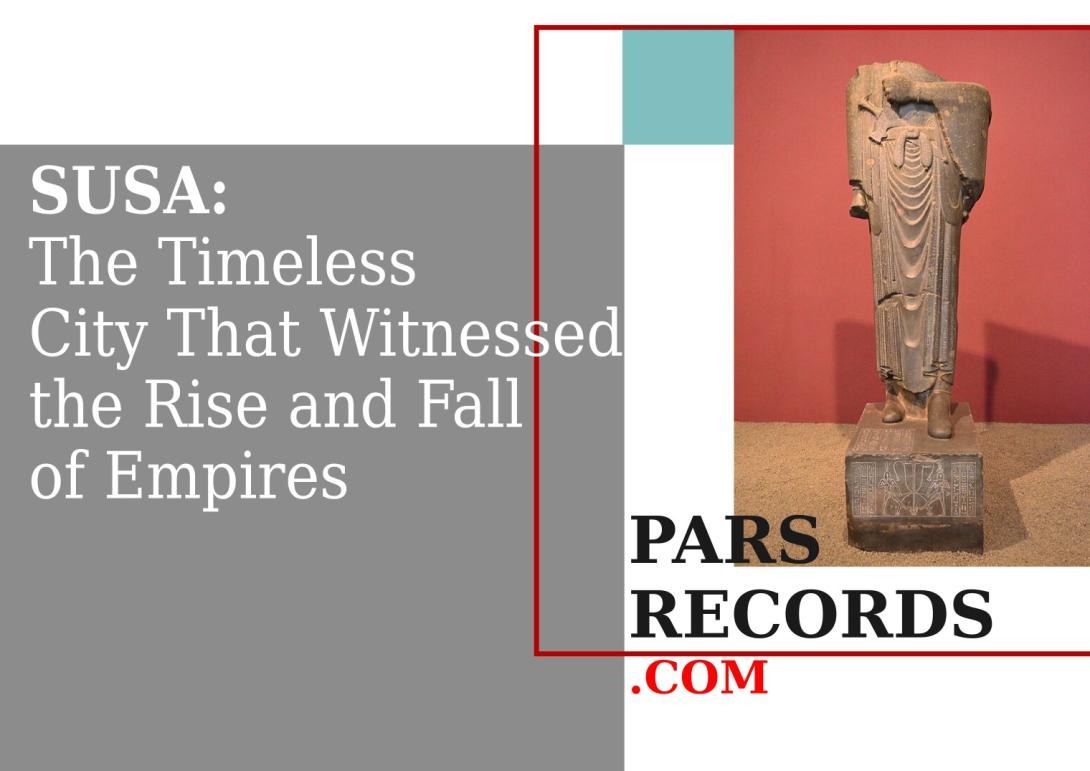
Few places on Earth have a history as deep and continuous as Susa, one of the world's oldest inhabited cities. Long before the rise of Rome, Athens, or even Babylon's greatest days, Susa stood as a thriving center of civilization in the fertile plains of southwestern Iran. For thousands of years, it served as a crossroads where cultures, empires, religions, and trade routes converged.
Today, the ruins of Susa remind us that civilizations may rise and fall, but their legacy can endure for millennia.
Where Is Susa?
Susa is located in today's Khuzestan Province in southwestern Iran, near the banks of the Shaur River. Its strategic location connected the Iranian Plateau with Mesopotamia, making it one of the most important political, commercial, and cultural centers of the ancient Near East.
Its advantageous position enabled merchants, diplomats, and armies to travel between east and west, contributing to Susa's remarkable prosperity.
One of Humanity's Oldest Cities
Archaeological evidence suggests that Susa was settled around 4200 BCE, although nearby human activity dates back even earlier. Over thousands of years, the city expanded into one of the great urban centers of antiquity.
Unlike many ancient cities that flourished briefly before disappearing, Susa experienced continuous occupation through multiple civilizations, making it an extraordinary archaeological site for understanding human history.
Excavations have uncovered:
- Monumental architecture
- Royal palaces
- Temples
- Administrative archives
- Colorful glazed bricks
- Cylinder seals
- Fine pottery
- Metalwork
- Thousands of cuneiform tablets
These discoveries have transformed Susa into one of the most valuable archaeological sites in the Middle East.
Capital of the Elamite Civilization
Susa became the principal capital of the ancient Elamite Kingdom, one of the earliest civilizations of Iran.
For nearly two thousand years, Elamite kings ruled from Susa, constructing magnificent temples and palaces while developing sophisticated administrative systems. Their influence extended across southwestern Iran and frequently brought them into conflict—and cooperation—with neighboring Mesopotamian powers.
The Elamites developed their own language, writing system, artistic traditions, and religious practices, giving Susa a unique cultural identity distinct from its western neighbors.
A Jewel of the Achaemenid Empire
Susa reached another golden age under the Darius I of the Achaemenid Empire.
Around 520 BCE, Darius transformed the city into one of the empire's principal capitals alongside Persepolis, Pasargadae, and Ecbatana.
He commissioned the magnificent Palace of Darius, built using materials gathered from every corner of the vast empire.
Historical inscriptions proudly describe how:
- Cedar wood came from Lebanon.
- Gold arrived from Lydia and Bactria.
- Ivory was imported from India and Ethiopia.
- Skilled craftsmen came from Egypt, Greece, Babylon, and Persia.
The palace itself became a symbol of imperial diversity and international cooperation.
The Famous Palace of Darius
The Palace of Darius at Susa represented the architectural brilliance of ancient Persia.
Its enormous audience halls featured towering stone columns supporting cedar roofs, while brilliantly colored glazed brick panels depicted royal guards, lions, mythical creatures, and floral motifs.
Although much of the palace has been destroyed over time, surviving decorative bricks displayed in museums continue to showcase the exceptional artistry of Achaemenid craftsmen.
Susa in the Bible
Susa appears numerous times in the Hebrew Bible (Old Testament), highlighting its significance beyond Persian history.
According to biblical tradition:
- The Book of Esther takes place largely in Susa.
- Nehemiah served the Persian king there.
- Daniel is described as receiving visions in Susa.
These accounts made the city well known throughout Jewish and later Christian traditions.
Alexander and the Macedonian Conquest
Following the conquest of Persia by Alexander the Great in 331 BCE, Susa peacefully surrendered and retained much of its wealth.
One of history's most remarkable political ceremonies occurred there in 324 BCE when Alexander organized the famous "Wedding at Susa," arranging mass marriages between Macedonian officers and Persian noblewomen to promote unity between the two cultures.
Although this policy proved short-lived, it remains one of history's boldest attempts at cultural integration.
Under the Parthians and Sasanians
Susa continued to flourish under both the Parthian Empire and the Sasanian Empire.
Its strategic location ensured its continued importance as:
- A regional administrative center
- A commercial hub
- A center of agriculture
- A religious community
Even after the fall of earlier empires, life in Susa continued for centuries.
Archaeological Discoveries
Modern excavations began in the nineteenth century and revealed astonishing treasures.
Among the discoveries are:
- Royal inscriptions
- Administrative archives
- Elaborate sculptures
- Glazed brick reliefs
- Luxurious jewelry
- Religious buildings
- Residential districts
- Massive fortification walls
Many important artifacts from Susa are now preserved in museums across the world, offering invaluable insight into ancient Near Eastern civilization.
A UNESCO World Heritage Site
In 2015, Susa was inscribed as a UNESCO World Heritage Site of Susa in recognition of its outstanding universal value.
The site preserves archaeological remains spanning more than six thousand years, documenting the evolution of urban life, imperial administration, architecture, religion, and international exchange.
Why Susa Still Matters
Susa is much more than an archaeological ruin. It represents the remarkable continuity of human civilization across thousands of years.
Its story illustrates how diverse cultures interacted, exchanged ideas, and shaped the ancient world. The city's legacy can be found in archaeology, architecture, literature, biblical tradition, imperial history, and the development of early urban societies.
Standing among the ruins of Susa today, visitors encounter not merely the remnants of an ancient city, but the enduring memory of countless generations who built, governed, traded, worshipped, and dreamed within its walls.
Final Thoughts
Susa occupies a unique place in world history. From its beginnings as an early settlement to its role as the glittering capital of the Elamites and one of the great capitals of the Persian Empire, it remained a center of civilization for thousands of years.
Its archaeological treasures continue to enrich our understanding of the ancient Near East, while its legacy reminds us that the foundations of modern civilization were laid by cities whose stories still resonate across time. Susa is not simply an ancient city—it is one of humanity's greatest historical treasures.
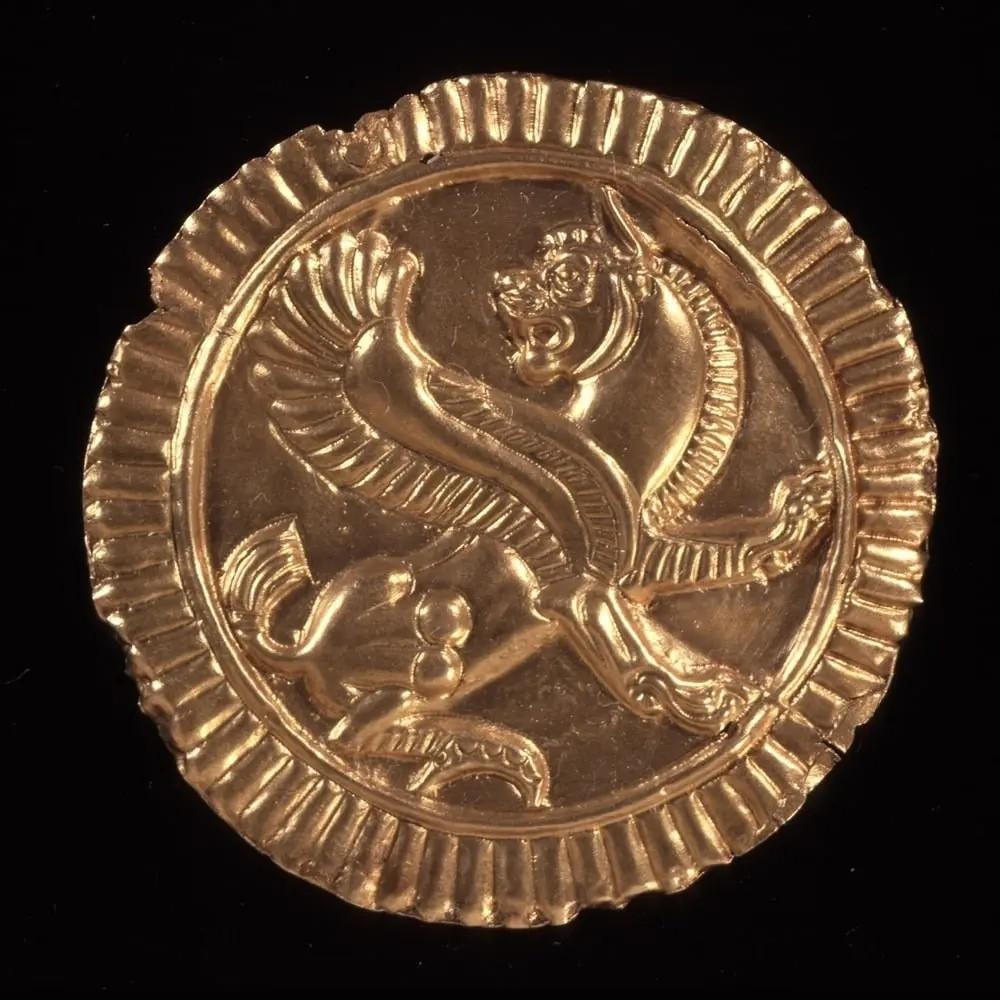
Achaemenid Golden Griffin
This golden griffin plaque, belonging to the Achaemenid royal dynasty of Persia, is a brilliant example of ancient Persian goldsmithing. It was crafted to be sewn onto formal or ceremonial garments. At its center is a repoussé depiction of a griffin—a mythical creature with the body of a lion, outstretched wings, and the head of an eagle or a powerful predatory animal—which was regarded in the culture and art of the period as a symbol of strength, kingship, and protection. The precise details in the design of the wings, body, and face demonstrate the exceptional skill of Achaemenid metalworkers. The surrounding scalloped border further enhances the plaque’s visual prominence while also contributing to its structural durability.
Griffins were among the most recognizable mythical symbols in the art and architecture of Achaemenid Persia, with examples appearing in the palaces of Persepolis and other royal monuments. The use of such imagery on golden plaques sewn onto the garments of nobles or royal guards reflects the deep connection between mythology, aesthetics, and the structure of political power in that era. This plaque was not merely a magnificent ornament; it also served as a carrier of the cultural and political messages of the Achaemenid Empire.
Page Term Reference
Comments