
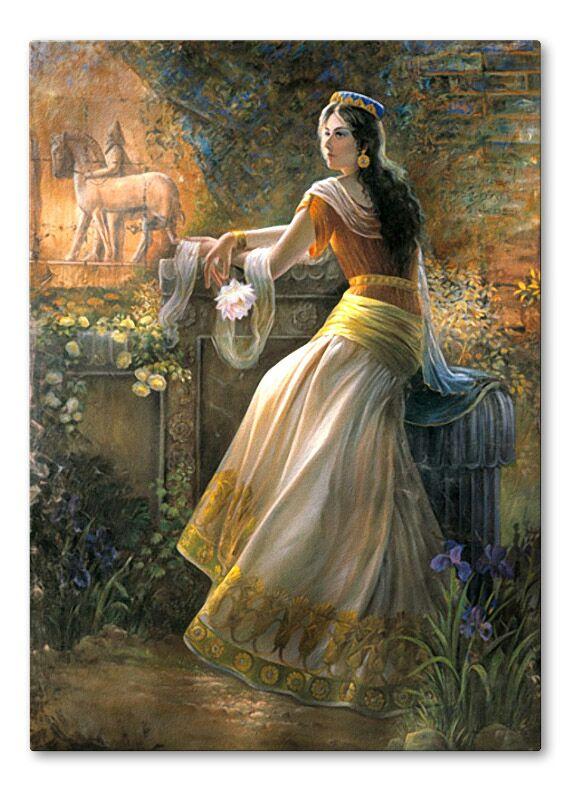
Shahrnaz & Arnavaz, according to the Shahnameh, are the sisters of Jamshid and are the first women whose names Ferdowsi mentions. He bestows upon them such epithets as “pure,” “veiled,” and “chaste”:
Two pure women from the house of Jamshid
Were brought forth, trembling like a willow;For both were sisters of Jamshid,
And were as crowns upon the heads of noble women.Of the veiled women, one was Shahrnaz,
And the other, chaste Arnavaz by name.
(Book One, The Reign of Zahhak, 55: 6–8)
In the Yashts, these two women are named “Sanghavak and Arnavak.” In the Shahnameh, these two figures possess a historical dimension and emerge from the most ancient Indo-Iranian myths. They were probably regarded in epic mythology as embodiments of the two Amesha Spentas, Haurvatat (Khordad) and Ameretat (Amordad)—representing immortality and perfection—as well as of water and vegetation.¹ Although Ferdowsi regards these two women as the sisters of Jamshid, the Avesta makes no mention of their being related to Jamshid and instead identifies them as the wives of Zahhak. Thus, in sections 24 and 25 of the Rām Yašt, we read Fereydun's words:
“O mighty Vayu! Grant me this boon, that I may prevail over Aži Dahāka—the three-mouthed, three-headed, six-eyed one, the possessor of a thousand forms of cunning, the exceedingly powerful demon of the Lie, the deceitful one who brings harm to the world, the mightiest of the Lie-demons whom Angra Mainyu created in the material world to destroy the world of Asha through sorcery—and that I may take from him both his wives, Sanghavak and Arnavak, who are worthy of preserving the family and deserving of increasing the lineage.” The mighty Vayu granted him this boon, and Fereydun was victorious.²
According to the Shahnameh, after Zahhak's conquest, Shahrnaz and Arnavaz are taken captive by this demonic figure and unwillingly become his bedfellows. These two women, who had been praised for their chastity, purity, and veiled appearance, acquire, through the emergence of the negative aspects of their anima, and under the influence of Zahhak's instruction and awakening of self-awareness, as well as under the pretext of fear of death, crookedness and wickedness. The presence of expressions such as “he raised them,” “he taught them,” and “teaching crookedness” is noteworthy, as it demonstrates the role of human beings and learning in their formation, as well as the effective role of the teacher; this, in turn, indicates the reciprocal influence of the individual and society.
Nevertheless, despite all this, Shahrnaz and Arnavaz, who possess an inherently pure nature, are cleansed of darkness as soon as they are freed from Zahhak's women's quarters and, at Fereydun's command, wash their heads. Their souls are thereby purified of all darkness and they return to their original pure nature. The most beautiful indication in the Shahnameh of the relationship between these two women and wisdom and awareness is the act of “washing the head,” which is the seat of wisdom, knowledge, and consciousness. Washing the head is a sign and symbol of purifying the soul from contamination and returning to the path of the pure Judge. Water, which is necessary for washing, is also sacred in mythology and is a sign of purity and innocence and, in fact, of self-awareness. Their heads and bodies are washed, and through this washing, the darkness and evil of their souls are, in reality, removed, allowing them once again to return to their true selves—that is, to human consciousness and wisdom.
The mythological ritual of washing the head and body, which is also encountered in the seven labours of the heroes, signifies, from a psychoanalytic perspective, becoming conscious, moving away from ignorance, and controlling the shadow through consciousness.³ Ultimately, Fereydun becomes the liberator of these women. Their captivity weighs so heavily upon Shahrnaz and Arnavaz that, as soon as they encounter Fereydun, they complain of the hardships they have endured and express their joy at his arrival in the following words:
They spoke to Fereydun, saying:
“May you remain ever young while the world grows old …How greatly the world has brought us misery
Because of the deeds of this witless sorcerer!How much suffering and affliction we have endured
At the hands of this demon-worshipping, accursed one.”⁴
(Book One, The Reign of Jamshid, 76: 333 and 336–337)
It should be noted that, in the course of Shahrnaz and Arnavaz's liberation, Ferdowsi also refers to Fereydun's relationship with these women. In accordance with his own characteristically faithful manner of narration, the poet, in addition to recounting Zahhak's taking possession of Shahrnaz and Arnavaz, also states that Fereydun, when he was Zahhak's guest, had been alone with his wives, and that this very incident aroused Zahhak's anger. Furthermore, after defeating Zahhak, Fereydun takes Shahrnaz and Arnavaz into his possession and marries them. The difference, however, is that Shahrnaz and Arnavaz themselves consent to this union. Kundrow,⁵ Zahhak's steward, recounts the episode as follows:
Kundrow answered him: “Yes, I have heard; now hear my answer.
If this renowned man is your guest, what business has he in your women's quarters?
Why does he sit with the sisters of the world-ruling Jamshid
And deliberate with them about what is more and what is less?
With one hand he takes hold of Shahrnaz's face,
And with the other, the ruby lips of Arnavaz.”Zahhak became enraged like a rhinoceros;
When he heard these words, he wished for death.
(Ibid., The Reign of Zahhak, 80: 403–405 and 408)
In this regard, it is also necessary to recall that “according to the Avesta, this was precisely what was expected; for among the warriors to whom Fereydun also belonged, it was customary that the dragon-slayer should marry the woman who had saved him.”⁶
Despite all these interpretations, one very obvious point concerning these two figures is that their presence in the Shahnameh is highly episodic and not particularly influential. Likewise, throughout the Shahnameh, women less frequently assume principal roles and more often appear in secondary ones. This may be attributed to factors such as the heroic, martial, and mythological atmosphere governing the Shahnameh; the pessimistic and disparaging attitudes towards women prevalent in past centuries; and the more limited participation and involvement of women—even the aristocratic women of the Shahnameh—in political and social affairs. Nevertheless, the secondary roles of women do not mean that they never influence the course of the narratives. Rather, it means that they are less frequently placed at the centre of the stories, with the narrative unfolding around them.⁷
Even so, of these two sisters, Arnavaz occupies a higher position from Ferdowsi's perspective, because:
1. She is a wise and perceptive counsellor. During Zahhak's dream, we witness her expressing an opinion and making a prediction concerning the event. Although her counsel, influenced by Zahhak's corrupt instruction and her estrangement from wisdom, serves to assist Zahhak's tyrannical actions and conduct, she is nevertheless the first to recognise Fereydun's identity from his allusions to himself:
When Arnavaz heard his words,
The hidden secret was revealed within her pure heart.She said to him: “Are you King Fereydun,
Who will destroy the body of tyranny and sorcery?”
(Ibid., 76–77: 347–348)
2. She is the mother of Iraj, a positive figure in the Shahnameh. As the poet's allusions suggest, Arnavaz appears to have been considerably more cherished by Fereydun than Shahrnaz, the mother of Salm and Tur.
References
- Motamedi, Nahid. (2009 [1388]). Ferdowsi and the Systematic and Marvellous Order of the Shahnameh. 1st ed. Tehran: Gutenberg Publishing, p. 91.
- Avesta. (2006 [1385]). Translated by Jalil Doostkhah. Vol. 1, 10th ed. Tehran: Morvarid Publications, pp. 451–452.
- Mousavi, Seyyed Kazem, and Ashraf Khosravi. (2008 [1387]). “Anima and the Mystery of the Captivity of the Companion Sisters in the Shahnameh.” Women's Research Journal, Vol. 6, pp. 149–150.
- Kundrow is an Indo-Iranian figure who possesses supernatural characteristics in the Avesta and Middle Persian texts and, like Aži Dahāka, is a renowned dragon-like figure. In the Shahnameh, however, in addition to retaining supernatural aspects similar to those of Zahhak, he is given a human dimension and introduced as Zahhak's steward. For further information, see: Jalal al-Din Chapati Gorgij, “An Analysis of the Character of Kundrow, Zahhak's Steward, Based on Ferdowsi's Shahnameh,” in Collection of Articles on the Shahnameh and Ritual Studies (2013 [1392]), ed. Farzad Qaemi. Mashhad: Ferdowsi University of Mashhad Press and Publications.
- Ferdowsi, Hakim Abu'l-Qasem. (2007 [1386]). Shahnameh. Edited by Jalal Khaleghi Motlagh. Vol. 1. Tehran: Centre for the Great IRANIAN Encyclopaedia.
- Khaleghi Motlagh, Jalal. (2016 [1395]). Women in the Shahnameh. Translated by Dr Ahmad Banazir. Tehran: Morvarid Publishing, p. 29.
- Ali-Naqi, Hossein. (2011 [1390]). “An Analysis of the Character and Role of Women in the Stories of the Shahnameh.” Women and Culture: A Scientific-Research Quarterly, Year 3, No. 9, page 80
Page Term Reference
Comments