

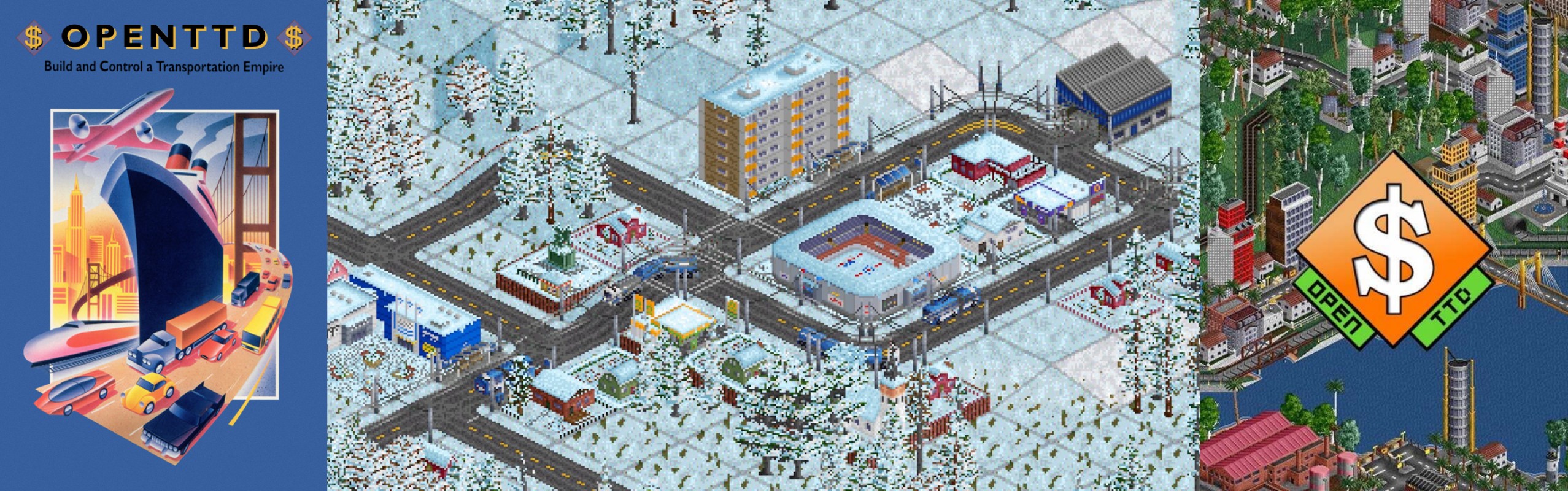
The Timeless Open-Source Transport Strategy Game
More than twenty years after its initial release, OpenTTD remains one of the greatest transport management and strategy games ever created. Built as an open-source reimagining of the classic Transport Tycoon Deluxe, it has evolved into a feature-rich simulation that rivals—and in many ways surpasses—modern commercial tycoon games. Developed and maintained by a passionate community, OpenTTD proves that outstanding gameplay never goes out of style.
Unlike many strategy games that focus on warfare or conquest, OpenTTD challenges players to build profitable transportation networks connecting industries, towns, and cities. Every decision matters—from laying the first railway track to designing massive multi-line logistics systems capable of moving thousands of passengers and tons of cargo efficiently. The game rewards careful planning, optimization, and long-term thinking rather than fast reflexes.
Gameplay
At its core, OpenTTD is about solving logistical puzzles.
Players begin with a modest loan and must establish transportation routes using:
- Railways
- Roads
- Buses
- Trucks
- Ships
- Aircraft
Raw materials such as coal, iron ore, timber, and livestock must be transported to processing industries before finished products are delivered to towns. Passenger transportation is equally profitable, requiring efficient connections between growing cities.
While the basic mechanics are easy to understand, the game gradually reveals remarkable strategic depth. Building a simple railway between two stations is straightforward; constructing an optimized network handling hundreds of trains without congestion is an entirely different challenge.
This balance between accessibility and complexity is one of OpenTTD's greatest strengths.
Strategic Depth
OpenTTD offers extraordinary freedom.
There are no scripted campaigns forcing players down predetermined paths. Instead, each procedurally generated world becomes a unique sandbox where creativity determines success.
Players constantly face meaningful decisions:
- Should profits be reinvested into faster trains?
- Is it better to expand into aviation or improve rail infrastructure?
- How can traffic bottlenecks be eliminated?
- Which industries promise the highest long-term returns?
- Should the company specialize or diversify?
As networks grow, optimization becomes increasingly rewarding. A small improvement in station design or signaling can dramatically increase network efficiency.
Few strategy games provide such satisfying long-term planning.
Building Rail Networks
Railways are unquestionably the heart of OpenTTD.
Designing efficient rail systems feels almost like solving engineering puzzles. Junction layouts, signaling, platform lengths, track priorities, and train scheduling all influence performance.
Players often spend hours refining intersections to eliminate delays and maximize throughput.
This engineering aspect gives OpenTTD enormous replay value. Two players may solve identical transportation problems using completely different network designs.
Economy
The economic simulation is surprisingly sophisticated.
Industries produce cargo depending on supply and demand, towns grow according to transportation quality, and vehicles gradually become obsolete as technology advances.
Managing finances involves balancing:
- Loan repayments
- Vehicle maintenance
- Infrastructure expansion
- Replacement costs
- Route profitability
Economic mistakes rarely end the game immediately, but poor planning accumulates over decades, making recovery increasingly difficult.
Graphics and Presentation
Graphically, OpenTTD looks modest by modern standards.
Its classic isometric pixel art reflects its heritage rather than contemporary visual trends. Yet the clean presentation remains remarkably readable, especially when managing enormous transportation networks.
Animation is simple but effective. Watching dozens—or even hundreds—of trains, trucks, aircraft, and ships moving simultaneously across an interconnected world creates an impressive sense of scale.
Rather than flashy visuals, OpenTTD focuses on clarity and functionality.
Sound
The soundtrack is pleasant and nostalgic without becoming repetitive.
Sound effects are minimal but sufficient, allowing players to focus on planning rather than audiovisual spectacle.
Many players eventually play while listening to podcasts or music, which suits the game's relaxed pacing perfectly.
User Interface
Although vastly improved over the original Transport Tycoon Deluxe, the interface still reflects decades of accumulated features.
New players may initially find the menus intimidating.
Fortunately, once the fundamentals are learned, the interface becomes highly efficient, offering quick access to almost every management tool imaginable.
The learning curve is steep but fair.
Multiplayer
One of OpenTTD's most impressive achievements is its multiplayer support.
Players can cooperate on massive transportation empires or compete economically in shared worlds. Large multiplayer servers often feature extensive rail systems built collaboratively over many real-world weeks.
Unlike many strategy games, multiplayer emphasizes planning and cooperation rather than fast-paced combat, making it ideal for relaxed but intellectually engaging sessions. Official builds also support dedicated servers, extensive networking options, and large multiplayer games.
Modding Community
OpenTTD has one of the strongest communities in open-source gaming.
Thousands of community-created additions include:
- New vehicles
- Additional industries
- Enhanced graphics
- Custom maps
- Artificial intelligence opponents
- Gameplay modifications
The integrated content downloader makes installing community content exceptionally easy, allowing players to customize nearly every aspect of the experience. (OpenTTD)
Performance
Despite supporting enormous maps and extremely complex transportation systems, OpenTTD runs exceptionally well on modern hardware.
It is lightweight, stable, and available across multiple operating systems, including Windows, Linux, macOS, and Android. The project remains actively maintained under the GPL open-source license. (GitHub)
Learning Curve
OpenTTD is not a game that reveals its brilliance in the first hour.
Beginners often struggle with:
- Railway signaling
- Station placement
- Industry chains
- Financial management
- Efficient routing
However, the satisfaction of mastering these systems is immense.
Each newly learned mechanic unlocks additional strategic possibilities.
Rather than overwhelming players through artificial difficulty, OpenTTD rewards patience and experimentation.
Strengths
- Outstanding strategic depth
- Nearly limitless replayability
- Excellent transportation simulation
- Massive maps
- Active open-source development
- Extensive multiplayer support
- Rich modding ecosystem
- Lightweight and highly optimized
- Completely free to play
- Timeless gameplay design
Weaknesses
- Dated graphics
- Steep learning curve
- Limited tutorial guidance
- Interface can overwhelm newcomers
- Lack of narrative or campaign objectives
Final Verdict
OpenTTD demonstrates that exceptional game design can outlast technological trends.
While its visuals may appear dated, the underlying gameplay remains among the finest examples of management and logistics simulation ever created. Every successful transportation network feels earned, every optimized railway brings genuine satisfaction, and every growing city reflects thoughtful planning.
The game's open-source nature has allowed it to evolve continuously for more than two decades, adding features that many commercial strategy titles still lack. Even today, it stands as one of the deepest and most rewarding transport management games available.
Whether you are an engineering enthusiast, a logistics fanatic, or simply someone who enjoys thoughtful strategy games, OpenTTD offers hundreds—if not thousands—of hours of rewarding gameplay.
Rating: 9.5/10
Who Should Play It?
OpenTTD is highly recommended for fans of simulation, management, logistics, and strategy games who enjoy solving complex systems. Casual players looking for fast action may find it demanding, but anyone willing to invest time into learning its mechanics will discover one of the greatest open-source games ever made.