

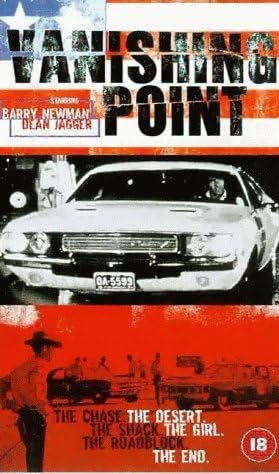
Vanishing Point is one of those rare road movies that feels less like a narrative and more like a speeding hallucination across the American West. Directed by Richard C. Sarafian, it has endured not because of traditional storytelling structure, but because of its hypnotic atmosphere, existential undertones, and relentless momentum.
At its core, the film follows Kowalski (Barry Newman), a former cop and race car driver tasked with delivering a Dodge Challenger from Denver to San Francisco. What begins as a simple cross-state drive quickly transforms into a surreal high-speed pursuit, as law enforcement across multiple states converges on him. But the plot is almost secondary; what matters is the experience of movement, rebellion, and fading identity.
Sarafian’s direction is remarkably fluid and kinetic. The camera often feels like it’s glued to the asphalt, turning highways into endless ribbons of isolation and escape. The editing reinforces this sense of propulsion, intercutting Kowalski’s drive with fragmented vignettes of people reacting to his mythic run—radio DJs, bikers, hippies, and bystanders who begin to treat him as a kind of folk legend. These radio segments, especially those voiced by Cleavon Little as “Super Soul,” add a countercultural pulse that grounds the film in its early-1970s context.
Barry Newman’s performance is deliberately restrained, almost ghostlike. Kowalski is not a traditional protagonist; he’s more symbol than character, a man shedding personal history with every mile marker. This ambiguity is central to the film’s appeal. Is he escaping the law, or something more internal—grief, disillusionment, or the empty promises of the American Dream?
Visually, the film is striking. The desert landscapes are shot with an almost mythic grandeur, evoking both freedom and desolation. The white Dodge Challenger becomes an icon in itself, a roaring extension of Kowalski’s will against an increasingly oppressive system. The practical stunt driving, especially for its era, remains impressive and tactile, giving the action a raw immediacy that modern CGI-heavy car films often lack.
What elevates Vanishing Point beyond a standard chase film is its philosophical ambiguity. It belongs to the same spiritual lineage as films like Easy Rider—works that question authority, identity, and the cost of absolute freedom. Its famously ambiguous ending only deepens its mythic quality, refusing to resolve Kowalski’s journey into simple triumph or defeat.
Ultimately, the film’s power lies in its refusal to slow down or fully explain itself. It is a meditation on motion as meaning, on escape as both liberation and annihilation. More than fifty years later, it still feels fast, strange, and unsettlingly modern—a cult classic that continues to outrun interpretation.
Page Term Reference
Comments