
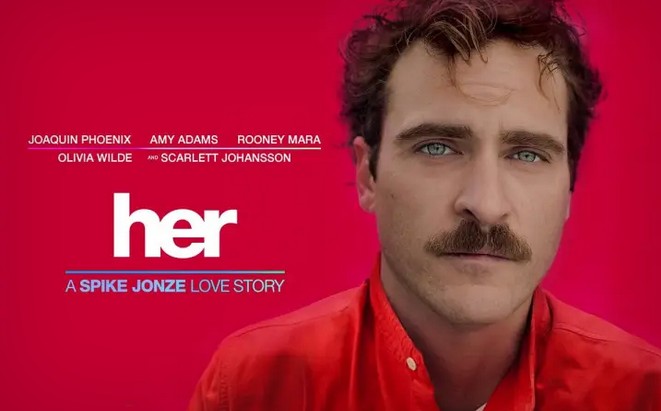
Her (2013), directed by Spike Jonze, is one of the most distinctive science-fiction dramas of the last decade—not because it predicts a flashy future, but because it quietly redefines what “connection” might mean in an increasingly mediated world.
At its core, the film follows Theodore Twombly, played with remarkable restraint and vulnerability by Joaquin Phoenix, a lonely writer who develops an emotional relationship with an advanced operating system named Samantha, voiced by Scarlett Johansson. What could have easily become a gimmick concept instead unfolds as a deeply human story about intimacy, isolation, and the evolving nature of love.
One of the film’s greatest strengths is its emotional intelligence. Jonze avoids cynicism and avoids sensationalizing technology. Instead, he builds a world that feels just slightly ahead of ours—clean, warm, and eerily believable. The production design leans into soft colors and minimalist architecture, reinforcing Theodore’s internal state: organized on the surface, quietly fragmented underneath.
Phoenix delivers a career-defining performance, carrying much of the film through subtle gestures—hesitations, half-smiles, and prolonged silences that communicate more than dialogue ever could. Johansson’s voice performance is equally crucial; Samantha is not a disembodied chatbot cliché, but a fully realized presence whose curiosity and emotional growth feel genuine, even when her physical absence creates narrative tension.
Where the film stands out most is in its philosophical ambition. It doesn’t reduce love to biology or challenge it with irony. Instead, it asks whether emotional truth requires physical form at all. That question is handled with surprising tenderness, even when the story begins to strain under the limits of its premise in the final act.
Visually, the film is restrained but elegant, and the score by Arcade Fire complements the tone without overwhelming it. Everything is calibrated toward introspection rather than spectacle.
If there is a critique to be made, it’s that the pacing occasionally drifts in the middle, and some thematic ideas are stated more directly than necessary. Still, these are minor issues in a film that is fundamentally more interested in feeling than explaining.
Ultimately, "Her" succeeds because it treats its strange premise with emotional seriousness. It is less about artificial intelligence than it is about human longing—and the uncomfortable realization that connection often exists in forms we don’t fully understand.
Comments