
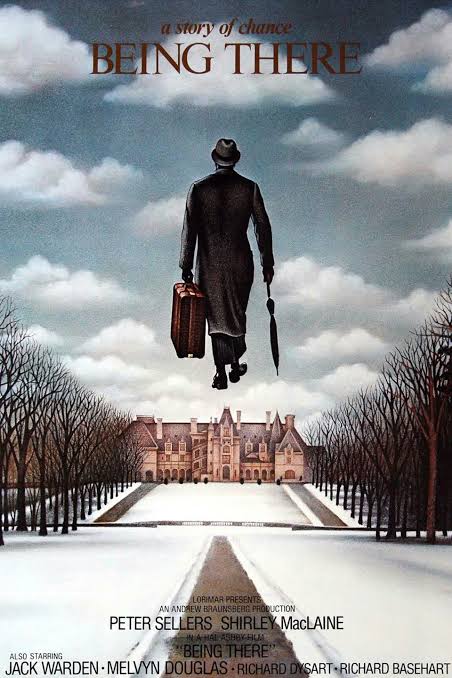
Being There (1979) is a quietly unsettling satire that unfolds with the simplicity of a fable and the precision of a scalpel. Directed by Hal Ashby and adapted from Jerzy Kosiński’s novel, the film uses its unassuming premise to expose how perception, language, and media can distort reality itself.
At the center is Peter Sellers in one of his most restrained and haunting performances. He plays Chance, a gardener with the mental development of a child who has spent his entire life inside a wealthy Washington D.C. household, absorbed only in television and gardening. When he is forced into the outside world, his limited vocabulary and literal interpretations of life are mistaken for profound wisdom. Sellers never overplays the role; instead, he commits fully to stillness and blankness, allowing others to project meaning onto him. It is one of cinema’s most striking portrayals of passive charisma.
The film’s satire sharpens as Chance is absorbed into elite political and media circles. Figures of power interpret his simple gardening metaphors as sophisticated economic and political philosophy. The absurdity is not loud or exaggerated; it is chillingly plausible. Hal Ashby directs with a patient, almost documentary-like tone, letting scenes breathe so that the misunderstandings feel increasingly inevitable rather than contrived.
Melvyn Douglas, as the dying billionaire Ben Rand, provides a warm but ironic counterbalance to Sellers. His performance earned him an Academy Award, and his final scenes with Chance are both tender and quietly tragic, suggesting a longing for innocence that the world can no longer afford. Shirley MacLaine, as Rand’s wife Eve, adds another layer of ambiguity, unsure whether she is witnessing enlightenment or absurdity.
What makes Being There endure is its refusal to fully explain itself. The film never confirms whether Chance is a fool or a mirror reflecting the foolishness of others. Its ending, drifting into metaphor rather than resolution, reinforces the idea that meaning is often manufactured by those who need it most.
More than a political satire, Being There is a meditation on emptiness, projection, and the seduction of simplicity in a world overwhelmed by complexity. It remains unsettling because it suggests that authority, intelligence, and influence may sometimes rest less on substance than on the willingness of others to believe.
Page Term Reference
Comments