

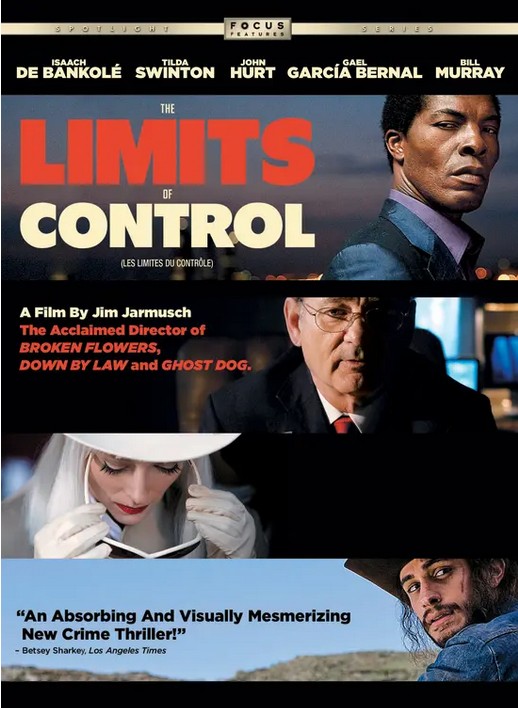
The Limits of Control (2009), directed by Jim Jarmusch, is less a conventional narrative film and more a meditative cinematic exercise in minimalism, repetition, and abstraction. It resists audience expectations at nearly every turn, offering instead a hypnotic journey through form, rhythm, and philosophical suggestion.
From a narrative standpoint, the film is deliberately opaque. The protagonist, played with stoic restraint by Isaach de Bankolé, moves through a series of cryptic encounters across Spain, exchanging matchboxes containing coded messages. Dialogue is sparse and often elliptical, circling around recurring motifs—“Use your imagination,” “He who thinks he is bigger than the others must go to the cemetery.” These fragments hint at a deeper thematic structure but never coalesce into a clear, traditional plot. Jarmusch seems uninterested in resolution; instead, he prioritizes mood and contemplation.
Visually, the film is striking. Cinematographer Christopher Doyle, known for his collaborations with Wong Kar-wai, brings a sensuous, almost tactile quality to the imagery. The Spanish landscapes—ranging from sun-bleached urban spaces to quiet, geometric interiors—are rendered with an emphasis on color, symmetry, and stillness. Each frame feels composed as a standalone artwork, reinforcing the film’s deliberate pacing and aesthetic rigor.
Thematically, *The Limits of Control* can be read as a critique of rationalism and control itself. The film subtly contrasts imagination with rigid systems of power, particularly through its enigmatic mission and its abstracted portrayal of authority. A late appearance by Bill Murray as a figure of control introduces a faint political dimension, suggesting tensions between creativity and institutional dominance, possibly alluding to broader geopolitical anxieties.
However, this approach is not without its challenges. The film’s insistence on repetition and its refusal to provide narrative payoff may alienate viewers expecting coherence or emotional engagement. Its characters, largely symbolic rather than fully developed, function more as philosophical conduits than as human figures. For some, this results in a deeply immersive, almost trance-like experience; for others, it may feel like an exercise in stylistic indulgence.
Ultimately, *The Limits of Control* stands as a quintessential Jarmusch work—cool, enigmatic, and defiantly non-commercial. It invites interpretation without ever demanding one, operating in the liminal space between cinema and visual poetry. Whether one perceives it as profound or pretentious largely depends on their tolerance for ambiguity and their willingness to engage with film as an experiential rather than narrative medium.
Page Term Reference
Comments