

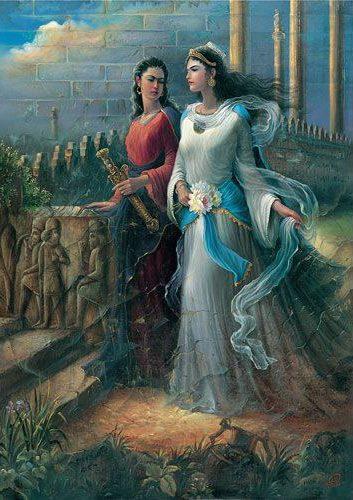
The Daughters of Goshtasp
Humāy and Beh-Āfarīd, the daughters of Goshtasp and sisters of Esfandiyār, are referred to by different names in various sources.¹ According to the Shāhnāmeh, they are “wise”, “fortunate”, and “noble” daughters, whose faces “had never been seen by the wind”; yet fate condemns them to captivity among the Turks, “with pain and grief, and faces like lamps”:
The wise Humāy and Beh-Āfarīd,
whose faces the wind had never seen;
they are captives among the Turks, in pain and grief,
driven on foot, their two faces like lamps.
(Volume III, Goshtasp, 89: 1255–1256)
The role and presence of these two girls in the course of the story are brief and secondary, and, apart from one scene, their actions and words have little particular influence on the events. Humāy’s role, however, is considerably more prominent than that of her sister Beh-Āfarīd. Ferdowsi refers to her twice as “Fortunate Humāy” (Farrokh-Humāy) and once as “Wise Humāy” (Humāy-e Kheradmand), and attributes most of the roles to her. Moreover, before the episode in which the two sisters are taken captive, we hear only Humāy’s name and have no information about Beh-Āfarīd. Beh-Āfarīd’s name appears alongside that of her sister Humāy only when the two are captured. Her role never has an independent significance in any scene; rather, it is alongside her sister Humāy that her character is defined.
Unlike many of the women of the Shāhnāmeh, who themselves play active roles and drive the narrative forward, the role and existence of Humāy and Beh-Āfarīd acquire meaning largely under the shadow of, and through the protection of, men. Although in several brief scenes we witness their efforts, actions, and words, these instances, with the exception of one scene, have little effect on the course of events. Thus, greater dependence upon male protection is incorporated into the characterisation of these two girls, and, in a sense, their roles disappear beneath the shadow of men—both before and after their captivity. On their own side, they serve to encourage and inspire the warriors to acts of bravery. For example, in the first verses in which one of the two sisters, Humāy, enters the story, we encounter Goshtasp, their father, offering his daughter’s hand in marriage as a reward to any volunteer who possesses the strength and courage to avenge the death of her brother Zariēr upon the army of Arjāsp:³
Whoever steps forward from among them,
to him I shall give my daughter Humāy;
yet from the army no one stepped forward,
nor did any of them stir from his place.
(Ibid., 63–64: 626–627)
In the Yādgār-e Zarirān, too, the promise of marriage to beautiful Humāy is made in the following manner:
“But which of you Iranians will arise and avenge Zarirān? I shall give my daughter Humāy to him in marriage, for throughout the whole land of Iran there is no woman more beautiful than she.”
(Yādgār-e Zarirān, 1392 [2013/14]: 32).
We then see that, after Arjāsp’s defeat and his return to Iran, Goshtasp gives Humāy to his eldest son, Esfandiyār:
When the King of the World returned to his place,
he gave fortunate Humāy to his eldest son.
(Ibid., 70: 800)
In addition to the aforementioned reference, one part of the story explicitly emphasises the protection and care provided by men for the two sisters. Thus, when Arjāsp assembles his army and advances upon Iran, the guards of Humāy’s palace are mentioned as the only military and defensive force in Balkh:
“Apart from these, there is no one in Balkh; these alone are the men of arms. Except for the guards of Humāy’s palace—come, rise quickly and delay no longer.”
(Ibid., 79: 1011).
This protective role becomes particularly pronounced in the episode of their captivity. Their capture as women sets the male community into motion, compelling men to strive for their rescue and for the preservation of their own honour and dignity. On this basis, it may be said that the captivity of the two girls, and the efforts undertaken to free them, constitute their first important and serious role in the Shāhnāmeh, setting in motion a number of subsequent narrative scenes. In this respect, although it is twice emphasised that even the wind had never seen their faces—“the wind had never seen her”, and “the wind had never seen their faces”—and although the guards of Humāy’s palace indicate that the two girls had been watched over with great care and attention, fate nevertheless brings them down from their golden throne as spoils of war and sends them as captives to Arjāsp’s women’s quarters. Goshtasp’s wife conveys the news of her daughters’ capture to their father in the following words:⁵
They have taken your daughters captive;
do not regard such a grievous deed lightly!
If it is only Humāy who has been lost,
the wise man’s heart would not leave its place;
and the other, the King’s daughter, Beh-Āfarīd,
whose face the wind had never seen—
they have taken her down from her golden throne,
leaving neither bracelet nor crown upon her.
(Ibid., 84: 1134)
On the other hand, the scenes concerning the liberation of Humāy and Beh-Āfarīd represent the most significant manifestation of the protective shadow cast by a man over these two girls. Nevertheless, after Esfandiyār sets out towards his captive sisters, we witness the beginning of the girls’ own presence and actions. At this point, they make a commendable effort to free themselves from captivity and enslavement. Rather than surrendering, losing heart, and accepting their terrible circumstances, they attempt to send word of their existence to the Iranians and secure their own liberation. Thus, as their first action, after Esfandiyār has reached the vicinity of Ruyīn-Dez, Humāy and Beh-Āfarīd, after sunset and once the buyers have left the marketplace around Esfandiyār, emerge from the palace veranda and go into the street, lamenting and carrying a water jar upon their shoulders. Although they have been humiliated and degraded and their hearts are filled with sorrow, they approach the renowned Iranian merchant—in reality, Esfandiyār—in the hope of finding some sign or news of Iran, the King, and Esfandiyār:
His two sisters went from the veranda into the street,
lamenting, with water jars upon their shoulders;
they came near Esfandiyār,
heavy-hearted and humbled.
(Volume III, Goshtasp, 122: 535–536)
Humāy and Beh-Āfarīd make every effort within their ability to free themselves from the terrible circumstances in which they find themselves. It may perhaps be said that this scene constitutes their only genuinely influential role in advancing the narrative: they make their brother aware of their presence:
The two of them went towards him,
with two streams of blood flowing down their cheeks;
the helpless women pleaded with
that noble merchant.
(Ibid., 539–540)
Here again, it is Humāy, the elder (mehter) sister, who speaks. She asks the merchant whether he has any news of Iran, Goshtasp, or Esfandiyār:
Then the elder said: “O caravan-driver,
from where did you first set your caravan on its journey?
May your days and nights be blessed,
and may all the nobles bow before you!
What news have you of Iran, Goshtasp, and Esfandiyār,
O renowned and valiant man?”
(Ibid., 122: 541–543)
Humāy and Beh-Āfarīd’s account of their condition during their captivity describes their enslavement and the extremely harsh circumstances in which they live. They are the daughters of a king, yet are held captive by an ignoble man; barefoot, they carry water upon their shoulders and run barefoot through every gathering, envying those whose bodies are clothed. It is because of these terrible circumstances that they ask the merchant, Esfandiyār, to remedy their suffering and, if he has any knowledge or news of Iran, to tell them:
Thus are we, two daughters of a king,
captives in the hands of an ignoble man;
bareheaded and barefoot, carrying water upon our shoulders,
while our father sleeps happily, day and night;
running barefoot through the gatherings,
fortunate is the one who clothes his body;
for a while we weep with blood-red tears—
you must be the physician who can cure this pain of ours;
if you have any news to tell us of our homeland,
then make this poison upon our land into an antidote.
(Volume III, Goshtasp, 122: 544–546)
After Esfandiyār loudly rebukes the two girls and deliberately drives them away, it is once again Humāy who recognises the voice of her brother. She knows, however, that Esfandiyār has covered his face so as not to be recognised and has deliberately driven them away. Once again, Humāy’s situational awareness and intelligence lead her to remain silent, lest her brother’s identity be revealed. The only thing Humāy can do is remain heartbroken before her brother and weep, while all her clothes are torn, her feet are covered with dust, and fear of Arjāsp has overwhelmed her. At this point, Esfandiyār realises that his sister Humāy has recognised him:
When fortunate Humāy heard that voice,
she recognised it, and her heart returned to its place;
when the sister recognised his voice,
she concealed the secret of who he was;
so grief-stricken, she remained before him,
shedding tears from both her eyes;
all her garments torn, her two feet covered in dust,
her soul filled with fear and dread of Arjāsp;
the pure-minded warrior realised
that she was Humāy, recognising him.
(Ibid., 123: 553–557)
Again, when Esfandiyār roars within Arjāsp’s palace, it is first Humāy who hears her brother’s voice and runs towards Esfandiyār together with her sister Beh-Āfarīd. The two sisters weep blood, and when their brother approaches them and sees the two veiled women, whose faces are “like spring”, he tells them to make their way to the marketplace as quickly as possible and not remain on the battlefield. Finally, he places them upon horses and returns them to Iran:
When wounds and cries arose from the palace door,
Humāy ran towards the noble warriors;
with her sister Beh-Āfarīd,
both their faces hidden beneath blood-red tears;
when Esfandiyār came close to them,
he saw the two veiled women, like spring;
the warrior said to his sisters:
“Hurry from here and raise the dust beneath your feet,
to the place where my marketplace stands,
where there is much gold and silver, and where I hold my position.”
(Ibid., 126: 640–644)
Another interesting point is that despite Esfandiyār’s passing through the Seven Trials and the bravery and sacrifices he undertakes on behalf of Humāy and Beh-Āfarīd, he is not satisfied with his sisters’ conduct as sisters. When Jāmāsp tells Esfandiyār that his sisters are imprisoned by Arjāsp, Esfandiyār complains about them. He asks why he should risk his life when, during the time he himself was imprisoned, neither of his sisters came to visit him. Why had Humāy not remembered him even for a single day while he was in captivity? And Beh-Āfarīd, he says, seemed never to have seen or known her brother in the world:
He replied: “Did Humāy ever, even for a day,
remember me in this narrow place?
And what of noble Beh-Āfarīd—
you would say she had never seen me in the world!”
(Ibid., 89: 1257–1258)
Esfandiyār’s complaint is not entirely unjustified. It is only after their brother’s death that Humāy and Beh-Āfarīd defend him before their father, although their protest is ultimately of no avail. After Esfandiyār’s death and their lamentation for him,⁷ and once the royal palace has been emptied of the nobles, they go before their father. They beat their faces and tear their hair in grief for their brother; they then stand before their father and, in the harshest possible tone, reproach and condemn him. The boldness, frankness, and severity of the sisters’ speech—although such behaviour may naturally be expected from mourners under intense grief and distress—is noteworthy:
They said to Goshtasp: “O renowned King,
you give no thought to Esfandiyār’s fate…
Neither the Simurgh killed him, nor Rostam, nor Zal;
you killed him—so do not mourn as though innocent.
Shame upon you for your white beard,
for you killed your own son for the sake of your ambition.
There were many rulers before you
who were worthy of the royal throne;
yet they did not give their sons to death,
neither their own offspring nor their kinsmen.”
(Ibid., 198: 1581–1596)
Qadam-Ali Sarami writes in this regard:
“The words of Humāy and Beh-Āfarīd, the daughters of Goshtasp, addressed to this king after Esfandiyār was killed by Rostam, are filled with masculine firmness, imbued with sisterly affection, and infused with the forthrightness of one who speaks the truth.”
(Sarami, 1392 [2013/14]: 702). It is interesting that the sisters’ bold presence and role in confronting their father are not found in Thaʿālibī’s History, al-Ṭabarī’s History, or other sources; this scene appears only in the Shāhnāmeh.
It should also be recalled that Humāy and Beh-Āfarīd complained about their father even during their captivity. This reference indicates that their relationship with Goshtasp, like that of their brother with his father, was not particularly close or harmonious. They go so far as to believe that their father is happy day and night and sleeps peacefully, while his daughters are captive and imprisoned among the Turks:
Bareheaded and barefoot, carrying water upon our shoulders,
while our father sleeps happily, day and night.
(Volume III, Goshtasp, 122: 545)
Notes
1. In the Avesta, the name Humāy is recorded in forms such as Humāyā, Humāyeh, and Humiyah, meaning “fortunate” and “auspicious”. In Middle Persian, the name is rendered Humāk. (Pourdavoud, 1307 [1928/29], vol. I: 391.) The name Beh-Āfarīd also appears in the Yashts in the form Vārīðkanā: “May I once again bring Humāy and Vārīðkanā home from the land of the Khions…” (Ibid.) According to the Yādgār-e Zarirān, the name is recorded as Humāg. (Yādgār-e Zarirān, 1392 [2013/14]: 56.) Ṭabarī refers to the two girls as Khummānī and Bādhāfra (Ṭabarī, 1362 [1983], vol. II: 479); Balʿamī as Humāy and Bādāfra (Balʿamī, 1353 [1974], vol. II: 663); Thaʿālibī gives Humāy as Khumāy (Thaʿālibī, 1368 [1989]: 184); and Ibn al-Athīr refers to her as Khumānā (Ibn al-Athīr, 1383 [2004], vol. I: 316).
2. These verses are spoken by Jāmāsp in his conversation with Esfandiyār. In the Gōsh Yašt, Karda 7 of the Avesta, the following passage appears on this subject:
“Grant me this success: that I may overthrow the wicked Thraetaona, that I may overthrow Spenjoya Urushka, the demon-worshipper, and that I may once again bring Humāy and Vārīðkanā home from the land of the Khions.”
(Avesta, 1385 [2006], vol. I: 351.) Thraetaona literally means “dark” or “gloomy” and is one of the daēvas. He stood against Kay Goshtasp with a group of the Khion tribe, associated with the Turanians, and was defeated by him. (Oshidari, 1371 [1992]: 213.)
3. Interestingly, the promise to give a daughter in marriage also appears in Thaʿālibī’s History, where it is made by Arjāsp to Gorgsār: “Arjāsp said to him: If you do this… I shall give my daughter to you in marriage.” (Thaʿālibī, 1368 [1989]: 190.)
4. In Bandārī’s translation, it is likewise stated: “He gave his daughter Humāy to his son Esfandiyār, according to the custom of that time.” (Bandārī Esfahānī, 1382 [2003]: 300.)
5. This news, which constitutes an extremely severe psychological blow to the Iranians, is delivered to Goshtasp by a woman. Jلال Khāleqī-Motlagh argues concerning her: “The expression ‘a woman’ indicates that this woman is not Katāyūn; otherwise the poet would have mentioned her name. It is not unlikely that traces of the story of Hotas may have remained in the account of this woman.” (Khāleqī-Motlagh, 1391 [2012], vol. X, part II: 242.)
6. The scene in which Esfandiyār’s sisters encounter their brother recalls the scene in which Manīzheh encounters Rostam. (Khāleqī-Motlagh, 1391 [2012], vol. X, part II: 264.)
7. When Esfandiyār’s mother, daughters, and sisters learn of his death, they all emerge from the palace veranda with their heads uncovered, their feet covered in dust, and their garments torn upon their bodies. With hearts filled with blood, they behold their brother’s face, covered with musk and with a black beard, and afterwards they all faint:
When the mother and sisters learned of his death,
they came out from the veranda with the daughters,
their heads uncovered and their feet covered in dust,
their garments all torn upon their bodies.
(Ibid., 196: 1552–1553)
References
Ibn al-Athīr, ʿIzz al-Dīn. (1383 [2004]). Al-Kāmil fī al-Tārīkh [The Complete History], translated by Sayyed Mohammad-Hasan Ruhānī, Vol. I. Tehran: Asātīr Publications.
Avesta. (1385 [2006]). Translated by Jalīl Dūstkhāh, Vol. I, 10th edition. Tehran: Morvarid Publications.
Oshidari, Jahāngīr. (1371 [1992]). Dāneshnāmeh-ye Mazdīsnā [Encyclopaedia of Zoroastrianism]. Tehran: Markaz Publishing.
Balʿamī, Abū ʿAlī Mohammad. (1353 [1974]). Tārīkh-e Balʿamī [The History of Balʿamī], edited by Malek al-Shoʿarā Bahār, Vol. II. Tehran: Zavvār Publishing.
Bandārī Esfahānī. (1380 [2001]). Taḥrīr-e ʿArabī-ye Shāhnāmeh-ye Ferdowsī [The Arabic Rendering of Ferdowsi’s Shāhnāmeh], translated by ʿAbd al-Hamīd Āyatī. Tehran: Association for the Promotion of Cultural Heritage and Distinguished Figures.
Pourdavoud, Ebrāhīm. (1307 [1928/29]). Yasht-hā [The Yashts], Vol. I. Tehran: Association of Iranian Zoroastrians.
Thaʿālibī Nishāpūrī, ʿAbd al-Malek ibn Mohammad ibn Esmāʿīl. (1368 [1989]). Tārīkh-e Thaʿālibī [Thaʿālibī’s History], with a preface by Mojtabā Mīnōvī and introduction and translation by Mohammad Fazāʾelī. Tehran: Noghreh Publishing.
Khāleqī-Motlagh, Jalāl. (1391 [2012]). Yāddāsht-hā-ye Shāhnāmeh [Notes on the Shāhnāmeh], Vol. X. Tehran: Centre for the Great Iranian Encyclopaedia (Centre for Iranian and Islamic Studies).
Sarāmī, Qadam-ʿAlī. (1392 [2013/14]). Az Rang-e Gol tā Ranj-e Khār: Shekl-shenāsī-ye Dāstān-hā-ye Shāhnāmeh [From the Colour of the Rose to the Pain of the Thorn: A Morphology of the Stories of the Shāhnāmeh]. Tehran: Scientific and Cultural Publishing Company.
Ṭabarī, Mohammad ibn Jarīr. (1362 [1983]). Tārīkh al-Ṭabarī [The History of al-Ṭabarī], Vol. II, 2nd edition. Tehran: Asātīr Publications.
Ferdowsī, Hakīm Abū al-Qāsem. (1398 [2019]). Shāhnāmeh, edited by Jalāl Khāleqī-Motlagh, first section (four-volume edition), 4th edition. Tehran: Sokhan Publishing.
Yādgār-e Zarirān. (1392 [2013/14]). Translated by Žāleh Āmuzgār. Tehran: Moʿīn Publications.
Page Term Reference
Comments