
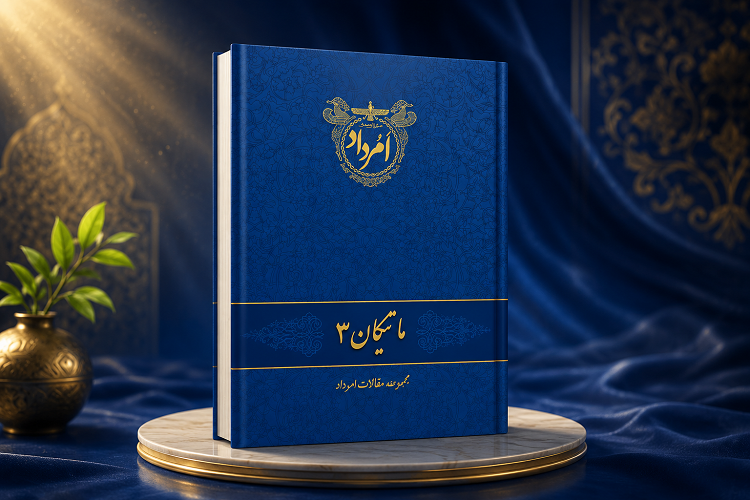
“ماتیکان” is the title of a book whose first and second volumes were previously published through the efforts of the Amordad weekly and Barسام Publishing and made available to readers interested in the history and culture of Iran. The third volume of ماتیکان is now before readers seeking Iranological studies in all their breadth and diversity. Further volumes of the book will also be published in the future.
Part of the printing costs of ماتیکان ۳ was donated in memory of the late Ardeshir Foroudi by his wife, Mahnaz Mojgani, and his children, Farin and Soroush Foroudi, in support of this cultural undertaking.
The book contains a collection of essays, some of which were previously published in the Amordad weekly, while others are being published for the first time.
ماتیکان ۳ contains 23 essays, which can be categorised as follows:
1. Studies of the Gathas and the Life and Thought of Zarathushtra
Discussion of the Gathas of Zarathushtra is highly informative and valuable. The essays related to the Gathas in ماتیکان ۳ include:
-
“The Gathas and Their Influence on Other Parts of the Avesta”, by Mehrdad Ghadardan. In this scholarly study, the author examines the influence of the Gathas on the Yashts, Visperad and Khordeh Avesta, presenting substantial arguments in support of his findings.
-
“The Value of Zarathushtra’s Thought in Today’s World”, by Kourosh Niknam. The vision and thought of Zarathushtra remain instructive and significant for the modern world. The author highlights examples of this outlook, including the universal character of these ideas, openness to knowledge, rational thought and other related principles.
2. Ancient and Medieval Iranian History
Essays shedding light on important periods of Iran’s ancient and medieval history include:
-
“The Statecraft of Darius the Great”, by the late Professor Farhad Abadani. In this scholarly essay, he discusses the birth and childhood of Darius, the beginning of his political career, his accession to the throne, the administrative system he effectively organised, road construction, his approach to justice, his humane treatment of followers of different religions and several other subjects of considerable importance. The essay introduces readers to an important part of the rich heritage of the Achaemenid Empire.
-
“Cyrus the Great and His Name”, by Dr Afsaneh Goli. The author examines the life of Cyrus the Great, conducts an in-depth study of his name and investigates his position in ancient writings, reaching informative conclusions.
-
“Iran (Media, Persia, Parthia)”, by Ahmad Nouri (Aryachehr). The boundaries of historical and cultural Iran have long been a subject of debate. In this essay, the author approaches the question from a scholarly perspective and draws a connection between history and mythology by referring to the story of Fereydun’s division of the world among his three sons, Iraj, Salm and Tur.
-
“The Flame of Shiz: Examining the Role of Khosrow II’s Policies in the Collapse of the Sasanian Empire”, by Dr Mehdi Yarahmadi. The author first divides the reign of Khosrow II into three periods and then analyses each period to assess the role of this Sasanian monarch in the destruction and eventual collapse of the Sasanian Empire.
-
“Examining Greek Sources on the Life of Cyrus the Great”, by Dr Kourosh Salari. Despite extensive scholarly research, questions still remain concerning the life of Cyrus the Great. In this essay, the author traces the life of the Achaemenid ruler through Greek sources.
-
“The Identification of the Time, Place, Names and Titles of the Median Kings with the Kayanian Kings”, by Javad Mofrad Kahlan. The author argues that the Kayanian kings mentioned in the Avesta, Pahlavi books and the Shahnameh were in fact the same rulers as the kings of Media. He presents significant arguments in support of this view.
-
“The Role of Tribes in the Rise and Fall of Iran’s Royal Dynasties”, by Dr Mehdi Keyvani. The author seeks, through an illuminating study, to trace the role of Iranian tribes in the historical transformations of the country and in the emergence of ruling dynasties.
3. Cultural Figures of Iran
Another group of essays in ماتیکان ۳ focuses on influential cultural figures throughout Iran’s history:
-
“The Influence of Persian-Language Poets on Amir Ali-Shir Nava’i’s Turkish Poetry”, by Dr Amir-Teymour Rafiei. Nava’i, the capable minister of the Timurids, was a gifted poet and man of letters. A number of his poems survive in Turkish, and he is regarded by some as a founder of Turkish poetry. The author examines Nava’i’s literary influences, including Persian-language poets such as Attar, Hafez and Jami.
-
“The Fire of Love in the Thought of Hallaj and the Mobadan Mobad”, by Dr Nasrollah Pourjavadi. A leading scholar of Iranian mysticism and its practitioners, the author examines the evolution of the concept of “love” before exploring the concept from the perspective of Hallaj and comparing it with the ideas of Adhar Farrobay, the Mobadan Mobad.
-
“Hormuzan Taught Umar the Methods of the Iranian Bureaucracy”, by Amir Soroush. If Hormuzan is considered not only in terms of his political position during the Sasanian period but also as a cultural figure, this essay belongs among the studies of Iran’s cultural personalities. The author presents historical evidence to illustrate how Hormuzan transmitted Iran’s long-established bureaucratic traditions to the Arabs.
4. Iranian Art and Rock Inscriptions
It is impossible to discuss Iran’s past without referring to its art. Among the essays in ماتیکان ۳ on this subject are:
-
“The Origins of Music and Musical Entertainment in Iran”, by Leila Haj-Abed. As its title suggests, the essay examines the antiquity of musical art among Iranians.
-
“The Stone Inscriptions of the National Museum of Iran”, by Dr Hamidreza Gholichkhani. Beyond their historical significance, stone inscriptions should also be regarded as works of art. This essay examines and introduces the marble inscriptions held at the Museum of Ancient Iran.
5. The Shahnameh and Mythology
The essays in ماتیکان ۳ dealing with the Shahnameh and mythology include:
-
“Simorghdokht: Examining the Aspects and Expressions of Sindokht’s Character in the Verses of the Shahnameh”, by Dr Katayoun Namirian and Narges Ghanavati. Simorgh occupies a prominent and distinguished position in the Shahnameh. The authors examine the mythical bird Simorgh from a new perspective.
-
“Myth in the History of Bayhaqi”, by Ali Hamidinia. The History of Bayhaqi is not merely a historical and literary work; it also contains themes that demonstrate its connection with mythology. This essay explores that relationship.
-
“Tradition Prevails, Not Idealism!”, by Asgar Bakhshoudeh. This essay offers a fresh examination of the Shahnameh and considers values that have received comparatively little attention.
-
“The Dialectic of a Statement”, by Bijan Janfashan. The essay discusses historical signs and references found in some of the stories of the Shahnameh.
6. Iranian Identity
Several essays in ماتیکان ۳ address the question of Iranian identity:
-
“The Cultural and Identity-Based Image of Iranians in Official Achaemenid Documents”, by Dr Zagros Zend. The author offers an in-depth examination of the concept of “self-perception” or “the view from within” in Achaemenid documents, including inscriptions and clay tablets. By “self-perception”, he means an understanding derived from Iranian sources rather than from the writings of foreigners.
-
“Persian Speakers of Iran and the Construction of the Persian Ethnic Identity”, by Ardalan Kouzehgar. The author examines the history of the name “Persia”, the emergence of the adjective “Persian” in reference to Persian speakers, and other related examples, concluding that the use of “Persian” to designate Persian-speaking people does not have a history extending back to before the modern period.
7. Geographical Studies
Geography is inseparably linked with history. Without an understanding of geography, historical knowledge cannot be complete. The geographical study in ماتیکان ۳ is:
-
“Greater Khorasan and Turan Instead of Central Asia and Middle Asia”, by Mehran Shafiei-Nasab Langaroudi. The proposal put forward by the author deserves consideration. He examines the historical roots of geographical names and criticises the use of newly coined geographical designations.
8. Other Essays in ماتیکان ۳
-
“The History of the Emergence of Genetics in the World and Iran, from Zarathushtra to the Third Millennium”, by Mohammad-Hassan Kariminejad and Ardeshir Khorshidian. Genetics in ancient Iran is a relatively new and significant subject, which the authors address in an exploratory study.
-
“The Sasanian Penal System”, by Ava Owhadi Navaei. The essay examines an important subject: the judicial system and its foundations during the Sasanian period.
The third volume of ماتیکان (A Collection of Essays from Amordad), comprising 235 pages and featuring a foreword by Babak Salamati, has been published and distributed by Barسام Publishing, in cooperation with the Amordad weekly.
Introduction to Matikan 1 and 2; Amrdad's Iranology Articles
Page Term Reference
Comments