

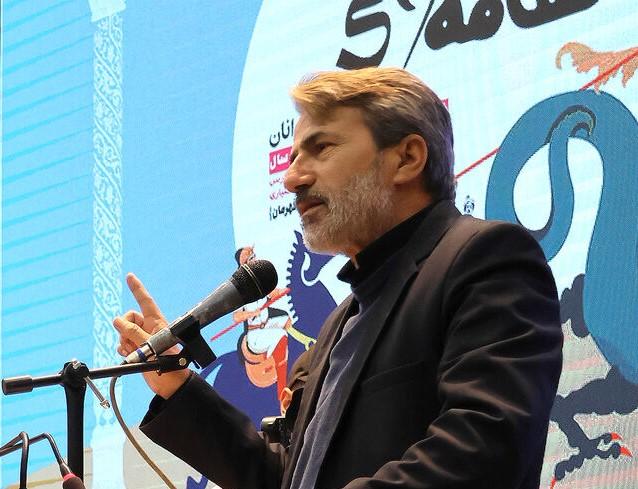
Shahnameh Researchers Club — Alireza Ghiamati: “The Shahnameh Is One of Our Greatest Assets for Preserving Persian Identity”
Alireza Ghiamati, a researcher of the Shahnameh and a professor of Persian language and literature, said in a recent interview with the Iranian Students News Agency (IBNA):
“A country with an ancient heritage should not lose its culture and identity. For this reason, I believe that the wave of globalisation should not undermine our national identity. In this regard, the Shahnameh and our proud literary heritage are among our greatest assets for ensuring our continuity.”
According to the Shahnameh Researchers Club, the interview was conducted as part of a discussion on “Literature and National Identity”, examining the role of epic and mysticism in reconstructing Iranian selfhood and the position of the Persian language as a force connecting dispersed identities across Central Asia.
The Shahnameh and the Iranian Conception of National Identity
In your works, you have examined the influence of the Shahnameh on other national epics and compared it with the Iliad and the Odyssey. In your view, what distinguishes national identity in Eastern and Western epics, and what characteristics make the “Iranian self” distinctive in Eastern epics, particularly in the Shahnameh?
The differences are quite clear. The Shahnameh cannot simply be compared with the Iliad and the Odyssey; it should be considered alongside the great epics of the world as a whole — from the Mahabharata and Ramayana in India to Goguryeo on the Korean Peninsula and the works of Virgil.
None of these works can be regarded as identical or equivalent to the Shahnameh, because the Shahnameh is fundamentally different. It contains the various dimensions of national identity in an exceptionally comprehensive form.
Here, the concepts of country and homeland are not confined to a particular geographical territory. They encompass an entire world of ideals, culture, mythology, history, rational thought, virtue, ethics, truthfulness, forms of governance and ways of life.
All these symbols can be found in the Shahnameh, whereas they do not appear in the Iliad and Odyssey in the same manner.
The important point is that in the Iliad, the Odyssey, and even the Indian epics, conflicts are largely tribal or ethnic wars. We do not encounter the same explicit representation of national identity; rather, the conflicts often take place between different groups within a broader cultural world.
In the Shahnameh, however, the conflicts are explicitly national in character. Iran stands against Turan, foreigners, the Arabs and the Romans. For this reason, the Shahnameh can be regarded as a fully developed national epic, in which the subtleties and symbols of Iranian nationality are clearly visible.
From flags and the Iranian tree to Iranian customs, rituals and mourning ceremonies, the work contains virtually every major marker of Iranian national identity.
Iranian Mysticism and a Universal Human Identity
In your book Iranian Mysticism: Messenger of Love and Truth, you emphasised the ethical dimensions of mysticism. Can Iranian mysticism be regarded as a layer of national identity that transcends geographical boundaries? And how can we draw upon this mysticism to reconstruct our identity in the modern world?
In Iranian Mysticism, we examined the Iranian strands and roots within the mystical tradition.
Of course, mysticism as a phenomenon is shared among peoples everywhere and cannot be restricted to a particular religion or nationality. There are certainly common mystical elements across different nations and faiths. At the same time, however, each tradition possesses its own distinctive characteristics.
For example, Western mysticism differs from Eastern mysticism, while the mystical traditions of China and India differ from those of Iran and Central Asia, even though they share a common essence.
In our examination of Iranian mysticism, we focused on dimensions that are shared by humanity as a whole, because mysticism seeks to bring human beings closer together regardless of their religion, faith or nationality, removing walls and distances between them.
We examined the specifically Iranian characteristics of mysticism from this perspective. These include concepts such as the unity of existence, union with God, and the Iranian conception of the divine — God as a compassionate, just and benevolent being.
We also examined the Iranian conception of the afterlife, heaven and hell, and union with God. For Iranian mystics, doing good and bringing a smile of contentment to the faces of the oppressed represents the most beautiful form of paradise.
Persian as a Bond Across Central Asia
To what extent do you believe the Persian language can serve as a force connecting dispersed identities across Central Asia, and what role can it play in reviving the shared identity of “Greater Iran” or the “Iranian cultural world”?
Without a doubt, the greatest defining feature of Iranian civilisation and the Iranian cultural world is the Persian language and its literature.
If we are looking for the most effective means of bringing different peoples together, we will undoubtedly find it in Persian language and literature.
In past centuries, Persian possessed a degree of reach and inclusiveness that, unfortunately, it no longer enjoys today because of various antagonisms.
Ibn Battuta, the Moroccan traveller, travelled from the westernmost parts of the Islamic world to its easternmost reaches, including present-day Indonesia. He writes that wherever he went and whichever city he reached, because he did not know the local languages, he communicated with people in Persian.
He even spoke Persian with the ruler of Constantinople — present-day Istanbul. He also communicated in Persian with the King of Siam, present-day Thailand, and in Malaysia. All of this demonstrates the extraordinary reach and geographical scope of the Persian language during that period.
Unfortunately, in the Indian subcontinent, colonial manoeuvring caused a language that had once been familiar to people throughout India to reach a point where today it is not even widely regarded as a second or third language and has largely faded from everyday use.
Although Indian languages and Urdu contain a very large number of Persian words, the people of India can no longer generally communicate using the structure of the Persian language itself.
Nevertheless, in Central Asia — from Samarkand and Bukhara to Khwarazm and Khiva in present-day Uzbekistan; from Khujand and Dushanbe in Tajikistan to Balkh, Ghazni, Herat and Kabul in Afghanistan; and throughout the geographical territory of Iran itself — Persian remains a connecting force.
Even countries such as Turkmenistan cannot separate their history from the Persian language. The same is true of Kazakhstan and parts of Kyrgyzstan, because a significant portion of their history, mythology and culture is expressed through Persian.
Globalisation, Subcultures and the Preservation of Iranian Identity
At a time when local identities are under pressure from “globalisation” and subcultures are disappearing, to what extent do you support the preservation of subcultures? And if we wish to preserve Iranian culture, how much can our classical literature — particularly the Shahnameh — contribute to preserving national identity?
If by “globalisation” we mean greater interconnectedness with the peoples of the world, then this very idea is reflected extensively in our culture, literature, history and mythology, particularly in the Shahnameh.
But if globalisation means losing our national culture and identity, then I believe this is no longer globalisation; it is being swallowed up.
Unfortunately, we are moving towards a situation in which the wave of globalisation is eroding the identities and subcultures of nations.
Some nations may be affected by this process, but this should not be the case for us. We are a civilised country with an ancient history, one of the world's great civilisations and, indeed, the creator of what is often regarded as the world's first empire on a truly global scale.
Some people say: if an Arab country such as the United Arab Emirates can hold a magnificent Christmas festival alongside the Burj Khalifa without resisting it, or if Christmas has become popular in Pakistan and Turkey, why should we resist it? Why should we not embrace it as well?
I say to these friends: the reason countries such as the UAE or Pakistan embrace Christmas is that they do not have an equivalent tradition of their own. But we have Nowruz, with a history stretching back thousands of years.
I do not mean to say that our traditions are necessarily “better”, because in my view there is no absolute cultural superiority. But they are undoubtedly more thought-provoking, more vibrant, more joyful and more ethically oriented.
For example, if some Arab countries or other parts of the world celebrate Valentine's Day as a festival of love, it is because they have no equivalent of their own. We, however, have Sepandārmazgān. We had a celebration honouring women and love long before such modern customs became widespread.
Therefore, if a country has no cultural alternative of its own and wishes to adopt another culture, perhaps that can be understandable. But a country with an ancient heritage should not lose its culture and identity.
That is why I believe that the wave of globalisation should not undermine our national identity. In this regard, the Shahnameh and our proud literary heritage are among our greatest assets for ensuring our cultural continuity.
Bringing Ancient Texts to a New Generation
How necessary do you consider revisiting ancient texts for the revival of national identity? How can ancient texts be used in the modern world so that younger generations can establish a meaningful connection with them?
I see the application of this idea in the following way: we cannot simply tell young people that they must go and engage directly with old texts such as Tarikh-e Beyhaqi, the Shahnameh, or the works of Hafez.
I believe that we should not begin with the original texts themselves. Instead, we should present these works in contemporary forms.
In other words, we should enrich them through art and combine them with modern technology, communications and social media.
We should place every available form of technology and art at the service of these texts — from performing arts and cinema to music, miniature painting and the visual arts.
For example, we could create video games based on the Shahnameh, using them to introduce its concepts and stories to younger generations and subsequently guide them towards the original text of the Shahnameh.
The same approach can be applied to other great works such as the Bustan and Gulistan of Saadi.
In my view, by employing contemporary technology, understanding the language and world of our audiences, and making effective use of art, we can achieve this goal.
Page Term Reference
Comments