
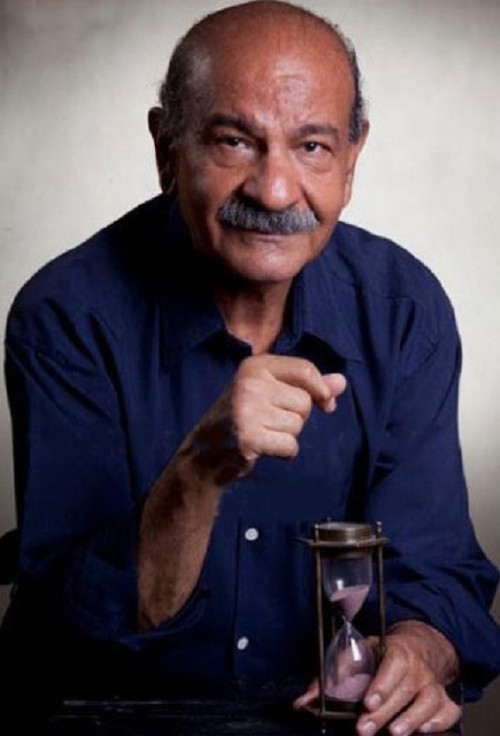
The roles that the late Ferdous Kaviani created in cinema, theatre, and television are part of an artistic legacy that will not fade from the memory of the Iranian people. He was a master of character portrayal, possessing an undeniable ability to bring his roles to life. On the eighty-fifth anniversary of his birth, we commemorate his enduring memory.
Ferdous Kaviani was born in the ancient and historic city of Kerman and inherited the cultural heritage of that land. Born into a Zoroastrian family on 26 September 1941 (4 Mehr 1320), he passed away in Tehran in the same month of Mehr. Indeed, his life and spirit seemed filled with mehr—love, affection, and kindness—and with a deeply compassionate way of living.
Kaviani grew up in his hometown. From childhood, he developed a passionate interest in acting. Perhaps it was this enthusiasm that led him, soon after completing elementary school, to move to Tehran, where he sought to study acting and the performing arts at the capital's schools and under established teachers. Yet he also had to work to support himself. Eventually, after obtaining his high-school diploma, an opportunity arose for him to travel to Germany. Remarkably, while in Germany, Kaviani studied chemistry. He soon became disillusioned with the field, however, and returned to Iran.
It was now 1961 (1340 in the Iranian calendar), and Iran had already experienced numerous social developments and transformations.
Ferdous did not waste time. After taking the national entrance examination, he entered the Faculty of Fine Arts at the University of Tehran, where he studied acting and directing. He completed his studies in 1971 (1350) and continued to pursue his artistic career with even greater determination.
Through his masterful performances in numerous films and television series, Ferdous Kaviani established himself as a highly accomplished actor with a remarkable ability to inhabit and portray his characters. His memorable performance in the television series Hamsaran (The Spouses, 1998/1377) remains unforgettable. The series had an engaging story, and Kaviani's performance, together with those of the other actors, added considerably to its appeal.
His role in the television series Ajans-e Dusti (Friendship Agency, 1999/1378) was also among the most enduring performances of his career. He played the driver of an agency, around which the events of the story unfolded. The series consisted of fifty-three episodes and attracted a large television audience.
We should also remember the widely popular children's series Mahalle-ye Boro-Bia (The Come-and-Go Neighborhood, 1983/1362), in which Ferdous Kaviani appeared alongside the late Reza Zheyan and Akbar Abdi, as well as Atila Pesyani, Fatemeh Motamed-Arya, and Hamid Jebeli, creating a highly memorable work. The series was produced for children and directed by Dariush Mo'addabian.
Another memorable television series was Mahalle-ye Behdasht (The Neighborhood of Health, 1984/1363). In this children's series, Kaviani appeared alongside well-known actors from Iranian television and cinema, portraying the neighborhood physician.
Ferdous Kaviani's cinematic works, too, include some of the notable films of Iranian cinema. He collaborated with prominent directors and demonstrated his exceptional and masterful acting abilities in their productions. Among these films were The Tenants (Ejareh-Neshinha), directed by Dariush Mehrjui (1986/1365); Spring in Autumn (Bahar dar Paeez), directed by Mehdi Fakhimzadeh (1987/1366); Savalān, directed by Yadollah Samadi (1989/1368); Banu, directed by Dariush Mehrjui (1991/1370); Del o Doshneh, directed by Masoud Jafari Jozani (1994/1373); The Mix (Mix), directed by Dariush Mehrjui (1999/1378); Killing Mad Dogs (Sag-Koshi), directed by Bahram Beyzai (2000/1379); and The Non-Profit Police Station (Kalantari-ye Gheyr-Entefāei), directed by Yadollah Samadi (2008/1387), among many others.
Kaviani also appeared in numerous television theatre productions, and in each performance he demonstrated his considerable talent and professionalism. He won the Crystal Simorgh for Best Supporting Actor at the 7th and 17th Fajr International Film Festivals, held in 1989 and 1998 (1367 and 1377), respectively. At the 42nd Fajr Festival, he was also honored with a special Crystal Simorgh recognizing a lifetime of artistic activity.
In the final years of his life, Ferdous Kaviani developed Parkinson's disease. As a result, he was forced to remain away from his work and the stage for a considerable period of time. Then, at the Night of Theatre Actors celebration on 6 May 2017 (16 Ordibehesht 1396), despite having great difficulty walking and speaking, he expressed his happiness at being there among his fellow artists.
He had returned to the stage—a place where he had spent his entire rich artistic life, bringing countless characters to life through his performances: the stage of acting.
Page Term Reference
Comments