
An impactful life is not necessarily a celebrated life; it is a life that leaves the world, after we are gone, a little wiser, kinder, more prosperous and brighter than we found it.
A human being does not come into this world merely to pass the days, fulfil everyday needs, and eventually fade from memory. Consciously or unconsciously, through every look, word, choice and action, each person leaves an impression on the world around them. Perhaps the fundamental question of life is not, “How many years have we lived?” but rather: What light have we added to our own lives and to the lives of others during those years?
Every human being has the capacity to become a source of goodness, knowledge, beauty, peace, progress and hope. Making an impact does not always begin with a famous name, great wealth or a position of prominence. Sometimes it begins with a sound idea, an honest word, responsible conduct, an invention, teaching, helping someone in need, or simply remaining steadfast in doing one’s duty properly. A person who makes an impact is someone whose presence makes something in the world better.
Undoubtedly, human history is not merely the history of poets and literary figures. In every corner of the world, scientists, inventors, physicians, teachers, industrialists, artists, philosophers, philanthropists and thinkers have emerged, lived and left their mark. Names such as Thomas Edison, Albert Einstein, Marie Curie, Avicenna (Ibn Sina), Al-Biruni, Al-Khwarizmi, Al-Razi and hundreds or thousands of others remind us of a fundamental truth: human growth and creativity have always been shaped by those who have questioned, learned, experimented, failed and risen again. Such people have existed, exist today, and will continue to exist.
Yet in this article, the great poets and writers of Iran are deliberately drawn upon, because they were not merely creators of poetry and beauty. They played a profound role in shaping the cultural, moral, emotional and spiritual consciousness of Iranians. They spoke of love, wisdom, suffering, hope, justice, identity, humanity, death, friendship and responsibility, and for successive generations they kindled a light along the path of living.
The Human Being and the Great Question: “Why Have I Come?”
At some point in life, every person encounters fundamental questions: Who am I? What abilities do I possess? What was I made to do? What is my contribution to making life better? What will remain after I am gone?
The answers to these questions are not the same for everyone. One person makes an impact through knowledge and research; another through art, education, industry, management, raising children, medicine, entrepreneurship, social service or everyday kindness. What matters is that a person should not turn life into nothing more than the consumption of time. Everyone should know themselves and strive to transform their abilities, experience and conscience into something beneficial.
Being the best version of oneself does not mean being superior to others. It means becoming more aware, responsible, capable, compassionate and truthful than one was yesterday. The true competition is not with another person, but with the laziness, fear, aimlessness, resentment, ignorance and indifference within oneself.
Ferdowsi: Wisdom, Truth and Responsibility Towards History
Ferdowsi, the great epic poet of Iran, presents life as a battlefield between wisdom and folly, justice and injustice, loyalty and betrayal. The Shahnameh is not merely a story of kings and heroes; it is a book about human responsibility towards oneself, one's people, one's homeland and the truth.
By composing the Shahnameh, Ferdowsi devoted his life to a work that extended far beyond his personal existence. He preserved Iran's language, mythology, values and cultural memory in an enduring form. His lasting legacy began with the fact that his purpose was not merely personal fame; he remained steadfast for many years in pursuit of a greater ideal.
“Powerful is the one who possesses knowledge;
Through knowledge, an old heart becomes young.”
In Ferdowsi's view, true ability arises from knowledge. A person who wishes to make an impact must learn, think and transform knowledge into beneficial action. He also makes clear the ethical limits of power:
“Do not harm even an ant that carries a grain,
For it has a life, and life itself is sweet.”
In other words, power, knowledge or status can never justify harming another being.
Ferdowsi's message for today: Live with wisdom, do not remain indifferent to falsehood and injustice, and do something that will continue to benefit others after you are gone.
Rudaki: Hope, Simplicity and the Strength to Rise Again
Rudaki, regarded as the father of Persian poetry, teaches through his clear and deeply human language that, however difficult life may become, there is always the possibility of beginning again. His poetry is filled with movement, hope and a return to life.
“The scent of the Mulyan stream comes to me;
The memory of a beloved friend comes to me.”
In Rudaki's poetry, the bonds of friendship, home, memory and the simple beauties of life are precious. He reminds us that we must not become so consumed by suffering and failure that we forget the way back to the light.
Rudaki's message for today: Do not empty your heart of hope. Life, with all its ups and downs, remains an opportunity to see beauty, to create and to rise again.
Khayyam: Awakening to Time and Honesty with the Present Moment
Khayyam, the questioning scientist and poet, confronts humanity with the fleeting nature of life. He understood that many regrets arise when people continually postpone life until tomorrow and forget the value of the present.
“How strangely the caravan of life passes;
Seize the moment that passes with joy.”
For Khayyam, “seizing the moment” does not mean irresponsibility; it means awakening. It means not postponing affection, not delaying learning, making use of healthy and constructive opportunities, and not allowing our talents to wither while waiting for the perfect moment.
Khayyam also invites us to approach the unknown with humility. He teaches us that claiming to know everything is not a sign of wisdom; sincere questioning is a sign of maturity.
Khayyam's message for today: Honour time, live consciously, and instead of allowing yourself to be consumed by neglect and procrastination, take action for what truly matters.
Sanai: Inner Awakening and Moving Beyond the Surface of Life
Sanai of Ghazna cautions human beings against becoming captive to appearances, greed, pride and self-centredness. In his view, a person may appear outwardly successful, yet if their inner world is devoid of truth, compassion and awareness, they have not truly attained a worthy way of living.
Sanai urges us to continually ask ourselves: Has what I have achieved also made me a better human being? Have power, knowledge, wealth or social position been placed in the service of humanity, or have they merely served to make my selfishness greater?
Sanai's message for today: Let outward growth go hand in hand with inner growth. A great life is not built merely through what we possess; it is built through what we become.
Rumi: Transformation, Love and Moving Beyond the “Smaller Self”
Rumi, the poet of movement and transformation, sees the human being as a creature in a continual process of becoming. He believes that a person should not remain trapped in a single failure, a particular suffering, a fear or a limited definition of the self. Human beings can continually renew themselves, learn and rise towards a higher level of understanding and love.
“I died as a mineral and became a plant;
I died as a plant and rose to animal;
I died as an animal and became human;
So why should I fear? When have I become less by dying?”
Rumi does not regard suffering as an end to life, but rather as a polishing of the soul, removing impurities and revealing the hidden jewel within. In his view, a person without pain or challenge is someone who has not yet fully grown. He teaches us that suffering, when approached with awareness and patience, can become a springboard for moving from the “smaller self” — imprisoned by transient desires, fears and selfishness — towards the “greater self”, a self connected with existence, truth and love.
Rumi invites human beings to abandon habitual patterns of thought and restrictive intellectual frameworks. To reach the “best version of ourselves”, he argues, we must move beyond the prison of prejudice, pride and superficial judgement. In Rumi's vision, becoming one's best self means reaching a state in which love of truth and service to others replace self-worship. He believes that through “voluntary death” — that is, turning away from pride and destructive selfishness — we can attain a life that is genuine, free and capable of making a meaningful impact.
From Rudaki to Einstein: Humanity, Purpose and Making an Impact on the World
Throughout history, countless influential people have emerged from different lands, cultures and eras, lived their lives and passed away; yet the effects of their ideas and efforts continue to flow through human life. Poets and writers such as Rudaki, Ferdowsi, Nizami, Khayyam, Sanai, Attar, Rumi, Saadi, Hafez, Saib Tabrizi, Shahriar, Nima Yushij, Sohrab Sepehri and many others have opened new horizons of thought, ethics, love, identity and the meaning of life through the language of poetry and literature.
Alongside them, great scientists, thinkers, inventors, reformers and artists such as Thomas Edison, Albert Einstein and thousands of other influential people have transformed the course of human development and creativity through discovery, creation, research and perseverance. They have shown us that making an impact does not take place in only one field. Sometimes it takes the form of a poem; sometimes a scientific theory; sometimes the creation of a tool; sometimes the education of another human being; and sometimes a simple, anonymous act of kindness. In each case, the world takes one step towards becoming a better place.
Therefore, this article should not be understood as disregarding scientists and great figures from other nations. Rather, its focus is deliberately placed on the great poets and writers of Iran. The reason for this choice is that Iranian poets were not merely creators of literary works; they also played a fundamental role in shaping the cultural, moral and spiritual consciousness of Iranians. Their poetry became a school for thinking, living, loving, dignity, patience, resisting hypocrisy and safeguarding human dignity.
Each of these great figures served the world in a different way. Ferdowsi, through the Shahnameh, preserved the memory and identity of a nation; Rudaki opened the path of Persian poetry; Khayyam invited human beings to awaken to the passage of time; Sanai and Rumi called upon humanity to undertake an inner journey and free itself from selfishness; Saadi taught social ethics and empathy; Hafez challenged hypocrisy and outward pretence; Saib transformed the small experiences of everyday life into profound wisdom; Shahriar turned emotion, memory and his bond with ordinary people into poetry; Nima Yushij transformed traditional forms and carried Persian poetry towards new horizons; and Sohrab Sepehri invited human beings to see the world, nature and the purity of perception anew.
Rudaki, regarded as the father of Persian poetry, demonstrated that a proper beginning can alter the destiny of an entire culture. He gave the Persian language new strength and beauty and proved that influence does not always begin with grand or spectacular achievements. Sometimes a clear idea, a beautiful verse or a new linguistic expression can lay the foundations for centuries of flourishing.
Nima Yushij, too, stands as a clear example of the courage required for innovation. He understood that, for poetry to remain alive, it must engage with its own age and, when necessary, transform worn-out forms. Nima did not regard breaking with tradition as an end in itself; rather, he sought to connect the spirit of poetry with the needs and experiences of modern human beings. From him, we learn that loyalty to the past should never become an obstacle to creativity and the search for the new.
Sohrab Sepehri, by inviting human beings to “wash their eyes” and see again, reminded us that many of life's darknesses originate in the habitual and misguided ways in which we look at the world. He did not see nature merely as a beautiful landscape; for him, nature was a school of humility, purity and tranquillity. Sepehri's vision draws human beings away from consumerism, violence and haste and towards simplicity, contemplation and respect for the living world.
What Were Human Beings Created For?
The fundamental question is not how long a person lives, how much wealth they accumulate, or how famous they become. The essential question is:
Why have we come into this world, and what impact are we meant to leave behind?
Every human being enters the world with a unique combination of abilities, talents, experiences and circumstances. No one is exactly interchangeable with another, and no life can be perfectly replicated. One person may become a scientist, another a poet; one may become a teacher, another a physician, engineer, industrialist, entrepreneur, farmer, artist or an unknown servant of others. Yet the value of every role depends upon the honesty, competence, sense of responsibility and benefit that a person brings to the world around them.
Making an impact does not necessarily mean becoming famous. Many influential people throughout history have never had their names recorded. Yet by raising their children well, teaching their students, helping those in need, improving their communities, fulfilling their duties properly or rescuing another human being from despair, they have made the world a better place.
For this reason, every person should, in moments of solitude, ask themselves:
-
What talents have been entrusted to me?
-
What can I do better than many others?
-
Which pain or need within society speaks most strongly to my conscience?
-
How can I use my knowledge and abilities in the service of goodness?
-
If I one day leave this world, what will remain of me in the hearts, thoughts or lives of others?
These questions move a person from a merely consumer-oriented life towards a creative and purposeful life.
Zoroaster's View of Human Responsibility
In the thought of Zarathustra, the human being is a choosing and responsible creature. Faced with the paths of good and evil, truth and falsehood, creation and destruction, human beings possess the freedom to choose and are expected to use their wisdom to follow the right path. In this view, humanity is not powerless or simply surrendered to fate; through thought, speech and action, each person shapes both their own destiny and, to some extent, the destiny of the world.
The three famous principles of Zoroastrian thought —
Good Thoughts, Good Words and Good Deeds
— are not merely moral recommendations for individual behaviour; they can also be understood as a framework for building a healthy life and a healthy society.
Good Thoughts
Good thoughts mean that before speaking or acting, a person should think with wisdom, fairness and goodwill. Good thought is not the same as naivety; it does not mean ignoring difficulties. Rather, it means seeking a constructive and humane path when confronted with a problem.
A scientist researching treatments for disease, an engineer working for development and safety, a poet encouraging people towards awareness and compassion, and a manager making decisions fairly can all represent expressions of good thought.
Good Words
Good words mean that our speech should not become a source of humiliation, deception, hostility or destruction. Words can inflict a deep wound or offer renewed hope. The great Iranian poets understood the power of language; they used words to awaken, educate, comfort and build.
Good words do not mean remaining silent in the face of lies and oppression. They mean speaking the truth with responsibility and courage, without hatred or vindictiveness.
Good Deeds
Good deeds are the ultimate test of thought and speech. If our thoughts and words do not lead to right action, their impact remains incomplete. Human beings should leave tangible traces of goodness and constructive action within their families, workplaces, communities and the natural world.
From this perspective, the best human being is not someone who merely speaks about goodness, but someone whose presence brings security, trust, knowledge, peace and prosperity to others.
From Self-Knowledge to Making an Impact
Self-knowledge is the starting point of meaningful influence. A person who is unaware of their abilities and limitations may spend years travelling along a path that is incompatible with their talents and inner sense of purpose. Self-knowledge is not narcissism; it is an honest understanding of oneself in order to make sound choices and serve others effectively.
To develop this understanding, we should:
-
Examine our abilities and interests.
-
Learn from our experiences and failures.
-
Pay attention to the genuine needs of society.
-
Avoid constantly comparing ourselves with others.
-
Continually expand our knowledge and skills.
-
Maintain a balance between personal desires and social responsibility.
-
Consider the effects of our decisions on other people and the environment.
A person becomes the best version of themselves when they do not use their talents solely for personal gain, but connect those talents with responsibility and the common good.
Final Conclusion
Throughout history, countless poets, writers, scientists, philosophers, artists, teachers, reformers and ordinary people have come and gone; yet each has added something to the world according to their abilities. Some did so through poetry, some through knowledge, some through invention, some through education, some through the struggle for justice, and some simply through living a decent and useful life that illuminated the path for others.
We are no exception to this rule. We are not all expected to become Ferdowsi, Hafez, Rumi, Edison or Einstein. But every human being can become the best version of themselves within their own place in the world. A person can be honest and capable in their profession, kind and responsible within their family, useful to society and courageous in the face of truth.
Zarathustra teaches us that the world is shaped by our choices. Every good thought, every truthful word and every constructive deed is a force for the betterment of the world; while every lie, act of irresponsibility, hatred and destruction moves the world one step further away from truth and peace.
Therefore, we must ask ourselves:
Why was I created? What ability lies within me? And how can I fulfil my share in making the world a better place through good thoughts, good words and good deeds?
The answer to this question does not lie in waiting to discover some mysterious mission. It takes shape through our daily actions: in the work we do properly, the person we help, the knowledge we acquire and pass on, the suffering we alleviate, the lie we refuse to tell, the right we refuse to violate, and the hope we keep alive in another person's heart.
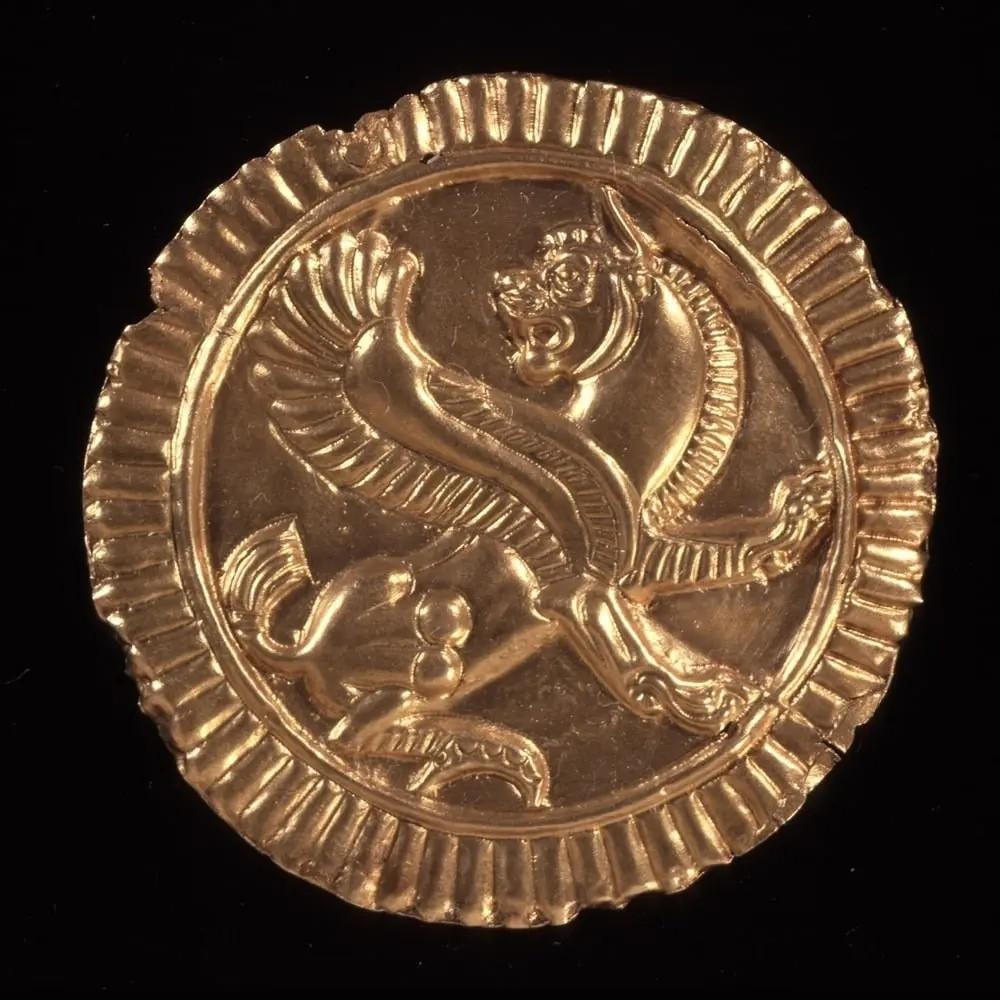
Achaemenid Golden Griffin
This golden griffin plaque, belonging to the Achaemenid royal dynasty of Persia, is a brilliant example of ancient Persian goldsmithing. It was crafted to be sewn onto formal or ceremonial garments. At its center is a repoussé depiction of a griffin—a mythical creature with the body of a lion, outstretched wings, and the head of an eagle or a powerful predatory animal—which was regarded in the culture and art of the period as a symbol of strength, kingship, and protection. The precise details in the design of the wings, body, and face demonstrate the exceptional skill of Achaemenid metalworkers. The surrounding scalloped border further enhances the plaque’s visual prominence while also contributing to its structural durability.
Griffins were among the most recognizable mythical symbols in the art and architecture of Achaemenid Persia, with examples appearing in the palaces of Persepolis and other royal monuments. The use of such imagery on golden plaques sewn onto the garments of nobles or royal guards reflects the deep connection between mythology, aesthetics, and the structure of political power in that era. This plaque was not merely a magnificent ornament; it also served as a carrier of the cultural and political messages of the Achaemenid Empire.
Page Term Reference
Comments