

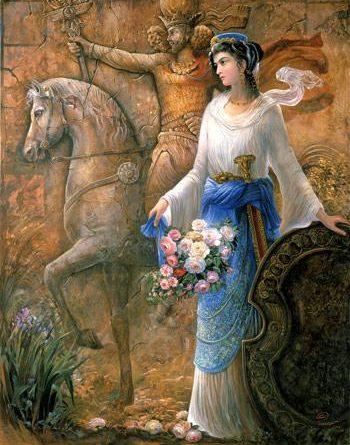
Faranak, the wife of Abtin and the mother of Fereydun, is portrayed in the Shahnameh as a free-spirited, knowledgeable and thoughtful woman, compassionate and generous, a vigilant and well-organised fighter, and a caring and affectionate mother. Her character and functions can, broadly, be divided into three categories: 1. a conscious and freedom-seeking warrior; 2. a devoted mother; and 3. a generous and humanitarian individual.
A Freedom-Seeking Warrior
Faranak is the first freedom-seeking woman in the Shahnameh. The extraordinary qualities Ferdowsi attributes to her distinguish her from many other women. In an environment overshadowed by political and social repression, this woman must defend her “personal”, “familial” and “social” integrity in the most effective manner and create, on a very broad scale, the necessary conditions for an uprising and the pursuit of justice. Indeed, Faranak may be regarded as a conscious advocate for justice, pursuing a precise and deliberate plan that gradually undermines the deeper foundations of Zahhak’s rule and ultimately brings an end to his tyranny, which has lasted for thousands of years.
This is why Ferdowsi highlights Faranak’s unique role in the social uprising and open revolt that would later be brought about by Kaveh. As one scholar observes, “On the one hand, there is a hidden and long-term struggle, carefully and wisely organised in stages; on the other, there is an open uprising that subsequently sets society in motion.”¹ From a broader perspective, “she is wisdom engaged in a struggle against ignorance and evil… and is also a symbolic element of the anima that brings movement and dynamism to man.”²
Faranak’s Role as a Mother
Faranak is one of the finest, kindest and most knowledgeable mothers in the Shahnameh. Based on the poet’s descriptions, she may be regarded as the foremost woman in the Shahnameh in terms of the centrality of her maternal actions and responsibilities. Not only does she defend her child’s personal safety with complete courage, determination and vigilance in extraordinarily critical and sensitive circumstances, but she also takes great care in Fereydun’s upbringing, from selecting his guardians to providing him with moral guidance for the future. As noted above, in accordance with her social role, she must prepare her son to overthrow the tyranny of Zahhak, who is an agent of Ahriman.
Accordingly, this mother makes every effort to protect her infant son. At a time when Zahhak is searching everywhere for the child and Faranak is deeply concerned for her son’s life, Ferdowsi explicitly acknowledges the efforts of this devoted mother, who safeguards her child against every potential danger and ultimately fulfils both her social and maternal responsibilities. In other words, “Faranak’s heart becomes aware at the appropriate moment of the danger threatening her son. This perceptive heart, which represents the emergence of a divine and mythical idea, is in reality the wisdom, prudence, caution and foresight of a mother.”³ Ferdowsi confirms Faranak’s concerns regarding her son’s safety in the following verses:
An inspired thought has arisen within my heart,
Through the path of wisdom and understanding.I must do what there is no avoiding,
For my child and my sweet-souled one are one with me.⁴
(Book One, The Reign of Zahhak, 63: 137–138)
In light of these considerations, it may be said that, following the mothers of the young men who fell victim to Zahhak’s oppression, Faranak is the first mother to be deprived of her maternal rights and forced to separate from her child. Yet, despite all these hardships, Faranak fulfils her responsibilities towards Fereydun as a mother with distinction. When she realises that the fame of Barmāyeh the cow has reached Zahhak, she once again makes every effort to keep her son out of danger:
I shall leave this land of sorcerers behind,
And go with my son towards Hindustan.I shall disappear from among the people,
For my child and my sweet-souled one are one with me.
(Ibid., 64: 139–140)
It should be noted that, although Faranak does not have direct supervision over her son’s upbringing throughout this period, she carefully chooses guardians whose soundness of mind and wisdom she can fully trust. Even during Fereydun’s pursuit of justice, she patiently and calmly teaches him wisdom and restraint, although by this time he has passed beyond childhood and is considered a young man:
His mother said to him: “This is not the right course for you;
You have no power to confront the whole world.There is another way, and there are ties that bind;
Do not look upon this world merely through youthful eyes.For whoever has tasted the wine of youth
Sees none in the world but himself.”
(Ibid., 66: 178, 181–182)
In fact, through her profound understanding of society and of Zahhak’s power, Faranak warns Fereydun that if he takes action under such circumstances, nothing will follow but defeat and destruction (Bigdeli, 1379: 30). Thus, Fereydun grows up under the care of such a mother and with such an upbringing, ultimately fulfilling his role in overthrowing tyranny and injustice.
Faranak’s Generosity and Humanitarianism
In addition to the qualities described above, Ferdowsi also draws attention to Faranak’s generosity and her compassion towards the lower classes of society, bringing the positive dimensions of her character to their highest point. Following Zahhak’s capture and his imprisonment in Mount Damavand, Faranak organises a magnificent celebration and distributes an enormous amount of wealth and property among those in need. This passage by the poet may be understood to suggest that, in addition to social justice in the form of an absence of oppression and tyranny, Faranak considers attention to the material needs of different sections of society essential to achieving a just society and ensuring the continuation of the rule of justice under her son Fereydun:
From then on, whoever was in need
He provided for their needs in their difficult days.He cared for them in secret and told no one;
He kept their secrets concealed.For a whole week he gave away his possessions in this manner,
Until the poor could scarcely recognise what they possessed.
(Book One, The Reign of Fereydun, 90: 19–21)
References
- Bigdeli, Ahmad. (1379/2000–2001). “The Epic of Faranak: Woman in the Mirror of the Wisdom of the Shahnameh.” Cheshmandaz-e Iran, No. 4, p. 31.
- Mousavi, Seyyed Kazem & Khosravi, Ashraf. (1387/2008–2009). “Anima and the Secret of the Captivity of the Accompanying Sisters in the Shahnameh.” Women’s Research, Vol. 6, p. 138.
- Ibid., pp. 136–137.
- Ferdowsi, Hakim Abol-Qasem. (1386/2007). Shahnameh, edited by Jalal Khaleghi-Motlagh, Vol. 1. Tehran: Centre for the Great Encyclopaedia of Iran.
Page Term Reference
Comments