
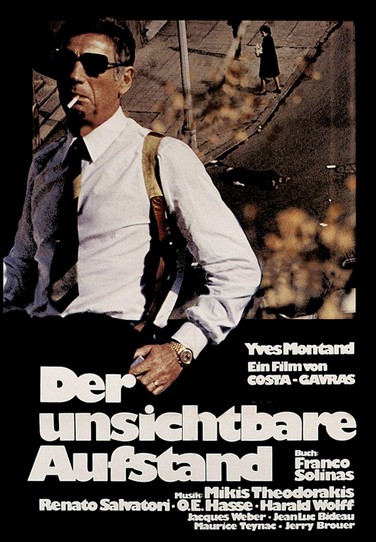
State of Siege is one of Costa-Gavras’s most incisive political thrillers, and arguably his most intellectually confrontational work. Released in 1972, it takes the structure of a procedural investigation and turns it into a moral indictment—less interested in suspense for its own sake than in exposing the machinery of state violence and foreign intervention in Latin America.
The film begins with the kidnapping of a U.S. AID official in Uruguay and quickly unfolds into an inquiry led by government authorities. But instead of building toward a conventional rescue narrative, Costa-Gavras methodically dismantles the official story. Through interrogation scenes, flashbacks, and bureaucratic exchanges, the film reveals that the kidnapped man was not a benign humanitarian worker, but a key operative in training and advising state security forces in torture and repression techniques.
Yves Montand delivers a restrained yet forceful performance as the interrogated official, embodying the calm rationality of technocratic power that the film seeks to interrogate. What makes the performance effective is its lack of villainous theatrics—he is not portrayed as overtly cruel, but as someone who has internalized a system where violence is abstracted into policy and procedure. This emotional detachment is precisely what the film critiques.
Stylistically, Costa-Gavras avoids sensationalism. The camera work is deliberate, often static, allowing dialogue and testimony to carry the weight of revelation. The editing structure resembles a dossier being assembled in real time, reinforcing the idea that truth emerges not through action but through accumulation of evidence. The result is a film that feels closer to an investigative report than a traditional thriller.
What gives State of Siege its enduring power is its refusal to simplify ideological conflict. It does not reduce politics to binary morality; instead, it exposes how democratic rhetoric can coexist with covert systems of repression abroad. The film’s critique of American foreign policy was controversial at the time of release, and it remains provocative today, not because of exaggeration, but because of its structural clarity.
While some viewers may find its pace austere or its didactic tone heavy-handed, that seriousness is also its strength. This is a film that demands attention rather than passive consumption. It challenges the audience to confront the ethical distance between administrative language and human consequence.
In the landscape of political cinema, State of Siege stands as a rigorous, unsentimental work—less a thriller in the conventional sense than a cinematic argument that refuses to be easily dismissed.
Comments