
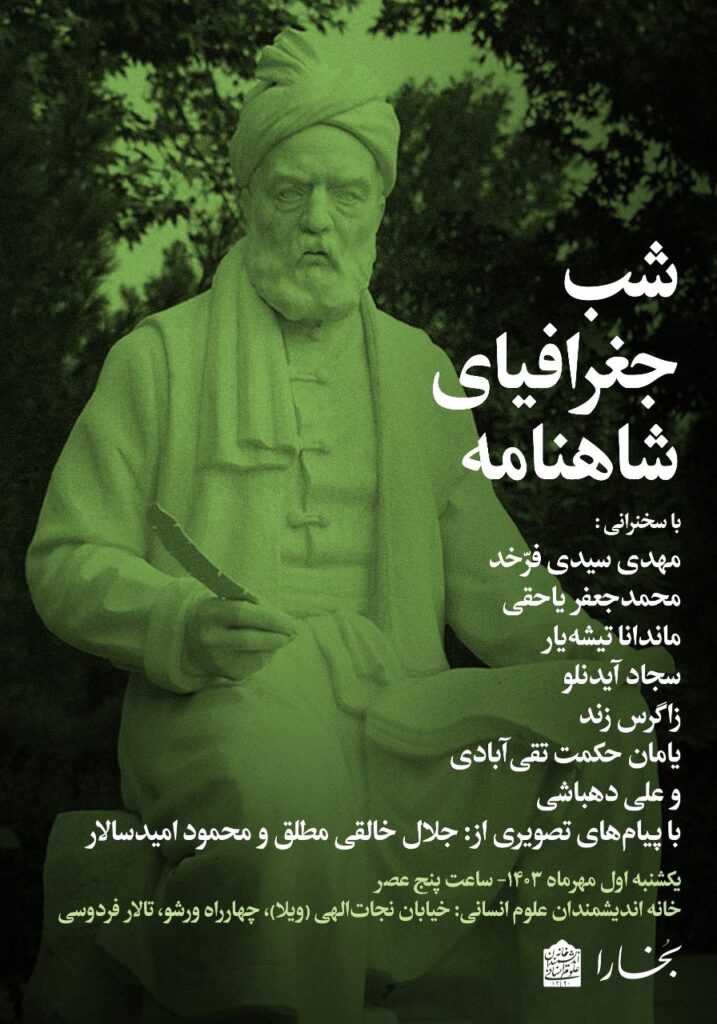
Familiarity with the geography of the Shahnameh is very important in understanding this important Persian text, because in the Shahnameh, about six hundred and twenty (620) geographical locations, including countries, territories, provinces, cities, fortresses, castles, seas, rivers, mountains, deserts, hills, springs, etc., are mentioned. Of these, about three hundred and sixty (360) are the main names, and the rest are secondary and substitute. It is clear that most of these titles and geographical names are related to Iran (the cultural area of Greater Iran), including Khorasan, Pars, Iraq, and Vararud, including cities such as: Balkh, Merv, Nishapur, Rey, Shiraz, Ardabil, Samarkand, Bukhara, etc. The rest are located in countries and territories neighboring Iran, such as: China, Machin, India, Turkestan; and beyond the Caspian Sea, Rome, and Arab lands. As a result, the names mentioned in the Shahnameh mainly belong to the current countries: Iran, Afghanistan, Pakistan, India, China, Kazakhstan, Kyrgyzstan, Uzbekistan, Tajikistan, Turkmenistan, Armenia, Georgia, Azerbaijan, Turkey, Syria, Jordan, Iraq, Arabia, Oman, Yemen, Egypt and even Rome and Greece, Russia, etc. During the several thousand years of the formation of the stories and events of the Shahnameh, dozens of different ethnic, religious and linguistic groups have occupied these lands and have remained in them or left them. It is clear that each ethnic group and group, depending on the length of time they have remained in these lands and their ethnic tastes and interests, has influenced the geographical names and changed or erased them, and instead has left new names in place of the old and original names. Therefore, the geography of the Shahnameh is now an important civilizational and identity geography, and its study under the heading of concepts such as "literary geography" and "historical and cultural geography" is a necessity and a new opportunity to reread the Shahnameh and other classical Persian literary and historical texts, because it shows what important capacities we have for the interconnection and closeness of the inhabitants of this ancient cultural geography. The study of the works of Naser Khosrow, Abolfazl Bayhaqi, Sana'i Ghaznavi, Ferdowsi Tusi, Rumi, Saadi, Jami, etc. is worth considering from this perspective. Our university and academic circles, especially the faculties of literature, should take this opportunity seriously and make it their educational priorities.
Page Term Reference
Comments