
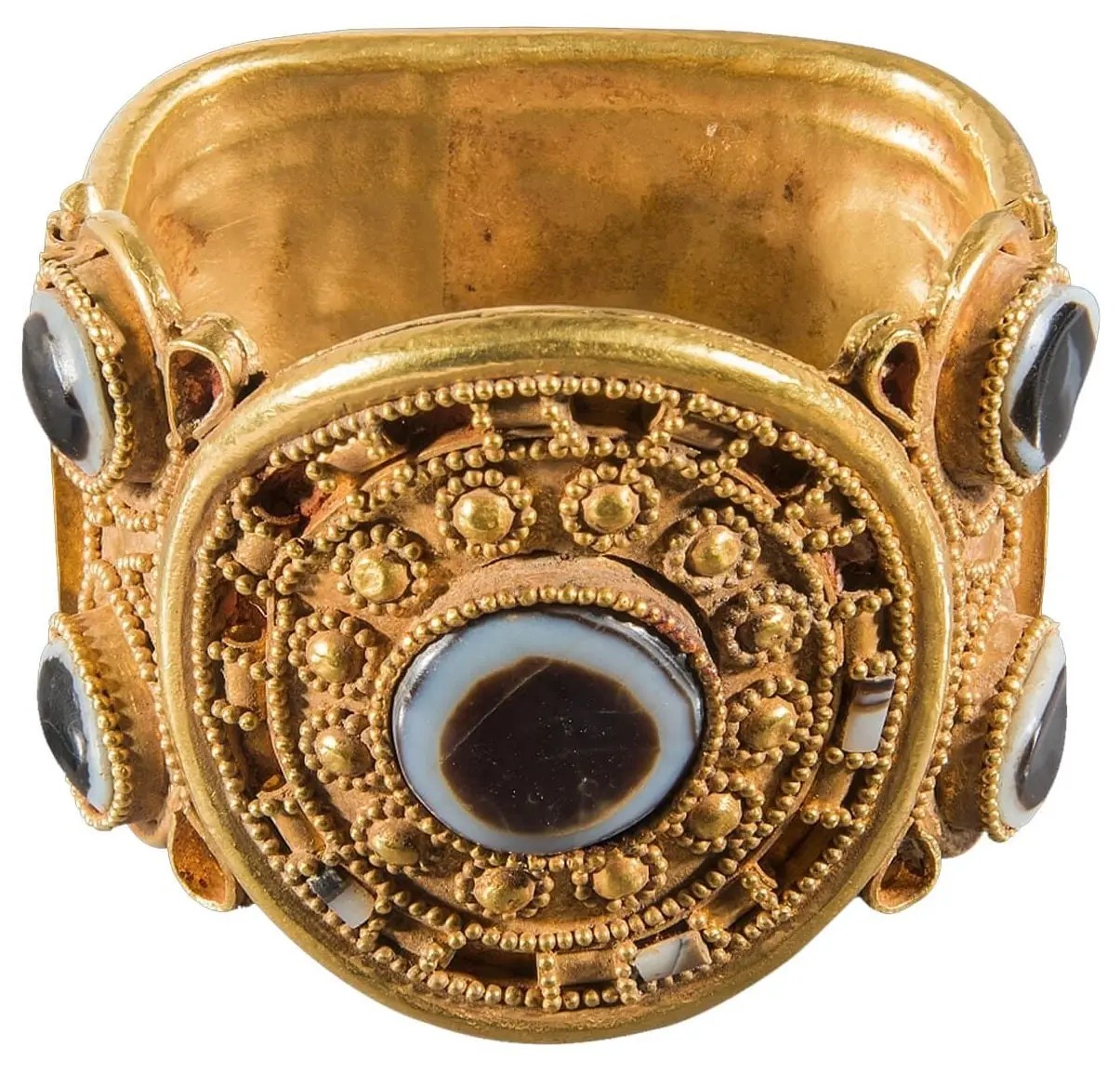
In 2007, during excavations and construction work near the village of Jobaji in Ramhormoz County, Khuzestan Province, a royal tomb dating back to the 6th century BC was discovered. Unfortunately, before archaeologists could conduct salvage excavations, the tomb had been largely destroyed. The structure consists of an east-west stone-built underground burial chamber measuring 4.5 meters long and 2.2 meters wide, accessible via a staircase in the west, and possibly a dome over this space. The discovery of the Jobaji tomb and the mention of the name Shotrok Nahunte indicate the importance of the Ramhormoz region in ancient Iranian history. Two bronze tub-shaped coffins were discovered in the tomb, in which two princesses, aged approximately 17 and 35, members of a royal family, were buried, along with a large number of objects. Among the diverse collection of gold and bronze artifacts discovered from this tomb, a gold bracelet inlaid with agate is noteworthy. This bracelet consists of three connected pieces, made of gold and agate.
Page Term Reference
Comments