
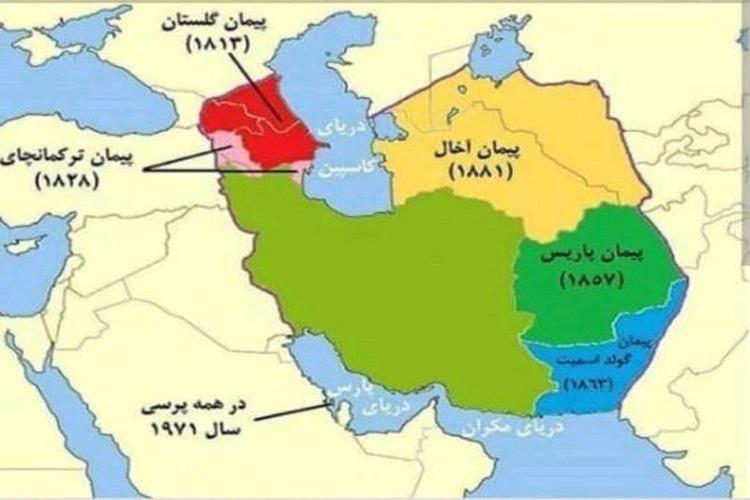
Anti-Iranian Convention 2018 Caspian Sea = Complete occupation of the only remaining maritime territory between the occupied land territories of #Turkmanchay (1828 AD), Golestan (1813 AD) and Akhal (1881 AD)!
When the highly controversial Convention on the Legal Status of the Caspian Sea was signed on August 12, 2018, in Aktau, Kazakhstan, during the eleventh administration, widespread clarification by specialists and experts, together with the vigilance of the Tenth Parliament, prevented its ratification due to its fundamental flaws and defects. However, under the current critical circumstances, on July 22, 2026, the Cabinet approved, on an urgent basis, a bill to ratify the Treaty on the Legal Status of the Caspian Sea—this time by simply removing the most important issue underlying its defects: Iran's maritime boundaries. This development, with its potentially unpredictable consequences for Iran's national security, maritime territorial integrity, and environment, has caused serious concern among many patriotic Iranian experts and specialists.
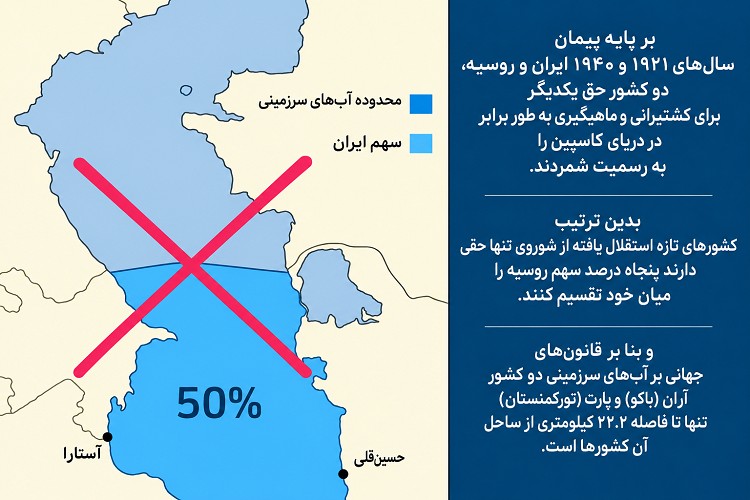
Misconception of equal rights, with the words (fair and equitable) found in the 1921 and 1940 treaties
In this regard, several points deserve attention:
1. Under the country's current laws, all conventions—including the one signed by Rouhani and Zarif—have no legal validity until they are approved by the Islamic Consultative Assembly (Parliament). Despite no changes whatsoever to the convention's fundamental flaws and defects, President Pezeshkian's Cabinet has submitted the bill to Parliament for final approval after removing the convention's greatest flaw, namely maritime delimitation. Yet, under Article 1 of the convention, the determination of baselines is deferred to future agreements. This means that until the baseline is precisely determined, Iran's actual share and rights concerning territorial waters and fishing zones in the Caspian Sea remain undefined and unrecognized by the other four neighboring states.
Moreover, the bill hastily sent by President Pezeshkian's Cabinet to Parliament for approval effectively recognizes and confirms Paragraph 1 of Article 8 of the convention, which explicitly validates all agreements reached among the four former Soviet republics regarding the division of the sea, seabed, subsoil, and the distribution of the Caspian Sea's vast oil and gas resources. These arrangements—which Iran has protested for years—including Kazakhstan's declared 30 percent share, Russia's 17 percent share, and, notably, Iran's zero percent share of Caspian oil and gas resources, are thereby recognized and accepted by President Pezeshkian's government.
2. Another noteworthy aspect of the controversy surrounding the Caspian Sea Convention is that immediately after it was signed by the leaders of the five littoral states in 2018, the former Soviet coastal republics hailed the agreement as a great victory that expanded their territorial waters, strengthened their territorial integrity, and secured their oil and gas resources, even holding national celebrations. In Iran, however, the exact opposite occurred: the signing of the convention generated widespread public anxiety and was interpreted as a "supplementary Treaty of Turkmenchay."
The efforts of patriotic experts and specialists to raise public awareness about Iran's zero percent share of Caspian oil and gas, the reduction of Iran's share from one-half of the Caspian Sea to one-fifth or less, and the deliberate ambiguity surrounding Iran's actual share, were met with serious concern in the Tenth Parliament. In a valuable and historic decision, the Tenth Parliament refused to sign or grant final approval to the convention due to its unresolved flaws and defects.
3. While the former Foreign Minister and President claimed that the greatest achievement of the 2018 Caspian Convention was the prohibition of military vessels from non-littoral countries entering the Caspian Sea, this was by no means a new development. The earlier treaties of 1921 and 1940 had already explicitly prohibited the presence of foreign vessels in the Caspian Sea.
Article 13 of the 1940 Treaty states:
"The High Contracting Parties, in accordance with the principles declared in the Treaty of February 26, 1921, between Iran and the Union of Soviet Socialist Republics, agree that throughout the Caspian Sea, no vessels other than those belonging to Iran or the USSR, or to nationals and commercial or transport enterprises of either Contracting Party sailing under the Iranian or Soviet flag, shall be permitted."
4. The name of every geographical region reflects its historical authenticity and roots, and the inappropriate use of any internationally recognized geographical name can have multiple consequences.
In this regard, the government resolution of December 9, 2002, officially adopting the name of the hostile, anti-Iranian, and invading Khazar tribe in place of the historically correct names "Caspian Sea" and "Mazandaran Sea" lacks any logical basis and has never been accepted by society, especially by patriotic scholars and experts in history, geopolitics, and national culture.
5. Another unresolved and problematic aspect of the 2018 Caspian Sea Convention concerns the environmental status of the sea. The increasing discharge of pollutants by the four former Soviet republics into the Caspian Sea—particularly chemical pollutants, ballast water from ships, and oil contamination—has played the greatest role in polluting the sea and has brought it to the brink of an environmental catastrophe. Therefore, adopting international legal and environmental mechanisms to seek compensation for damage inflicted upon the marine environment, natural ecosystems, and human-made ecosystems is of utmost importance.
Paragraph 2 of Article 8 of the 2018 Convention states:
"A littoral State shall have the exclusive right to construct, and to authorize and regulate the construction, operation and use of artificial islands, installations and structures within its sector."
Paragraph 2 of Article 12 further states:
"Each Party shall exercise jurisdiction over its artificial islands, installations, structures, submarine cables and pipelines within its sector."
This effectively authorizes the repetition of the UAE's anti-national-security and environmentally destructive practice of constructing artificial islands in the Persian Gulf—this time by the Republic of Azerbaijan through the construction of a large artificial island in the Caspian Sea.
Likewise, Paragraphs 1 through 3 of Article 14 readily facilitate the construction of submarine cables and pipelines, which are contrary to Iran's geopolitical interests, national security, and national interests, and which also pose serious environmental pollution risks and high ecological hazards.
6. Iran's national interest—today and in the future—requires steadfast adherence to the principle of joint and common exploitation of the entire Caspian Sea. Iranian officials should therefore replace the phrase "determination of the legal status of the Caspian Sea" with "completion of the current legal regime of the Caspian Sea" in all present and future negotiations.
7. The notion of a 20 percent share—or any smaller share—is an undocumented, unstable, arbitrary, and emotional illusion, because those who advocate this figure fail to explain what role the Islamic Republic of Iran played in the collapse of the Soviet Union that would justify reducing Iran's legitimate share from one-half to one-fifth.
Furthermore, if in the future any of these republics were hypothetically to split into two separate states, would Iran's share then be reduced to one-ninth under the same logic? Conversely, if these republics were to unite into one state, would this same reasoning require restoring Iran's share to its previous one-half?
8. The undeniable legal documents contained in the 1921 and 1940 treaties, along with their annexes and correspondence, establish Iran's and the Soviet Union's equal and joint share. Whether one calls it 50-50, equal, joint, or by any other name, this does not alter the documented legal reality. Whether we like it or not, whether we acknowledge it or close our eyes to it, whether we want it or not, the legal facts remain unchanged.
Accordingly, the national interests of future generations of Iranians require that the 1921 and 1940 treaties not be discarded under pressure from foreign lobbies, but rather be supplemented where necessary.
Moreover, contrary to the widespread misconception, the concept of a 50 percent share of the Caspian Sea does not mean dividing the sea into two equal halves by drawing a line down the middle (the imaginary Baku–Turkmenbashi line). Rather, it refers to equal rights over the seabed, subsoil, and surface waters of the entire sea—from north to south and from east to west—excluding the exclusive 10-mile coastal zone.
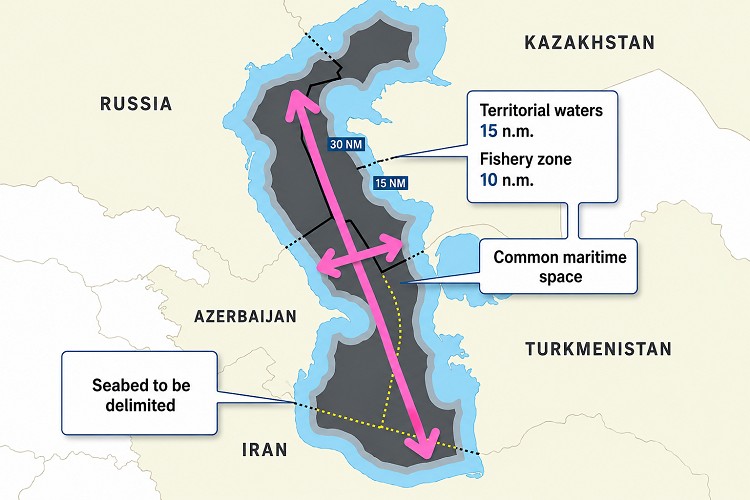
The concept of Iran's equal rights with the Soviet Union (and its survivors in any number) with the words (balsoyeh and balmanasifah) found in the 1921 and 1940 agreements, meaning Iran's equal rights to the entire Caspian Sea, from north to south and from east to west of the sea, minus the 10 exclusive coastal miles.
In conclusion:
1. Since the determination of the Caspian Sea baseline under the 2018 Convention has been postponed to the future, even if we were to accept the convention's provisions (which deny our legitimate rights), we would merely satisfy the four neighboring countries. Until the baseline is determined, Iran would gain no tangible benefit.
2. Any new legal regime must not violate Iran's historical rights recognized under the 1921 and 1940 treaties between Iran and the former Soviet Union, particularly the principle of equality in navigation rights.
3. It is imperative to enact binding legislation requiring official maps of Iran to depict the Caspian Sea in its entirety (rather than the commonly used version divided down the middle).
4. Any decision concerning the Caspian Sea must insist upon protecting Iran's national interests, territorial integrity, and the natural environment of the sea.
Therefore, the government's duty is not to hastily ratify the convention commonly referred to as the "supplementary Turkmenchay" and thereby facilitate the interests of the former Soviet republics. Rather, its duty is to safeguard the interests of the great Iranian nation by firmly asserting Iran's "equal, joint, and common" rights with the Soviet Union (and now, with the four successor republics), and by working toward the establishment of a regional institution for cooperation, coordination, policymaking, and joint exploitation of the resources of the Mazandaran Sea, based on a 50 percent share for Iran and a 50 percent share for the successor republics of the former Soviet Union. Anything short of this, it argues, neither reflects Iran's rightful entitlement nor serves the interests or acceptance of future generations of Iranians.
Dr. Mirmehrdad Mirsanjari
Associate Professor, University Scholar, and Researcher in Culture and Geopolitics
*Some experts claim that the ratification of the Caspian Convention will prevent the presence of military forces of Iran's enemies in the Caspian waters. These people cite the following clauses: Clause 6 of Article 3 of this convention emphasizes the absence of armed forces in the Caspian Sea that do not belong to the parties to this agreement. Clause 7 of Article 3 also emphasizes this position: not making its territory available to other states by each party to commit aggression and carry out other military actions against each party. In the previous report, we examined that in practice, the situation is very different from the legal issues on paper and a country like Azerbaijan can allow the forces of the Zionist regime to enter the Caspian Sea under its cover. But in addition to these possibilities, a practical event also occurred that violated the aforementioned clauses 5 years ago. In 1400, a military exercise between Azerbaijan, Pakistan and Turkey entitled "3 Brothers" was held and hosted by Baku. Azerbaijan is a member state of the convention and, according to the mentioned clauses, it should not allow the military forces of non-member countries to participate. Of the three countries present in this exercise, two of its members, namely Pakistan and Turkey, were not present in the Caspian Convention. As a result, in 1400, important clauses of the Caspian Convention were violated by Azerbaijan. The interesting thing about the story is that after Baku violated the convention, what deterrent legal action was taken against it? The answer is simple: no action.
Therefore, the only benefit of the Caspian Convention for Iran, which is to prevent foreign forces, has already been violated and has no guarantee of legal enforcement. The problem becomes serious when, if such a gross violation is repeated many times, there is not even a guarantee of military enforcement in the field. Suppose Azerbaijan conducts an exercise with the presence of one of Iran’s enemies. Does this convention allow Tehran to use its military power to implement the mentioned clauses and prevent this presence? The answer is no.
Page Term Reference
Comments